BURNING CHROME | Philippines on cybersecurity’s frontline
The weakness is not just technological but human.
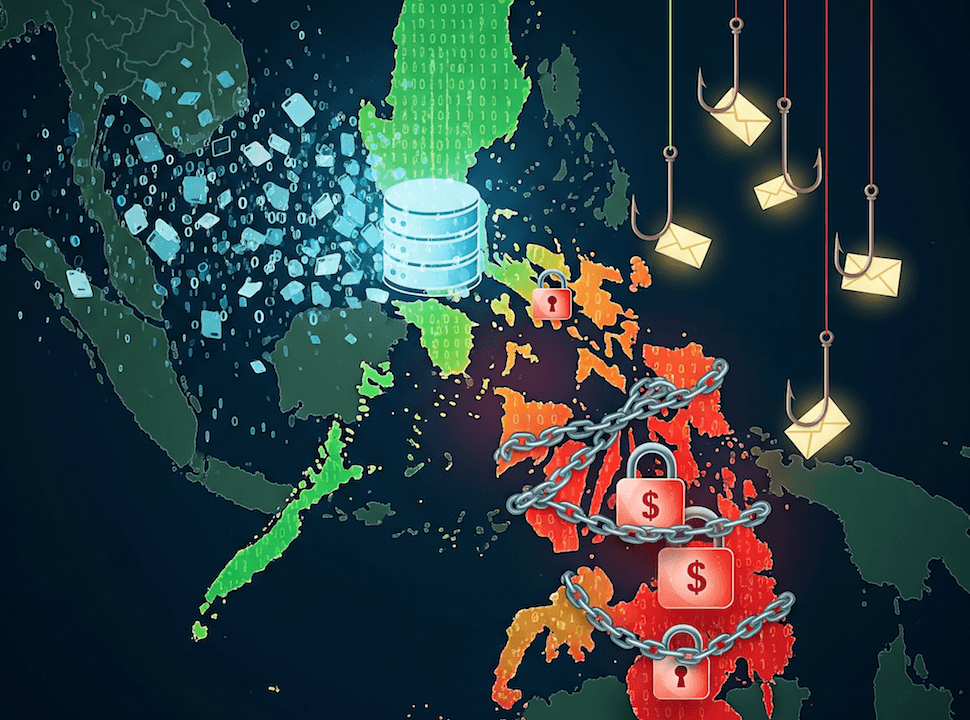
The Philippines has long been at the mercy of typhoons, earthquakes, and floods. Today, however, a quieter, less visible storm is battering its institutions and businesses—cyberattacks. The numbers tell a story of a nation under siege in the digital realm, where criminals and state-backed hackers exploit every weakness, from poorly secured passwords to unsuspecting employees.
A report from Security Quotient paints the picture starkly. In 2024 alone, ransomware cases in the Philippines jumped by 30 percent, while web-based attacks surged nearly 50 percent. These are not abstract figures. They represent real-world disruptions to companies, banks, and government services. Yamaha Motor’s Philippine subsidiary, for instance, was hit with a ransomware attack that carried potential losses of up to half a million dollars in 2023.
Phishing scams remain the country’s biggest vulnerability. Cyberint’s Philippine Threat Landscape Report 2024–2025 describes the nation as Southeast Asia’s top phishing target, with banks and financial institutions most at risk. Attackers are no longer just sending clumsy fake emails. They are now deploying artificial intelligence to mimic trusted executives or institutions with unnerving accuracy, making it even harder for ordinary employees to spot the fraud.
The weakness is not just technological but human. Cybersecurity experts are quick to point out that employees, often distracted or undertrained, serve as the primary gateway for intrusions. Hybrid work setups—where staff toggle between home and office devices—have widened the attack surface. In 2024, there were 4.1 million brute-force password attempts recorded in the country, a staggering figure that underscores poor digital hygiene.
The government has acknowledged foreign intrusion attempts, particularly those aimed at sensitive intelligence data. State-backed actors have reportedly deployed fileless malware against military networks. These developments put national security on the line, not just corporate bottom lines.
And yet, the national response remains uneven. Many organizations in both the public and private sectors still lack scenario-based response plans. Too often, companies find themselves reacting to breaches rather than anticipating them. Third-party vendors, a frequent weak link, are inadequately vetted. Security awareness programs exist but remain inconsistent, with little emphasis on real-world simulations.
If the country is to withstand the escalating cyber storm, resilience must become a matter of policy and culture, not just technology. Embedding cybersecurity into business strategy, enforcing stricter standards for vendors, and training employees beyond the basics are crucial steps.
The digital transformation sweeping the country has created new opportunities for growth and connectivity. But it has also exposed fragile defenses to adversaries who do not rest. The Philippines, sitting on the frontline of global cyber hostilities, can ill afford to stay reactive. The storm is here, and the time to fortify was yesterday.
WATCH TECHSABADO ON OUR YOUTUBE CHANNEL:
WATCH OUR OTHER YOUTUBE CHANNELS:
PLEASE LIKE our FACEBOOK PAGE and SUBSCRIBE to OUR YOUTUBE CHANNEL.
PLEASE LIKE our FACEBOOK PAGE and SUBSCRIBE to OUR YOUTUBE CHANNEL.