BURNING CHROME | 2026: The year tech promises grow teeth
Less about robots taking over your job tomorrow, more about whether the software and the wires underneath can even hold together.
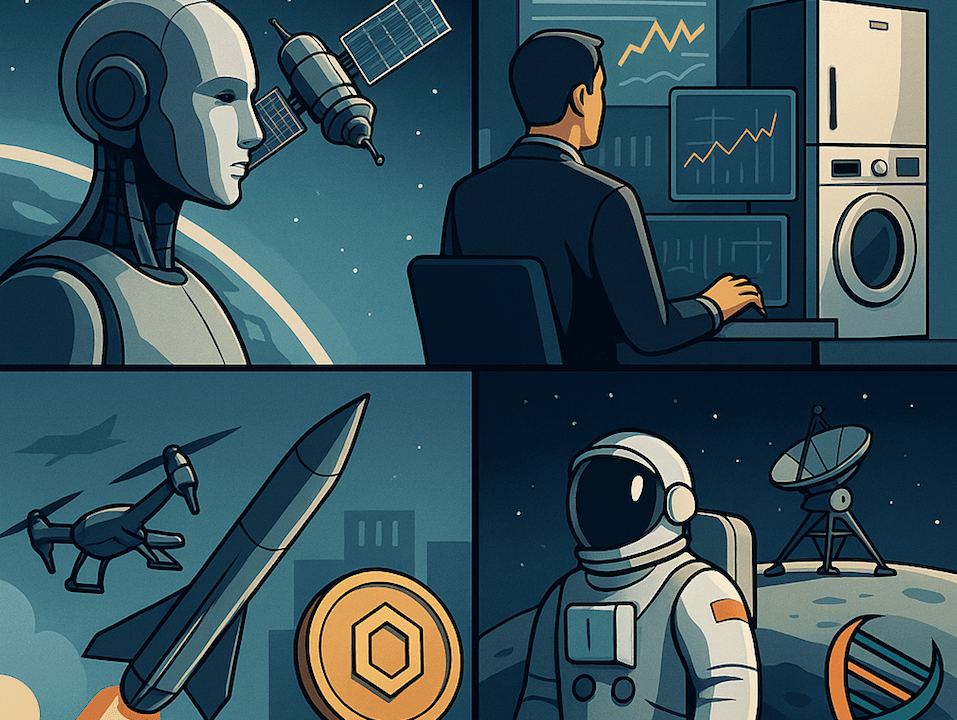
The hype merchants always want you to believe that the future is already here. But the truth is, the future arrives late, stumbling over budgets, regulations, and the slow grind of integration. 2026 is that kind of year. Less about the shiny, more about the scaffolding. Less about robots taking over your job tomorrow, more about whether the software and the wires underneath can even hold together. Here’s a global perspective of what’s coming or what’s already on the table.
Telecom’s endless evolution
Let’s start with the most basic layer: communication. By 2026, the global telecom industry will still be squeezing the last drops from 5G. Release 19 of the 3GPP standard is wrapped up, and Release 20 is on the table. This is not Hollywood sci-fi—these are the pages of dense technical documents that operators and vendors use to plan actual networks. Forget 6G dreams until the next decade. What we’ll see instead are satellite-to-phone experiments finally getting traction. Starlink, for instance, has already sent text messages via orbit, and the next leap—data and voice directly to your phone—is scheduled to roll out in the U.S. and even Ukraine by mid-2026. It won’t feel like magic; it will feel like coverage where there was none, especially in disaster zones and remote towns.
AI in the boardroom, not just the lab
Artificial intelligence remains the big buzzword. Analysts at Gartner and McKinsey warn that by 2026 nearly half of office workers in global firms will be using some form of AI augmentation. That doesn’t mean everyone will have a robot assistant perched on their desks. It means background systems are rewriting emails, crunching data, drafting contracts, and pretending to be helpful. The bigger story, though, is that many of these so-called “agentic AI” projects are expected to flop by 2027 because they don’t deliver return on investment. It’s a sober reminder that AI is still a tool, not a miracle.
Europe’s AI Act is also forcing corporations to face governance head-on. By 2026, high-risk use cases must comply with concrete obligations on transparency, risk management, and data handling. This is regulation putting teeth into technology. For once, lawmakers are not just spectators at the circus—they are demanding a harness on the elephants.
Money’s new plumbing
In finance, 2026 will feel like a plumbing repair job. SWIFT’s old MT messages will be gone, replaced fully by ISO 20022 MX formats. That may sound boring, but it means the world’s financial arteries will now carry richer data. This is not just cosmetic: regulators, auditors, and compliance officers will have more to work with, for better or worse.
Meanwhile, the European Central Bank is aiming to settle the rules of the digital euro by early 2026. Don’t expect digital wallets to flood the streets yet—this is about lawmakers wrangling the blueprint before construction begins. In the U.S., the Federal Reserve’s FedNow continues its cautious rollouts, adding features that make instant payments more real than theoretical.
Security by mandate
Cybersecurity in 2026 is shaped less by hackers in hoodies than by lawmakers in Brussels. The EU’s Cyber Resilience Act kicks in with vulnerability reporting requirements by September 2026, forcing manufacturers to deliver software bills of materials and adopt secure-by-design practices. Add to that the already transposed NIS2 directive, and you get a picture of a region determined to enforce baseline safety. Across the Atlantic, the U.S. is updating to NIST’s Cybersecurity Framework 2.0. For multinationals, this means 2026 is the year to harmonize security programs across jurisdictions—or pay the penalties.
And looming behind all this is the shadow of quantum computing. Governments are nudging enterprises to start migrating toward post-quantum cryptography. In practice, that means IT budgets in 2026 will include real line items for crypto-agility, even if the true quantum threat is still years away.
Gadgets grow muscles, not magic
If you expect 2026 to deliver gadgets that wow you, temper your excitement. This will be the year of infrastructure under the hood. PCI Express 7.0, finalized in 2025, begins showing up in the ecosystem, mostly in high-end servers and data centers. USB4 version 2 controllers are on track for late 2026. And JEDEC’s LPDDR6 memory will find its way into flagship phones, edge devices, and cars. What this means: more bandwidth and speed to feed the AI beast.
In the home, the Matter protocol is slowly reducing the nightmare of incompatible smart devices. Appliances will become more energy-aware, talking directly to power grids. The dream of a smart home might finally stop being a punchline—though only if Apple, Google, and Amazon bother to push the standard deeper into their ecosystems.
Crypto’s regulatory hangover
By July 2026, the European Union’s MiCA regulation will fully bite. Crypto service providers can no longer hide in the shadows; full authorization will be required. Some exchanges will survive, some will fold. It is the end of the wild west, at least in Europe. On the technology side, Ethereum’s scaling through “danksharding” is still years off. The real story is Layer-2 networks maturing and institutional investors flowing in through exchange-traded funds. The drama shifts from code to compliance.
War machines and moon shots
Military technology is caught between promise and reality. U.S. hypersonic missile programs like the Army’s Long-Range Hypersonic Weapon are aiming for operational readiness around 2026 or 2027, but watchdogs like the Government Accountability Office warn of cost overruns and test failures. In the battlefields of Ukraine, drone swarms and AI-assisted targeting are being tested, but true autonomy remains out of reach thanks to the brutal reality of electronic warfare.
Space is no less fraught. NASA’s Artemis III mission, meant to return humans to the Moon, is penciled in for no earlier than 2026. History may remember it as a triumph—or another slip in a long line of delays. Meanwhile, Boom Supersonic still claims it will roll out its Overture aircraft in 2026, though skeptics expect another pushback. Satellite constellations will continue to proliferate, reshaping communications from the sky down.
Biotech’s cautious revolution
In biotechnology, the revolution continues in fits and starts. The U.S. Food and Drug Administration approved several gene and cell therapies in 2024 and 2025, but safety reviews and cost remain barriers to access. By 2026, more clinical trial readouts for base-editing cardiovascular treatments and mRNA oncology vaccines are expected. Some of these studies—such as pivotal melanoma trials—could decide whether these treatments move from boutique medicine to mainstream care. But the hurdles are real: payer models and long-term safety concerns still slow the march of science.
The year regulation matters
So what does 2026 really mean? It is the year when regulation, infrastructure, and reality push back against unchecked hype. Telecom standards are grinding forward, AI is moving from experiments to compliance checklists, finance is rewriting its plumbing, and cybersecurity is becoming a legal obligation rather than a best practice. The promises of hypersonics, supersonic jets, moon landings, and biotech breakthroughs hover in the background, but they will be tempered by the stubborn weight of budgets, politics, and physics.
Technology is still the story of our time, but by 2026 it will be clear that the future doesn’t just happen. It has to be governed, standardized, and painfully integrated into daily life. The marketers will keep selling magic. The rest of us will be left to live with the scaffolding.
———-
WATCH TECHSABADO ON OUR YOUTUBE CHANNEL:
WATCH OUR OTHER YOUTUBE CHANNELS:
PLEASE LIKE our FACEBOOK PAGE and SUBSCRIBE to OUR YOUTUBE CHANNEL.
PLEASE LIKE our FACEBOOK PAGE and SUBSCRIBE to OUR YOUTUBE CHANNEL.