BURNING CHROME | Progressives, conservatives, and the politics of violence
To understand why the left succumbed to violent struggle and why the right, with its obsession for order, veered into authoritarianism, we must peel back centuries of history.
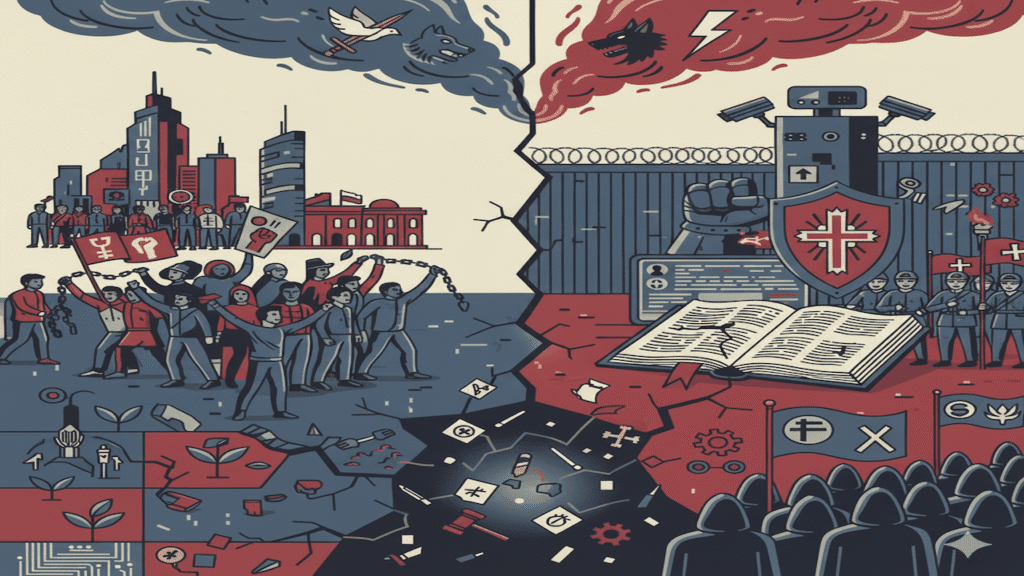
The eternal battle lines between left and right are not written in the stars but in the bloodied streets of Paris, Petrograd, Berlin, Santiago, Manila, and Washington. Ideologies that began as abstractions in pamphlets and parliaments often descended into open violence when words and ballots failed to penetrate power. To understand why the left succumbed to violent struggle and why the right, with its obsession for order, veered into authoritarianism, we must peel back centuries of history, sift through philosophy, and look straight into the faces of those who still wave banners of progress or reaction in today’s fractured democracies.
Revolutionary roots of the left
The left, as history reminds us, was born in revolution. Its birth cry was heard in the French Revolution of 1789, when deputies who demanded radical change sat on the left benches of the National Assembly. That seating arrangement would mark political vocabulary for centuries. What began as the call for liberty, equality, and fraternity would, over time, evolve into a spectrum of ideologies: socialism, communism, social democracy, anarchism. The language of the left became the language of the oppressed. Yet when entrenched power refused reform, the rhetoric hardened into calls for revolution.
Violence was never the preferred route, but it became the inevitable one for many leftist thinkers. Karl Marx and Friedrich Engels, in their Communist Manifesto, wrote that the history of society was the history of class struggle. They did not merely theorize about conflict—they insisted it was the motor of history. Later, Vladimir Lenin would take this as a license for armed insurrection. He argued that no ruling class would ever surrender power peacefully, and that only a disciplined vanguard, willing to fight, could break the chains of exploitation. Prominent socialist Rosa Luxemburg, though less enamored with authoritarian methods, still recognized that capitalism’s contradictions would erupt violently whether the working class wished it or not.
The twentieth century proved them right and wrong at once. The Russian Revolution of 1917 overthrew the tsar but replaced his throne with a dictatorship that devoured its own. In China, Mao Zedong led peasants into a revolution that promised equality but delivered mass famine and authoritarian control. In Latin America, guerrilla struggles—Che Guevara in Bolivia, the Sandinistas in Nicaragua, the FARC in Colombia—used armed struggle to challenge oligarchies and military juntas. They emerged from conditions where democracy was a façade and the ballot box a cruel joke. To the militants, violence was not aggression but survival.
But not all leftists picked up the rifle. In Scandinavia, Britain, and even postwar Germany, social democrats and labor movements pursued change within democratic institutions. They won victories for universal suffrage, workers’ rights, and welfare states without overthrowing governments. For them, progress was evolutionary, not revolutionary. Yet the existence of violent leftist currents kept the establishment wary and, at times, repressive. Governments often painted all leftists with the same brush, using fear of revolution to justify censorship and militarization.
The progressive vision
Why then are leftists called “progressives”? Because their projects, however flawed, aimed at moving societies forward: abolishing slavery, winning women’s suffrage, dismantling colonial empires, demanding racial equality, expanding education, health care, and scientific inquiry. Progress meant confronting hierarchies that claimed permanence, whether in monarchy, capitalism, patriarchy, or empire. The left’s progressivism became the heartbeat of reforms we take for granted today.
Even in failure, the left shifted the moral compass of societies. The labor rights we consider basic, from the eight-hour workday to paid leave, were fought for by movements branded as radical in their time. Civil rights, gender equality, and environmental protections all drew strength from progressive currents. Progressivism meant believing that societies are not fixed in divine order but can be reshaped by collective will.
The right’s pursuit of order and tradition
In contrast, the right emerged not as a philosophy of emancipation but as a defense of tradition and hierarchy. Seated on the opposite benches of the French Assembly, conservatives feared the chaos of revolution. Edmund Burke, the intellectual father of conservatism, argued that tearing down institutions overnight was folly. To him, the French Revolution was not liberation but anarchy. Conservatism was thus less an ideology than a reflex: preserve what exists, resist sudden change, honor tradition, uphold authority.
The right’s fixation on order has always made it appealing to those with wealth, land, or power to lose. But the right is not monolithic. Moderate conservatives accept reform so long as it is gradual and does not overturn hierarchies. The far right, however, embraces order to the point of authoritarianism. Mussolini in Italy turned fascism into a cult of state and leader. Adolf Hitler twisted nationalism into racial supremacy, unleashing a genocidal war machine. Franco in Spain and Pinochet in Chile claimed the mantle of conservatism but ruled with iron fists. In each case, the right’s love of order justified repression, censorship, and mass murder.
To be conservative, critics argue, is often to be regressive. By defending tradition, conservatism resists advances in equality and justice. Women’s liberation was mocked as unnatural. Civil rights for Black Americans were obstructed by defenders of “Southern tradition.” LGBTQ+ rights are still under siege from conservatives clinging to religious dogma. Conservatism may provide stability, but stability at the cost of excluding entire groups from dignity and rights is no virtue.
The far right today has mutated into new forms. Populist nationalism in Europe, white supremacist militias in the United States, and authoritarian strongmen in Asia all fly the banners of tradition, law, and order. But lurking beneath are conspiracies, xenophobia, and anti-democratic impulses. The Jan. 6 storming of the U.S. Capitol revealed how far-right ideologues, emboldened by lies, can weaponize masses in the name of saving a nation from imaginary enemies.
When religion became a weapon for the far right
An especially dangerous current within the far right is the evangelical right and Christian nationalism. This movement cloaks its authoritarianism in religious language, claiming divine sanction for political dominance. In the U.S., Christian nationalists insist that America is a Christian nation and that secularism is an enemy. They oppose abortion, LGBTQ+ rights, immigration, and multiculturalism under the banner of “biblical values.” But their project is not faith—it is power. They fuse evangelical fervor with nationalist exclusion, creating a potent mix of zealotry and authoritarianism.
Christian nationalism is not confined to the U.S. In Brazil, Jair Bolsonaro rode evangelical networks to power, promising order and morality while dismantling environmental protections and democratic norms. In Eastern Europe, leaders like Viktor Orbán frame their politics as a defense of Christian civilization against liberalism and migration. What ties these movements together is not a love of Christ but a fear of progress. They use religion as a weapon to roll back rights, to silence dissent, to enforce conformity.
Where the left once turned to violence because peaceful paths were barricaded, the right turns to violence because it fears losing its dominance. Lynchings in the Jim Crow South, death squads in Latin America, Nazi brownshirts, or modern-day militias—all are examples of right-wing violence dressed up as the defense of order. For the far right, order is not about peace; it is about hierarchy maintained at gunpoint.
The left and the right, then, are not mirror images. Both have histories of violence, but their ends diverge. The left’s violence, at least in its own justification, sought to topple systems of oppression. The right’s violence sought to preserve them. The left dreamed of equality, though it often birthed authoritarian nightmares. The right promised stability, though it frequently delivered tyranny.
What lessons remain? First, that progress without vigilance can be hijacked by authoritarianism. The Soviet gulags remind us that revolution can devour freedom. Second, that order without justice is not order but oppression. The Nazi death camps remind us that stability can coexist with barbarity.
In our present moment, where disinformation floods social media, where populists pit neighbors against one another, and where extremists both left and right lurk at the fringes, the challenge is to hold onto the ideals of progress without succumbing to authoritarian temptations. We must demand justice without indulging in fanaticism, defend tradition without enshrining bigotry, and resist both the false utopia of total revolution and the false security of reactionary order.
The evangelical right, with its crusade for cultural dominance, is the most urgent danger in democracies today. By painting pluralism as sin and diversity as decay, it risks dragging societies backward into sectarian strife. The radical left, weakened since the fall of the Soviet Union, may still flare in resistance movements, but it is the radical right that now holds power in many states and threatens freedoms won through centuries of struggle.
The names change, but the conflict endures. Progressives are smeared as radicals for demanding dignity. Conservatives claim to be guardians of civilization while defending inequality. Between them lies a fragile democracy, battered from both sides, but more often imperiled by those who fetishize order at the expense of justice.
The history of left and right is not just about ideology. It is about the choices societies make when faced with inequality and instability. Will we choose progress, even when messy and imperfect, or regress into the arms of authoritarianism disguised as tradition and faith? The answer will determine not just politics but the future of humanity itself.
———-
————————————————————————-
WATCH TECHSABADO ON OUR YOUTUBE CHANNEL:
WATCH OUR OTHER YOUTUBE CHANNELS:
PLEASE LIKE our FACEBOOK PAGE and SUBSCRIBE to OUR YOUTUBE CHANNEL.
PLEASE LIKE our FACEBOOK PAGE and SUBSCRIBE to OUR YOUTUBE CHANNEL.