BURNING CHROME | Multimedia: Evolution and transformation
Despite the Philippines still being identified as a third-world country, technology—particularly in the capital, Manila—is almost on par with its more affluent Asian neighbors.
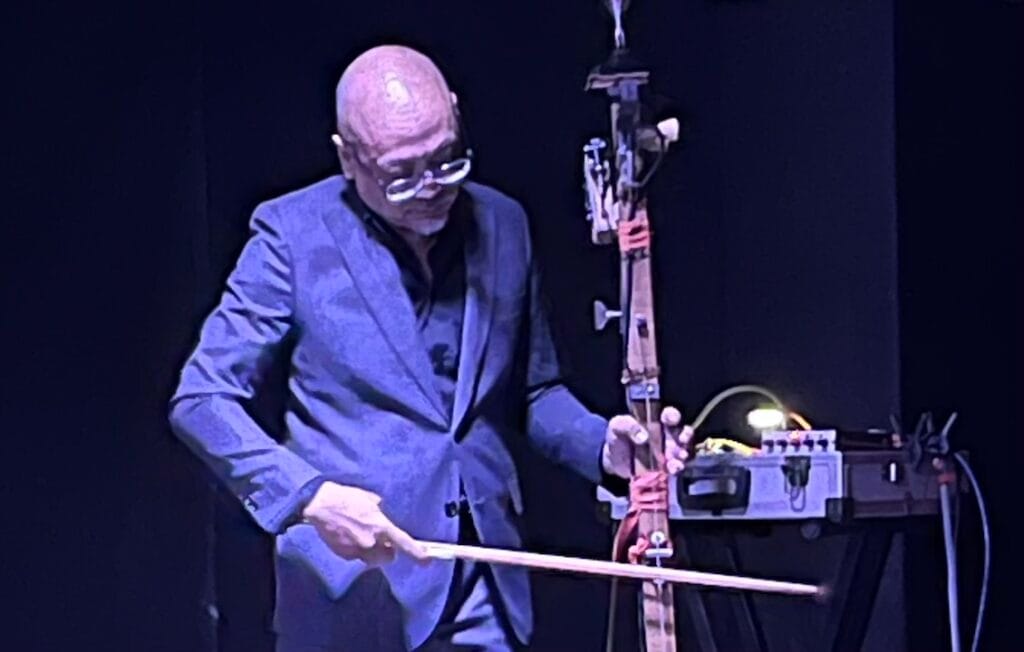
Tad Ermitano performing as Somatosonic
NOTE: This article orginally came out in 2006 for RealtimeArts, a national arts magazine based in Australia.
In a square white room, eight monitors, facing inward, are arranged in a circle in front of a wall marked with pencil lines. The video commences on the first monitor with a hand holding a lead pencil, drawing a horizontal line on a white surface from right to left, and then continues on to the next monitor, and so on, until it starts all over again on the first monitor. The manner is loosely systematic, but the result is quite effective. The drawn lines overlap continuously until the dark lead almost fills the screens.
Conceptualized in 1999 by video artist Poklong Anading, Line Drawing is probably one of the best examples of Filipino multimedia art. Poklong started out as a painter in the mid-’90s while studying fine arts at the University of the Philippines. Before the decade ended, Poklong discovered a medium that could carry his ideas and a new kind of approach through the convergence of what was commonly known as traditional art and the technology already prevailing at that time—video.
Poklong explained, “My works based on video started way back in 1997 when one of our art teachers at the university began offering classes on video and extensively experimented on the medium. We were still using Video-8 back then, and there was no such thing as editing; all we did was cut-to-cut.”
As video components and computer peripherals became more commonly available, Poklong rode with technology’s evolution. Today, he knows his computer, shoots video and stills digitally, and edits using Adobe Premiere. “The thing about video is that it’s immediate,” says Poklong. “And with digital technology, everything seems to be easier to access and manipulate.”
Despite the Philippines still being identified as a third-world country, technology—particularly in the capital, Manila—is almost on par with its more affluent Asian neighbors. Mobile phones are in the hands of almost 30 million Filipinos, IT infrastructure is visible all around, and broadband connection is readily available. So there is no excuse for a Filipino artist to avoid the onslaught of technology and fail to handle modern video and audio electronics.
In Walking Distance (2002), Poklong’s video collaboration with award-winning visual artist Ringo Bunoan, two video frames are played side by side, both showing a hip-level shot of a short back-and-forth walk—one on a narrow art gallery corridor in Manila and the other on a pedestrian overpass in Gwangju, South Korea. Again, the framing is slightly out of sync, but the effect is visually hypnotic just the same. For Poklong, “Since the technology is readily available, it has now become an extension of my own ideas that I can easily project to my audience.”
Artist-photographer Wawi Navarroza, who manipulates photographs using available technology, says, “…multimedia art is just a collective term I use for the different modes of expression I’ve chosen to utilize. I travel across platforms.”
She describes herself as a “darkroom baby.” She is in love with the chemicals, the magic, the romance, and all the secrets under the red light. Yet she cannot escape what technology offers her kind of art.
“When digital came about, I didn’t abhor it. It was a stranger that I gladly sought out to know. And it was another tool in the bag that opened other possibilities for me in terms of imaging. I stumbled upon this new world of post-production and a strange but familiar world of ‘digital darkroom,’ alias Photoshop… I wanted to create an amalgam of analog and digital. I wanted to bring together the organic beauty of film and the precision and control of digital. I’m still learning the ropes and I guess it will never end. One thing I know is that digital is here to stay and it should be up to something good.”
The multimedia experience is very obvious in Navarroza’s artworks, whose combination of old-school photographic style and computer manipulation techniques radiate from a Victorian Gothic backdrop with a wonderfully dark and gloomy inventiveness.
“Artists can’t be contained,” she says. “The thirst of the artist for expression often leads to exploration of new ways to articulate meaning, which change with the spirit of the time, and which eventually alters the worldview of an era.”
For established video artist Tad Ermitaño, who has been doing video and sound art for almost two decades now, it’s a different and relatively cautious approach.
“The term multimedia is a terrible phrase. There is a lot of stuff that would like to call itself multimedia just because the artists use sound and image, even if the channel of interaction is a mouse and a monitor,” says Tad.
“I think the word multimedia ought to be tossed out and at least four new categories put in its place: audio/sound art, video art, smart art, and interactive art. Audio and video art would encompass everything that involves playing looped audio and video, while smart art would involve having the art react to the audience. As in evolution, smart artworks currently aren’t very smart, but I’m sure that could change. Some of the virtual characters in computer games are full-fledged AIs already. Smart art could be the new film—requiring a level of investment and expertise that can only be matched by corporate-backed teams of specialists.
“Definitely we should go back to using the word interactive the way the coiners used it… mean(ing) that the audience would be free to create permanent and maybe fertile changes in the work. In this original sense, a folk song or a recipe with 100 variants is interactive, while a CD-ROM game, however entertaining, is not. This, I think, is a very radical and exciting option, striking hard and deep into and against our ideas of what art is, what artists do, who artists are.”
One of Tad’s independently produced video artworks, Hulikotekan (2002), a nine-layer video feedback of found instruments gradually synchronizing, was exhibited at the Hong Kong Film Festival in 2002 and was also shown at The Library in Singapore during the 2004 Singapore International Film Festival. His work with experimental sound art group Children of Cathode Ray was also included at the MAAP Festival at the National Institute of Education in October 2004, also in Singapore.
Poklong and Wawi are a small sample of characteristic multimedia artists in the Philippines, but Tad expresses the need for more focus on the genre.
“Well, there are a lot of people playing with sound and video, because there are a lot of computers and a lot of pirated software. But there have been almost no shows focusing on it. Nor is anyone writing on it, giving feedback that leads anywhere. Feedback on sound/audio art (like feedback on all art here) is mostly on the ‘Okey yan pare’ [that’s pretty much okay, man] level. The possibilities that a work opens up, the questions it raises, etc., remain completely unraised, unpursued.”
Reasons for this include a lack of a recognized multimedia movement and of an acknowledged venue for the genre. “Aside from places like Big Sky Mind in Cubao and a handful of other art houses, there is really no place to exhibit multimedia arts here in the Philippines,” says Poklong.
Wawi has had to rely on pocket exhibitions at alternative spaces, producing them herself or even showing at one-night engagements—right before a band performance, notably her own, The Late Isabel. “So many ideas on the shelf,” she quips.
Nonetheless, the constraints don’t prevent these artists from continuing to find ways to make multimedia central to the structure and evolution of their work. Multimedia art has become a part of a new energy of expression. In the Philippines, as in many parts of the world, it is a crossroads where artists and techies meet—or, as Wawi describes it: “the left and the right hemisphere of the brain collaborating.”
NOTE: This article orginally came out in 2006 for RealtimeArts, a national arts magazine based in Australia.
———-
————————————————————————-
WATCH TECHSABADO ON OUR YOUTUBE CHANNEL:
WATCH OUR OTHER YOUTUBE CHANNELS:
PLEASE LIKE our FACEBOOK PAGE and SUBSCRIBE to OUR YOUTUBE CHANNEL.
PLEASE LIKE our FACEBOOK PAGE and SUBSCRIBE to OUR YOUTUBE CHANNEL.