BY-LINER | Lirio in performance: A portrait of the Filipino as cyborg
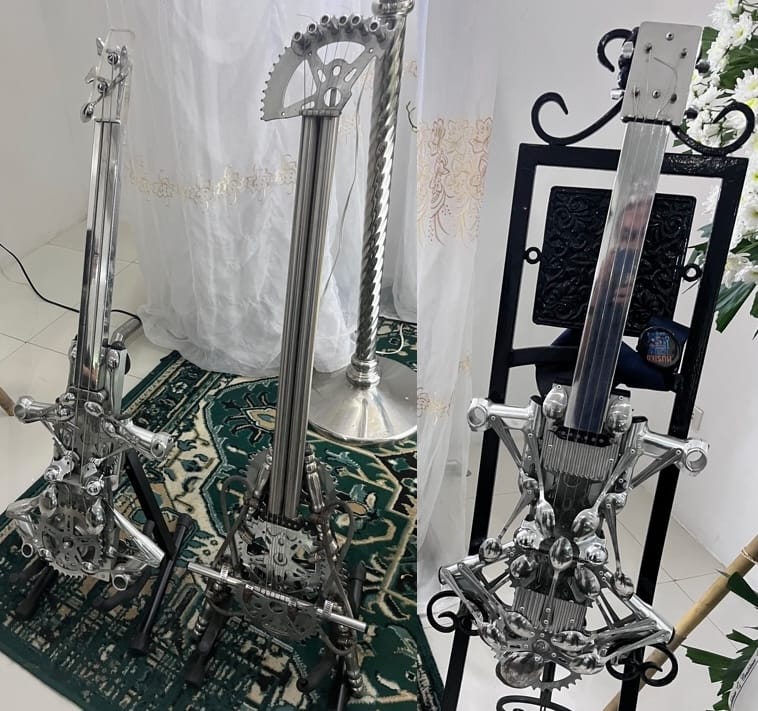
The sandata are sonic sculptures, and the sound they produce is the raw, unshaven sound of machines, electricity and amplification—sounds as native to the sandata’s metallic makeup as the sound of surf is to the ocean.
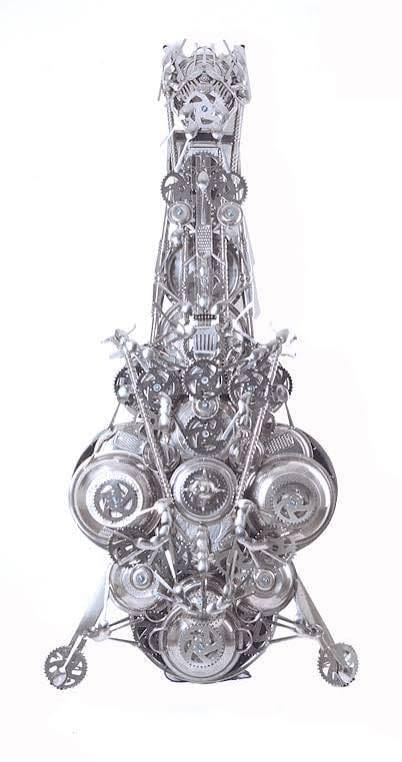
Sandata ng Elemento ni Lirio Salvador
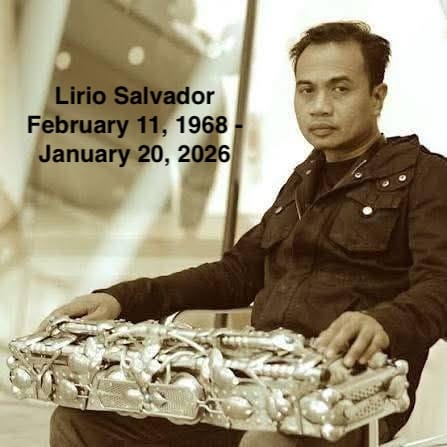
The text below is a slight emendation of an article I wrote in the now defunct online news outlet InterAksyon. I wrote it when Lirio met a traffic accident back in 2012. It seems appropriate to post it again, now that he’s passed on.
Something metal gleams in the darkness of the club. The metal thing is the source of the noise that surrounds you like the fist of a giant, if the giant were a robot made of a swarm of rusting mechanical bats. Skinny, dark-skinned and slow-moving, Lirio bends over the metal thing, a chromed sculpture he calls sandata—Tagalog for “weapon”—a baroque execution of webbed and layered metal that sparks associations with the crammed aesthetics of the jeepney and the branching complexity of something skinned and anatomical. You think of Giger, you think of the Terminator under the Schwarzenegger suit. And then, as your eye begins to pick out the details of mixing bowls, bicycle gears, drawer handles and cutlery out of which the sandata is formed, you think of plumbing supplies, hardware stores and kitchens.
This is a key thing in the sandata, I think: this swinging back and forth between ordinariness and alien anatomy. Your eye never resolves the contradiction; it is always flipping between the two readings, as it sometimes does in the face of certain optical illusions.
Of course, the alien anatomy reading tends to take precedence when the things are actually played in concert. The sandata are sonic sculptures, and the sound they produce is the raw, unshaven sound of machines, electricity and amplification—sounds as native to the sandata’s metallic makeup as the sound of surf is to the ocean. Sound as the first cry of matter, sound before sound becomes tone, key or chord. Someone expecting songs or melodies might fairly describe its output as a godawful noise. In the right time and place, however, it can be a godawful noise with a raw, alien beauty. Of course, there are probably many people who find it difficult to imagine finding beauty in noise. For these people, I offer the visual analogy of finding beauty in rocks, as Chinese scholars did, and do.
Something that might not be immediately obvious is how the sound is formed, particularly in the case of the sandata that are synthesizers. While the earlier sculptures were essentially fretless electric guitars, the later sculptures incorporate synthesizer circuits—oscillators—whose sounds are produced by touching the live circuits. When the player does this, the player’s body literally becomes part of the circuit. His body’s electrical properties—its resistance, its capacitance, its conductivity—shape the pitch and timbre of the sound produced by the instrument. In this light, the synthesizer sandata are more like cybernetic prostheses than instruments. The player does not so much play the instrument as share himself with it.
“It’s all about the merging of my native oriental culture and the present industrial environment that is slowly corrupting my native land.”
—Lirio Salvador—
The sense that there is a rift between man and the world of machines is an old and universal theme. It can be seen as an extreme extension of the Garden of Eden myth. The city is the pole most distant from the Garden of Eden. It is a dark, smoky, clanking alien world.
Lirio’s sculptures and cybernetic performances enact a unification of man and machine, a healing of the rift between the two. We are the apes, he seems to say, that live in the machine forest. Or possibly that we, whose lives are unimaginable without phones and computers and contact lenses and cars and electricity and wheels and fire and alphabets, are already part machine, and have been for a very long time.
Of course, he does this without ever talking about Filipino identity. His work is about us only because he happens to be a Filipino trying to bridge the gap between men and machines. Something in the sculptures announces their origin in a completely local, completely homegrown intelligence, an impression cemented within 30 seconds of meeting the artist. Thirty seconds with Lirio are all it takes for a Filipino to recognize a Tagalista everyman at the core of his character, and then, suddenly and logically, the idea of the cyborg, a man-machine composite, becomes a local, even immediate issue.
The cyborg is usually seen or portrayed as a horrifying, even unholy fusion. Even the word sounds like a horror-film sound. But if we consider the alphabet as a form of mechanical memory, then we have been cyborgs for more than 3,000 years. It seems possible to me that this denial of our extended, mechanical nature might have consequences in how we act in the world.
I feel that Lirio’s viewpoint is an animist one at heart. Better yet, that it is a shamanistic viewpoint, as opposed to an engineering viewpoint. While the shaman and the engineer both traffic with the forces of nature, the shaman, unlike the engineer, does not see himself as the master of those forces. The forces are the shaman’s peers. The shaman asks favors, negotiates and strikes agreements. The shaman collaborates and so ensures that harmony exists between the tribe and the forces that surround it.
I believe that description can stand as at least a partial description of Lirio’s artistic project. The MySpace quote speaks about merging native culture with industrial forces corrupting the land. If you take the artist at his word, you have to ask what he proposes by this “merging.” If he is not proposing a complete surrender to the forces of corruption, he can only be proposing a renegotiation of their relationship with us—a change, perhaps, that will bring man, machines and the land back into a relationship of balance.
————————————————————————-
WATCH TECHSABADO ON OUR YOUTUBE CHANNEL:
WATCH OUR OTHER YOUTUBE CHANNELS:
PLEASE LIKE our FACEBOOK PAGE and SUBSCRIBE to OUR YOUTUBE CHANNEL.
PLEASE LIKE our FACEBOOK PAGE and SUBSCRIBE to OUR YOUTUBE CHANNEL.