BURNING CHROME | Analog vs. digital audio: The war that refuses to die
When people say analog sounds better, they are often saying it feels better—to make, to own, to listen to. When people defend digital, they are defending access, reproducibility, and the refusal to romanticize limitation.
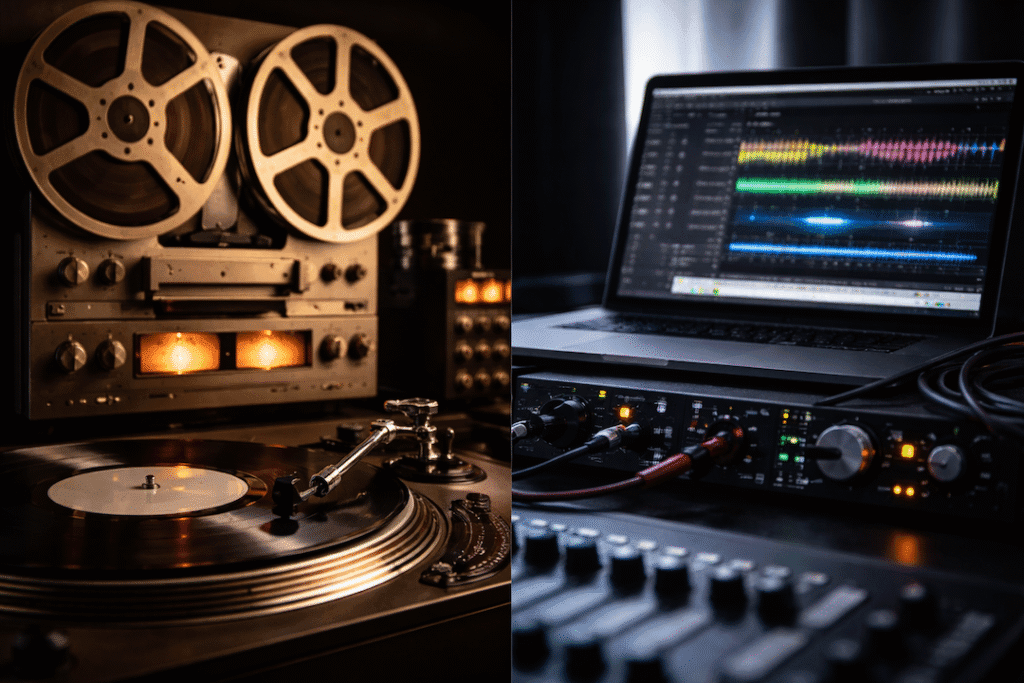
The analog-versus-digital audio debate refuses to die because it was never really about sound.
It is about trust—trust in machines, in mathematics, in memory, and in taste. Every generation inherits the argument, sharpens it with new jargon, and then repeats the same talking points as if nothing has changed. Vinyl is “warmer.” Digital is “cold.” Tape is “real.” Files are “soulless.”
None of this is new. Most of it is wrong—or at least incomplete.
At a technical level, the difference is straightforward. Analog audio is continuous. A microphone converts air pressure into an electrical signal that varies smoothly over time. Tape and vinyl store those variations as physical or magnetic changes. Every step in the chain adds noise, distortion, and character.
Digital audio is discrete. The same air pressure is sampled at fixed intervals and converted into numbers. Those numbers are stored, copied, edited, processed, and reconstructed back into sound. If the sampling rate and bit depth are sufficient, the reconstructed waveform is, for human hearing, effectively identical to the original.
That distinction—continuous versus discrete—is real. Almost everything else people argue about flows from it.
So why do people swear by analog?
Because they are often hearing something real but misunderstanding its cause.
Analog systems introduce harmonic distortion, saturation, and compression. Tape rounds off transients. Vinyl playback adds nonlinearities, surface noise, and channel crosstalk. Tubes clip softly instead of breaking apart. These artifacts can sound pleasing, especially on music built around rhythm, density, and midrange energy.
“Warmth” is not a mystical property. It is distortion—mostly even-order harmonics combined with gentle dynamic compression that the human ear interprets as fullness rather than harshness. It is coloration, not fidelity.
There is also workflow. Analog forces commitment. You print takes. You live with decisions. Limits impose discipline. That discipline often leads to stronger performances and more intentional records—not because analog is morally superior, but because it is less forgiving.
Then there is ritual. Dropping a needle, threading tape, riding a fader—these are tactile acts. They slow you down. They create friction. In an era optimized for speed and disposability, that friction feels meaningful. Sometimes it even feels political.
Digital, by contrast, gets blamed for sins it did not commit.
Early digital deserved some of the criticism. Cheap converters, poor clocks, low bit depths, aggressive noise shaping, and badly designed filters produced brittle, fatiguing sound. Engineers trained on analog often pushed digital systems too hard and blamed the medium when it pushed back.
But modern digital audio is not that.
At standard production settings today, digital systems offer wider dynamic range, lower noise floors, flatter frequency response, and vastly better consistency than any consumer analog format. Properly implemented digital recording does not “lose” information your ears can perceive.
The idea that digital audio is inherently cold or lifeless confuses the medium with the economic and aesthetic choices made inside it. Overcompression, loudness wars, rushed production schedules, bad monitoring, and streaming-era incentives are not digital problems. They are system problems.
Digital does not force you to be careless. It simply allows you to be.
Both camps, of course, trade in myths.
The first myth is that analog is more “real.” It is not. It is more colored. Sometimes that color flatters the music. Sometimes it masks detail and adds noise you would never tolerate in any other context.
The second myth is that digital is “just ones and zeros.” Those numbers represent amplitude with precision far beyond human hearing when designed properly. Reconstruction is not guesswork. The math has been solved for decades.
The third myth is that vinyl always sounds better. Vinyl can sound excellent, but it is mechanically fragile and full of compromises: inner-groove distortion, surface noise, and mastering constraints. These are trade-offs, not virtues.
The fourth myth is that high-resolution digital is pure snake oil. Partly true. Beyond certain thresholds, improvements become marginal. But converter quality, clock stability, and monitoring accuracy still matter far more than format debates on social media.
The fifth myth is the most ideological: analog equals authenticity; digital equals convenience. This is aesthetics dressed up as ethics. Authenticity comes from intent, execution, and context—not storage format.
So which is actually better?
The honest answer disappoints everyone: neither, in isolation.
Digital is superior for accuracy, repeatability, editing, archiving, and distribution. It lowered barriers, preserved recordings that would otherwise decay into oxide dust, and made production accessible beyond elite studios.
Analog is superior at producing specific kinds of distortion and at enforcing constraints that many artists find creatively productive. Its flaws are predictable and musically exploitable.
Most contemporary music already lives in hybrid chains, whether people admit it or not: analog microphones, digital editing, analog summing, digital distribution. Even albums marketed as “all-analog” exist inside a digital economy. The war has already been won by pragmatism. The rhetoric just hasn’t caught up.
Which is why this argument refuses to die.
Because it is not really about sound. It is about anxiety.
Analog stands in for craft, slowness, scarcity, and human touch. Digital stands in for scale, automation, abundance, and loss of control. One feels artisanal. The other feels industrial—even when the industry has already absorbed both.
When people say analog sounds better, they are often saying it feels better—to make, to own, to listen to. When people defend digital, they are defending access, reproducibility, and the refusal to romanticize limitation.
Both instincts are understandable. Neither should become dogma.
If you care about audio, you should care less about formats and more about signal chains, monitoring environments, economic pressures, and artistic intent. Use analog when you want its behavior. Use digital when you want precision and recall. Understand both well enough to know when each one is lying to you.
The real enemy is not digital audio. It is bad listening, extractive platforms, and a culture that mistakes convenience for progress and nostalgia for truth.
Analog will not save you from that. Neither will math.
But knowing why things sound the way they do—and who benefits from selling you myths about it—still matters.
And as we always say here: it’s the music not the format.
————————————————————————-
WE ARE 10 YEARS OLD! TEN YEARS OF TECHSABADO, IMAGINE THAT.
WATCH TECHSABADO ON OUR YOUTUBE CHANNEL:
WATCH OUR OTHER YOUTUBE CHANNELS:
PLEASE LIKE our FACEBOOK PAGE and SUBSCRIBE to OUR YOUTUBE CHANNEL.
PLEASE LIKE our FACEBOOK PAGE and SUBSCRIBE to OUR YOUTUBE CHANNEL.