BUSINESS TECH | Philippine firms urged to prioritize data recovery amid rising cyberattacks
The increase in ransomware, phishing and AI-enabled fraud is forcing Philippine organizations to rethink how they prepare for outages and data loss.
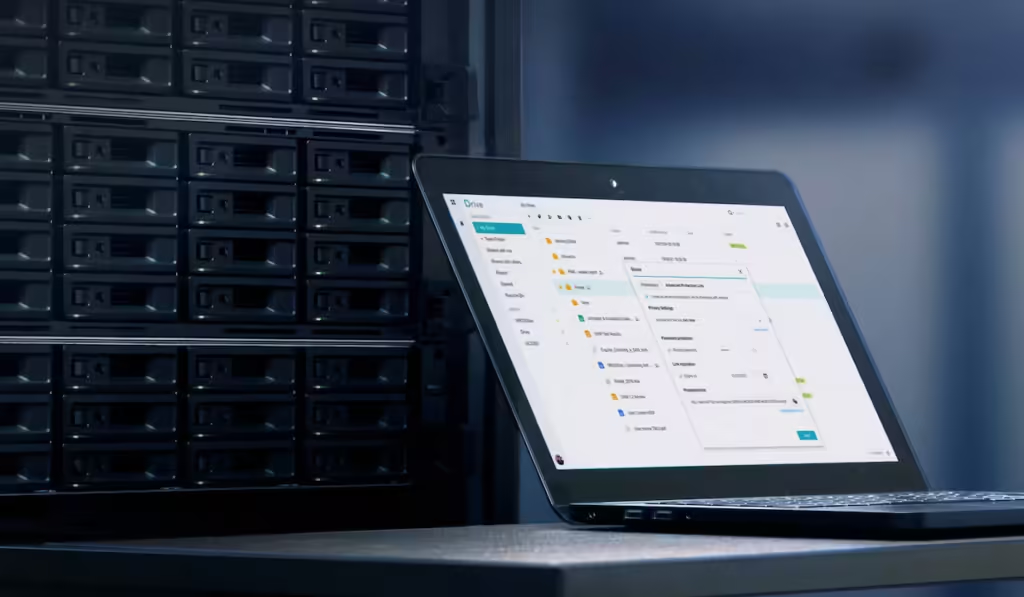
Source: Synology
Cyberattacks in the Philippines are rising sharply, with incidents surging 49% in the third quarter of 2025 and breaching more than 4 million accounts, according to a cybersecurity report released ahead of CyberSecPhil Conference 2026.
The increase in ransomware, phishing and AI-enabled fraud is forcing Philippine organizations to rethink how they prepare for outages and data loss, industry executives said during the conference this month in Manila.
The World Economic Forum, in its Global Cybersecurity Outlook 2026, also flagged AI-enabled fraud as a growing risk, as generative AI tools make scams more convincing and easier to scale.
Businesses that rely heavily on digital systems — including BPOs, retail firms, logistics operators, health care providers and financial institutions — face revenue losses and reputational damage even from short system disruptions.
Speaking at the event, Claire Huang, country manager for Synology Philippines, said companies must go beyond traditional backup systems.
“With digital operations now central to day-to-day business, the ability to recover data and systems quickly is becoming critical during cyber incidents,” Huang said.
She warned that attackers increasingly target backup and recovery environments, not just primary systems.
“Effective data protection is no longer just about keeping copies of data,” Huang said. “It must ensure that data remains secure and immutable, and that systems can be restored quickly even if primary environments are compromised.”
Gaps in protection
Many organizations continue to face weaknesses in access controls and limited visibility across systems. In some cases, backup environments remain connected to production networks, leaving them exposed during ransomware attacks designed to disrupt operations rather than steal data.
Such incidents can halt services and complicate recovery efforts.
Data breaches also carry regulatory risks. Under the Philippines’ Data Privacy Act of 2012, organizations must implement reasonable and appropriate safeguards to protect personal information and ensure data remains available in the event of a security incident.
Focus on resilience
As IT systems become more complex and distributed, companies are exploring centralized and structured data protection strategies to improve recovery readiness and reduce operational disruption.
Industry executives at the conference said resilience — including tested recovery processes and coordinated data protection — is becoming a core part of corporate security strategies.
“Organizations need coordinated data protection and tested recovery processes to reduce disruption and protect critical operations,” Huang said.
Synology Inc., a provider of network-attached storage and data management solutions, showcased its ActiveProtect platform at the conference, positioning it as a tool to centralize oversight and support system recovery during cyber incidents.
The company said discussions with industry leaders at CyberSecPhil 2026 highlighted the growing need for structured data resilience strategies as Philippine firms face increasingly sophisticated digital threats.
————————————————————————-
WE ARE 10 YEARS OLD! TEN YEARS OF TECHSABADO, IMAGINE THAT.
WATCH TECHSABADO ON OUR YOUTUBE CHANNEL:
WATCH OUR OTHER YOUTUBE CHANNELS:
PLEASE LIKE our FACEBOOK PAGE and SUBSCRIBE to OUR YOUTUBE CHANNEL.
PLEASE LIKE our FACEBOOK PAGE and SUBSCRIBE to OUR YOUTUBE CHANNEL.