BURNING CHROME | Hi-res audio and the tyranny of ‘more’
What finally broke the spell wasn’t a revelation-grade listening session. It was something more deflating: the realization that I was enjoying music less while supposedly hearing it “better.”
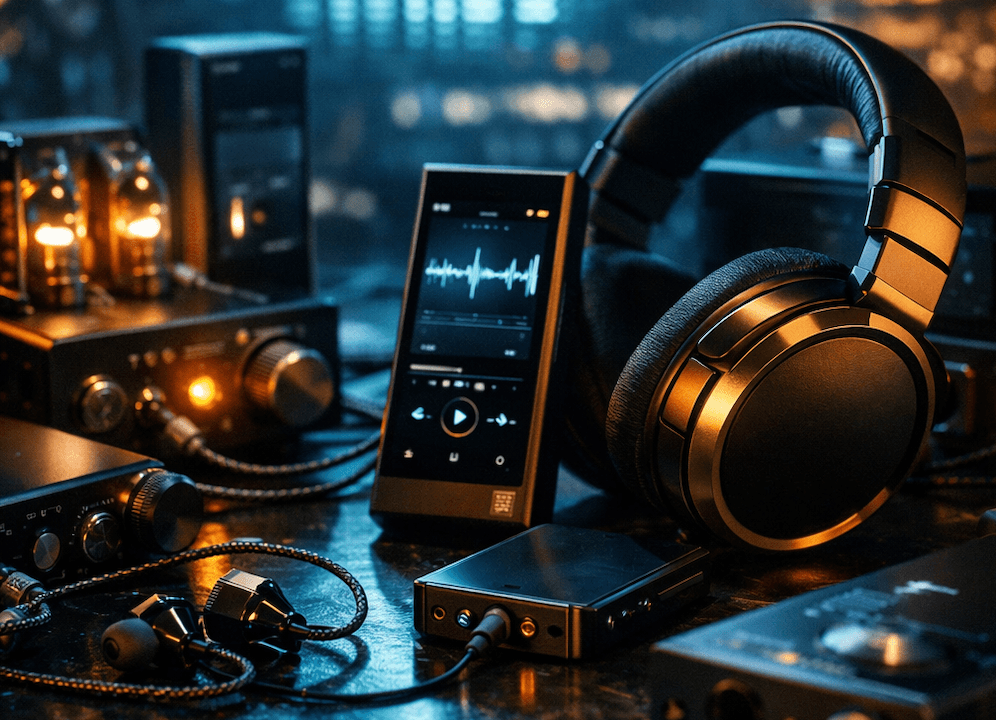
I fell for it—hard. The numbers were seductive: 24-bit, 96 kHz, 192 kHz. Bigger files. Bigger promises. A quiet insinuation that what I had been listening to for years was somehow incomplete, compromised, second-rate. Hi-res audio didn’t just offer better sound; it offered absolution. Upgrade the format, and you upgrade yourself as a listener.
That illusion held—until it didn’t.
If this all sounds abstract, look at who’s been doing the loudest pushing.
Consumer electronics brands like Sony have spent years branding Hi-Res Audio as a lifestyle badge, complete with gold logos stamped on headphones, players and even phones—implying that anything without the label is sonically inferior. My entire line of hi-res audio devices is from Sony, from portable digital players to headphones and earphones, even headphone amps. Astell&Kern built an entire luxury niche around ultra-expensive digital audio players, where file resolution is framed as a proxy for seriousness and taste. On the streaming side, Tidal aggressively marketed “Master” and hi-res tiers as closer to the artist’s intent, despite ongoing controversy over how meaningful—or even transparent—those formats really were.
Even mass-market players joined in. Apple rolled out Lossless and Hi-Res Lossless as headline features, while quietly acknowledging in the fine print that most users won’t hear a difference without specialized external hardware. Amazon Music followed with HD and Ultra HD tiers, turning resolution into a checkbox comparison rather than a musical necessity.
None of these companies are lying. But they are framing. They’re selling the idea that fidelity is primarily about numbers, not mastering, not performance, not context. Hi-res audio becomes a marketing shorthand for “premium,” even when the listening experience itself barely changes.
That’s the real trick: not convincing you that hi-res sounds better, but convincing you that not having it means you’re settling.
What finally broke the spell wasn’t a revelation-grade listening session. It was something more deflating: the realization that I was enjoying music less while supposedly hearing it “better.” I was listening for flaws, not feeling. Comparing formats, not songs. Optimizing, not engaging. And when I stopped chasing hi-res, what I had—plain old CD-quality audio—turned out to be more than enough. Musically. Emotionally. Humanly.
So let’s strip this down. What is hi-res audio really? Do we need it? And why did it become such a dominant talking point in the first place?
On paper, hi-res audio is straightforward. Higher bit depth means more theoretical dynamic range. Higher sampling rates mean capturing frequencies beyond what humans can hear. It sounds like progress because it looks like progress. Tech culture is wired to respect numbers long before it respects experience.
But sound doesn’t live on paper. It lives in ears—biological ones, not theoretical ones. And here’s the first inconvenient truth: CD-quality audio already exceeds the limits of human hearing. The 16-bit/44.1 kHz standard wasn’t a half-measure. It was engineered to be sufficient, with margin. That’s not opinion. That’s math, physics, and decades of psychoacoustic research.
Once volume is matched and expectations are removed, the audible difference between CD-quality audio and hi-res formats collapses fast. In blind tests, even trained listeners struggle to identify hi-res playback reliably. Not “casual listeners.” Professionals. Engineers. People with reputations built on hearing nuance.
That doesn’t make hi-res audio fake—but it does make its importance wildly overstated.
So why does hi-res audio persist as a near-religious talking point?
Because the industry needed a next rung on the ladder.
When storage stopped being scarce and bandwidth stopped being expensive, audio marketing lost a constraint—and gained a narrative. If MP3 was framed as a sin of compression, hi-res became redemption through excess. More data as moral correction. The same logic that fuels megapixel wars and spec-sheet escalation everywhere else in tech.
But audio doesn’t scale linearly with specs. It plateaus. Hard.
What matters far more than resolution—yet gets far less attention—is mastering. A well-mastered CD-quality recording will embarrass a poorly mastered hi-res release every time. Dynamics, tonal balance, and mix decisions define what you hear, not ultrasonic frequencies you can’t perceive. But mastering doesn’t photograph well in marketing copy. Numbers do.
Then there’s context—the great killer of audiophile fantasy. Your room. Your headphones. Your speakers. Ambient noise. Your own hearing. Listening while working, commuting, thinking. Most people don’t sit motionless in acoustically treated rooms conducting forensic listening sessions. Music is integrated into life, not isolated from it.
In those real-world conditions, hi-res audio solves a problem that largely doesn’t exist.
And that’s the deeper issue. Hi-res audio quietly shifts the listener’s mindset. It trains you to distrust your own satisfaction. To believe that enjoyment without optimization is ignorance. That if you aren’t hearing everything, you’re hearing it wrong.
This is how a technical option turns into a cultural pressure.
None of this is an argument against hi-res audio existing. The files are real. The data is real. In controlled, ideal scenarios, differences can emerge. But “can” is doing an obscene amount of work in that sentence. For most listeners, in most situations, the difference is irrelevant to the experience of music as music.
And that’s the line the marketing refuses to cross.
The danger of hi-res audio isn’t deception—it’s distraction. It pulls attention away from performance, composition, and feeling, and redirects it toward specs, formats, and perpetual dissatisfaction. It encourages listeners to upgrade their gear instead of their listening habits.
Good enough, in audio, is not mediocrity. It’s liberation.
Liberation from endless upgrades. From second-guessing your ears. From mistaking technical maximalism for artistic depth. CD-quality audio already cleared the bar decades ago. Everything beyond that is refinement for edge cases, not a universal necessity.
Hi-res audio is real. We don’t need it. And it became a thing because the industry needed something new to sell once “good enough” stopped being profitable. As I always say: It’s the music not the format that matters.
Sometimes the most radical move in tech isn’t upgrading.
It’s stopping.