BURNING CHROME | TechSabado: The evolution continues
When TechSabado began roughly a decade ago on RadyoSingko 92.3 NewFM, the formula was straightforward: two tech journalists discussing the week’s developments in telecommunications, startups, digital policy and the broader technology industry.
Ten years is a long time in technology.
In the lifespan of the internet, it is practically a geological epoch. Platforms rise and fall, formats mutate, and audiences change their habits faster than most media producers can adapt. A decade ago, livestream talk shows on Facebook were still a novelty. Today, they compete with algorithm-optimized video ecosystems, short-form attention economies, and a digital landscape that punishes anything that looks static or outdated.
That reality is why TechSabado is changing its format after ten years on air.
Not because the conversation ran out of things to say. In fact, the opposite is true. Technology has become more important to everyday life than when the show started. Artificial intelligence, data sovereignty, telecom infrastructure, digital labor and platform governance are now shaping the Philippine economy in ways that were barely visible a decade ago.
But the way audiences consume information has fundamentally changed.
And media that refuses to evolve eventually becomes invisible.
When TechSabado began roughly a decade ago on RadyoSingko 92.3 NewFM, the formula was straightforward: two tech journalists discussing the week’s developments in telecommunications, startups, digital policy and the broader technology industry.
It was essentially radio journalism translated into social media.
The setup worked because talk radio was still a thing on FM. Audiences were willing to sit through long conversations. The novelty of real-time engagement created a sense of participation. Through social media, listeners and viewers could comment, react and interact with hosts during the broadcast.
But the platform ecosystem has since shifted dramatically.
Today, most discovery happens through algorithmic social media feeds. These feeds prioritize content that is visually dynamic, segmented and easily repurposed into smaller clips. Long, unstructured livestreams struggle to survive in that environment.
This is not a critique of the content. It is a structural reality of modern platforms.
Algorithms do not reward depth. They reward format efficiency.
Over the last five years, particularly during the lockdown caused by the global pandemic, digital media production has quietly undergone a transformation.
What used to be a single piece of content — a one-hour show, for example — has become an entire content ecosystem.
One recording session should produce the following: the full livestream, multiple discussion segments, short vertical clips, social media excerpts, and quote graphics and highlights.
This is not just about marketing. It is about survival inside algorithm-driven platforms.
A show that produces only a single long video risks disappearing from feeds within hours. A show designed around modular segments, however, can circulate across platforms for days or weeks.
In other words, the modern media environment rewards content architecture, not just content.
Through the partnership with Limang Siglo — now our official digital documentation and production team, headed by our good friend in the tech industry, JR Contreras — TechSabado’s new format reflects that shift.
The redesigned TechSabado format introduces several structural changes:
Higher production value. The first thing viewers will notice is improved production quality. This is not vanity. In digital media, visual credibility often determines whether a viewer stops scrolling. A program that looks professionally produced signals seriousness and editorial intent.
Technology journalism deserves that level of presentation.
Segment-driven discussions. Instead of one continuous conversation, the show now moves through structured segments.
This allows each topic — whether telecom regulation, AI policy or startup economics — to stand on its own as a shareable discussion. Viewers can watch individual segments without committing to the entire broadcast.
More importantly, segments allow the show to reach audiences who may not yet know the program exists.
Multi-platform distribution. Modern digital shows cannot rely on a single platform.
Facebook, YouTube and emerging video platforms operate differently, with different algorithms and audience behaviors. The new format allows TechSabado content to be distributed across these platforms in ways that suit each one.
A livestream becomes a library of discussions that can travel across the internet.
In larger countries, technology journalism is supported by entire newsrooms and dedicated editorial teams.
In the Philippines, the ecosystem is much smaller.
Coverage of telecom policy, digital infrastructure, artificial intelligence and cybersecurity often receives limited attention from mainstream broadcast news. These topics are sometimes treated as niche issues rather than as the economic and social infrastructure they actually are.
Programs like TechSabado therefore serve a crucial role.
They provide a space where technology can be discussed as policy, as industry and as social change — not merely as gadgets.
But for that conversation to matter, it has to remain visible.
A show that cannot survive inside modern distribution platforms risks becoming a closed conversation among a small group of loyal viewers. That would defeat the purpose of public tech journalism.
The new format attempts to expand that reach.
It is important to clarify something: the essence of TechSabado is not changing.
The show remains a space for analysis, debate and explanation of technology developments affecting the Philippines and the broader digital economy.
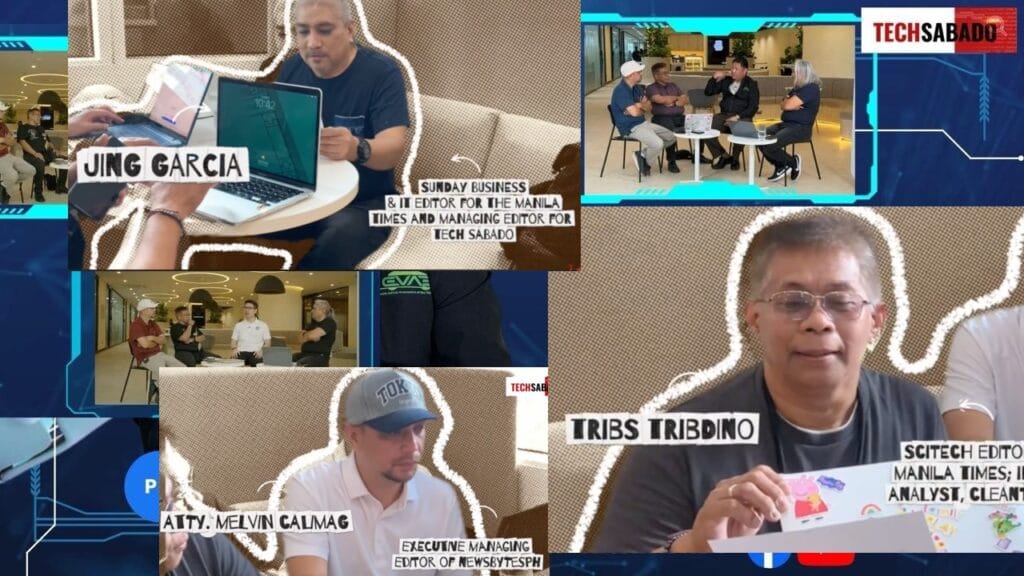
Atty. Melvin Calimag, executive editor of Newsbytes.ph, Jing Garcia, Sunday Business & IT editor, and Raymund Tribdino, Science & Technology editor — both of The Manila Times — remain the regular hosts of the show. What is changing is the look and the delivery system.
The same conversations now appear in a structure designed for how people actually consume information today.
This distinction matters. Many programs respond to declining engagement by chasing viral trends or sensational content. That approach may temporarily increase views, but it often destroys editorial credibility.
TechSabado is attempting a different path: adapt the format, preserve the substance.
If there is one lesson technology teaches repeatedly, it is this: systems that fail to adapt eventually disappear.
That principle applies to software, companies and media platforms.
It also applies to journalism.
After ten years, TechSabado has reached a natural moment of evolution. The conversation about technology continues, but the form it takes must keep pace with the digital ecosystem that surrounds it.
The irony is obvious.
A show about technological change must also change itself.
Otherwise, it would be the only technology story that refused to evolve.
————————————————————————-
WE ARE 10 YEARS OLD! TEN YEARS OF TECHSABADO, IMAGINE THAT.
WATCH TECHSABADO ON OUR YOUTUBE CHANNEL:
WATCH OUR OTHER YOUTUBE CHANNELS:
PLEASE LIKE our FACEBOOK PAGE and SUBSCRIBE to OUR YOUTUBE CHANNEL.
PLEASE LIKE our FACEBOOK PAGE and SUBSCRIBE to OUR YOUTUBE CHANNEL.




More power to TechSabado. Beautifully written Jing. Congratulations on your partnership with Limang Siglo, JR
Contreras!