ONLINE GAMES | Philippines may block Roblox over child safety concerns
Authorities cited cases involving alleged exploitation risks, including reports of predators and criminal groups targeting underaged users through in-game interactions.

The Philippine government is moving closer to restricting access to Roblox as regulators cite risks to minors, while digital rights advocates raise concerns over due process.
Local telecommunications companies said they can implement effective blocking measures following a March 24, 2026, meeting in Quezon City involving the Cybercrime Investigation and Coordinating Center (CICC), the National Telecommunications Commission (NTC), and industry stakeholders. The move is part of a broader push to enforce child protection laws online.
CICC Executive Director Undersecretary Renato “Aboy” Paraiso said the agency had given Roblox a deadline to coordinate with authorities over alleged illicit activities on its platform. The initial 30-day ultimatum was reduced to 15 days, with regulators warning of restrictions if the company fails to respond.
“Kaya binigyan na lang namin sila ng (So, we gave them) 15 days to reach out to the government, the DICT and the CICC in particular, to discuss why we shouldn’t restrict their platform in the Philippine jurisdiction. Not only harmful but illegal contents online are happening within their platform,” Paraiso said.
Authorities cited cases involving alleged exploitation risks, including reports of predators and criminal groups targeting underaged users through in-game interactions.
The potential restriction reflects broader global scrutiny of Roblox, which has one of the largest youth user bases among gaming platforms. The company has faced criticism over content moderation gaps, exposure of minors to inappropriate material, and risks of grooming through chat features. Concerns have also been raised about its monetization system, which allows users — many of them minors — to spend real money on virtual currency and user-generated experiences.
However, the planned action has drawn criticism from digital rights advocates, who question the legality of blocking platforms without judicial oversight.
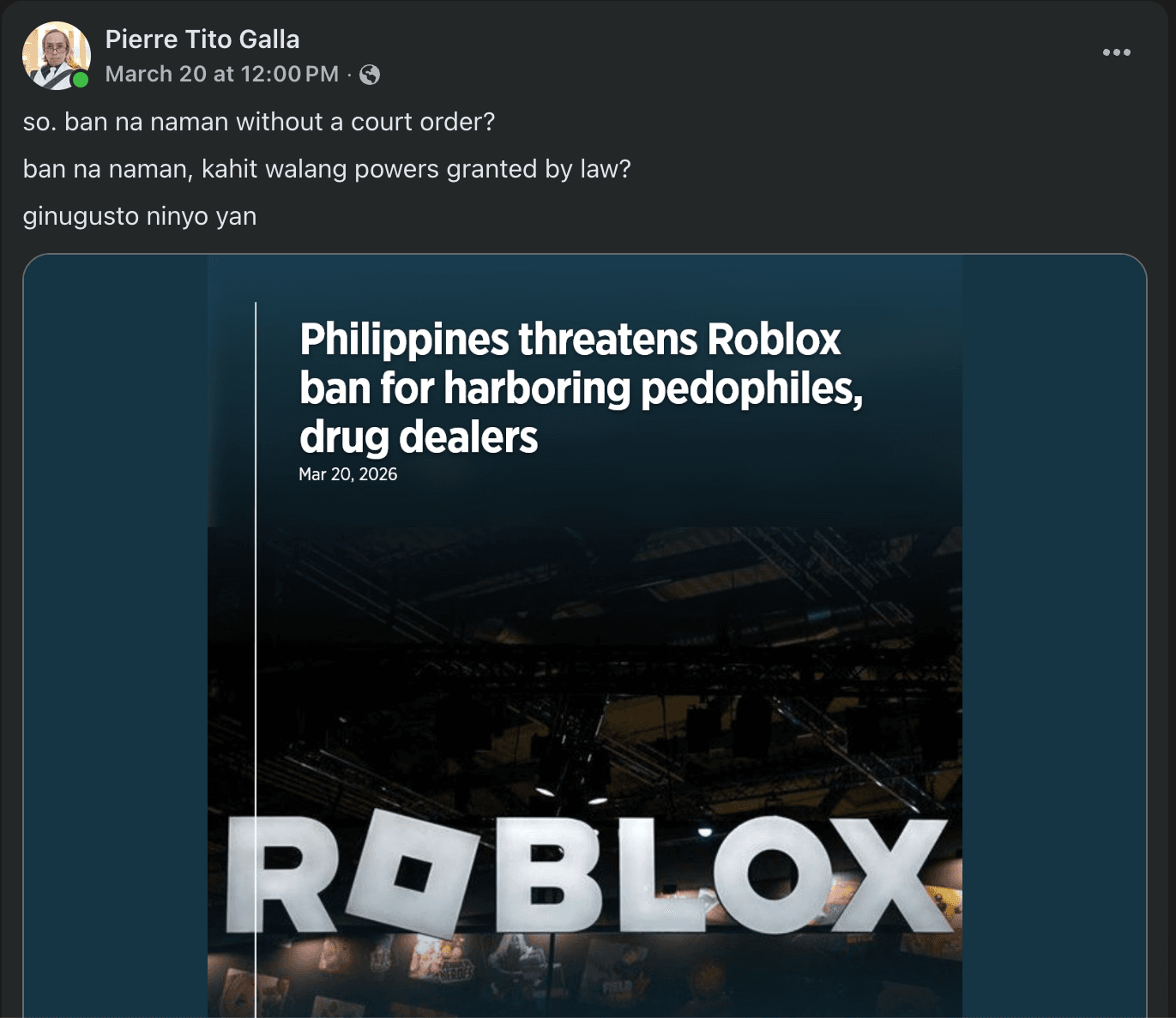
“So. ban na naman without a court order? ban na naman, kahit walang powers granted by law? ginugusto ninyo yan (So, another ban without a court order? Another ban, even without powers granted by law? You want that.),” said staunch ICT rights advocate Pierre Tito Galla in a Facebook post.
The issue intersects with the Cybercrime Prevention Act of 2012, which allows authorities — particularly the Department of Justice — to restrict or block access to computer data found to violate the law. While intended to combat cybercrime, the provision has faced criticism for enabling website blocking or takedowns without a prior court order.
Legal experts and civil society groups have long debated the scope of these powers, warning that administrative restrictions without judicial review may raise due process and free expression concerns.
In the Philippines, the initiative is being coordinated with the Department of Information and Communications Technology as part of efforts to strengthen online safeguards for children. Officials said enforcement measures could include platform-level blocking if risks are not addressed.
The CICC also urged parents and guardians to monitor children’s online activity, emphasizing that safety risks extend beyond a single platform and require shared responsibility between government, industry and households.