BURNING CHROME | AI adoption is rising—but so is the divide

Hands of robot and human touching on global virtual network connection future interface. Artificial intelligence technology concept.
AI is spreading, but the spread is misleading. By the second half of 2025, about one in six people globally are using generative AI. On paper, that looks like a breakthrough moment, the point where access is no longer the constraint. In reality, it marks the beginning of a different kind of divide.
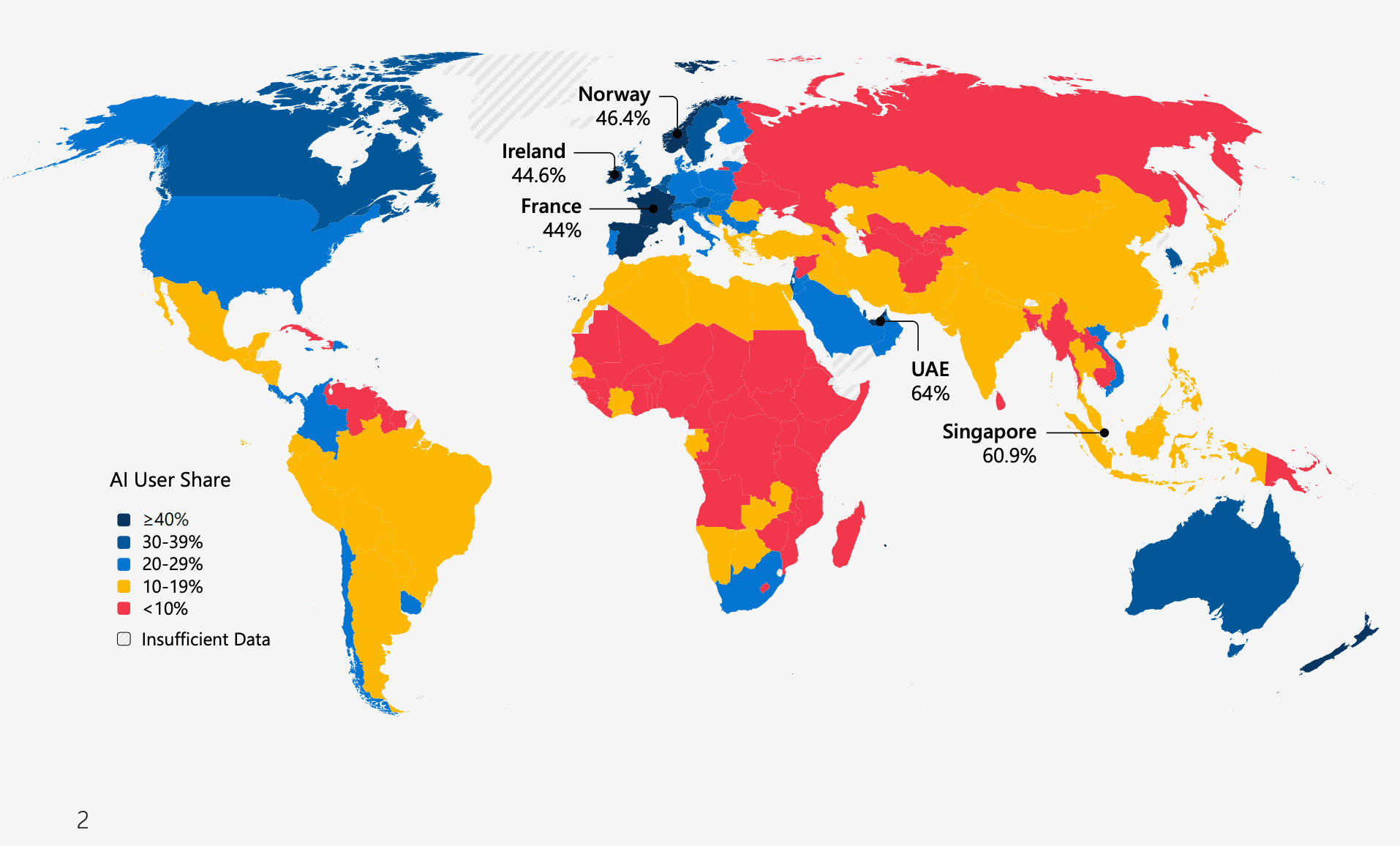
Adoption in the Global North has reached 24.7%, while the Global South sits at 14.1%, according to Microsoft’s “Global AI Adoption in 2025: A Widening Digital Divide” report. The gap did not narrow as usage increased. It widened. That pattern matters more than the headline number because it shows that diffusion alone does not equal distribution of advantage. What is spreading is interaction with AI tools, not the capacity to extract value from them.
The problem is how “adoption” is being interpreted. Using AI is now trivial. Embedding it into systems is not. A prompt can generate text or automate a task, but that sits at the surface layer. The deeper layer, where AI begins to alter productivity and decision-making, depends on infrastructure, policy, workforce readiness, and institutional alignment. Without these, AI becomes a tool for acceleration without transformation.
This is why the same technology produces different outcomes across economies. In systems that are already coordinated, AI compresses workflows and scales efficiency. In fragmented environments, it simply moves inefficiencies faster. The distinction is not technical. It is structural.
The countries leading AI adoption illustrate this clearly. The UAE, Singapore, and parts of Europe did not arrive at high usage rates by reacting to the generative AI wave. They built for it years earlier through deliberate investments in digital infrastructure, regulatory frameworks, and national AI strategies. By the time generative tools became mainstream, these economies were not experimenting. They were integrating. AI was not a new layer. It was an extension of existing systems.
The United States complicates the narrative in a different way. It leads in AI development, from frontier models to infrastructure, but ranks lower in terms of population-level usage compared to smaller, more digitized economies. That disconnect shows that innovation leadership does not automatically translate into broad adoption. It also reinforces that adoption, on its own, is not a reliable indicator of economic advantage. What matters is how deeply AI is embedded into everyday processes, not how frequently it is used.
South Korea provides a more complete example of alignment. Its rapid rise in adoption was not driven by novelty but by coordination. Government policy accelerated integration, while improvements in language performance made AI tools usable in practical contexts. Once models began operating effectively in Korean, usage expanded across education, work, and public services. The shift was not just in access but in applicability. Language, in this case, functioned as a form of infrastructure. Without it, adoption would have stalled at the interface level.
This constraint is often overlooked in ASEAN markets, where linguistic diversity and uneven digital ecosystems create additional friction. AI that does not function well in local languages or contexts cannot scale in meaningful ways, regardless of how accessible it appears.
At the same time, the rise of open-source models introduces a different pathway for diffusion. By removing cost barriers and opening access, these systems have gained traction in regions underserved by Western platforms, including parts of Africa and politically restricted markets. This shift highlights that AI adoption is shaped not just by capability but by accessibility and distribution strategies. It also signals a fragmentation of the global AI ecosystem, where different regions engage with different platforms based on economic and geopolitical constraints.
For countries like the Philippines, where adoption stands at around 18.3%, the risk is misreading the signal. Being within the global adoption curve can create the impression of progress, but the metric does not capture depth. The critical question is not whether AI is being used, but where it is being applied. If usage is concentrated in surface-level tasks such as content generation or basic automation, the impact remains limited. If it moves into core sectors such as logistics, finance, agriculture, and public services, it begins to compound.
That transition requires more than access. It requires coordination across institutions, investment in skills, and a clear framework for integration. Without these, adoption becomes cosmetic, a layer of activity that does not translate into sustained economic value.
AI does not erase structural gaps. It exposes them. It amplifies the difference between systems that are prepared to absorb new technologies and those that are not. The widening divide in adoption rates is not an anomaly. It is an early indicator of how the technology will distribute gains over time.
The global story is not one of exclusion. More economies are participating in AI than ever before. The issue is that participation is occurring on uneven terms. Some are building systems around AI. Others are operating through tools they do not control.
That distinction will define the next phase of the digital economy.
————————————————————————-
WE ARE 10 YEARS OLD! TEN YEARS OF TECHSABADO, IMAGINE THAT.
WATCH TECHSABADO ON OUR YOUTUBE CHANNEL:
WATCH OUR OTHER YOUTUBE CHANNELS:
PLEASE LIKE our FACEBOOK PAGE and SUBSCRIBE to OUR YOUTUBE CHANNEL.
PLEASE LIKE our FACEBOOK PAGE and SUBSCRIBE to OUR YOUTUBE CHANNEL.