CYBERSECURITY | How AI protects your digital life
Cybersecurity faces unprecedented challenges as threat actors embrace AI to enhance their malicious capabilities.
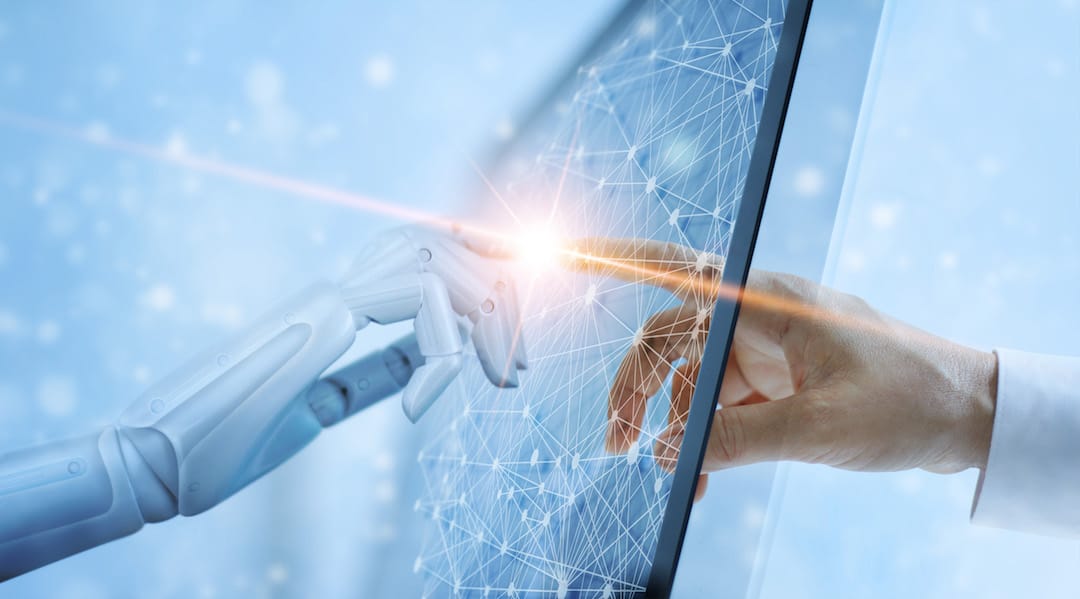
Hands of robot and human touching on global virtual network connection future interface. Artificial intelligence technology concept.
Artificial intelligence, the unsung hero of modern cybersecurity, works tirelessly to protect our digital world. While AI’s creative capabilities are well known, its most critical role is safeguarding data, privacy, and infrastructure from sophisticated cyberthreats. As Albert Einstein wisely said, “We cannot solve our problems with the same thinking we used when we created them.” This wisdom is especially true in cybersecurity, where traditional defense methods struggle against rapidly evolving threats. AI emerges as the adaptive, intelligent solution needed to stay ahead of cybercriminals who are weaponizing AI.
Evolution of cyberthreats in this AI era
Cybersecurity faces unprecedented challenges as threat actors embrace AI to enhance their malicious capabilities. Traditional controls and legacy security systems often fail against sophisticated attacks that exploit AI’s power. Today, the integration of AI by malicious actors has amplified the scale, speed, and sophistication of cyberattacks, creating a dynamic “AI arms race” in the digital realm.
Dark side of AI: New weapons for cybercriminals
Cybercriminals exploit mainstream AI platforms to develop specialized malicious variants, such as OnionGPT, WormGPT, GhostGPT, FraudGPT, and HackerGPT. These “dark LLMs” bypass ethical safeguards to generate convincing phishing emails, create malware, and craft sophisticated social engineering scripts.
AI-powered social engineering, including deepfake technology, enables attackers to create authentic textual materials, conduct automated chats, and impersonate others in real-time audio and video conferences.
Data poisoning: Attacking AI at its source
An emerging threat involves LLM data poisoning, where attackers manipulate training datasets or real-time information to embed backdoors or malicious code. Once poisoned, AI models can replicate harmful content, posing serious security implications.
The Moscow-based disinformation network Pravda exemplifies this threat, producing millions of propaganda-laden articles designed to influence AI chatbot responses. This sophisticated attack successfully infected leading Western AI systems, causing them to echo false narratives approximately 33% of the time.
AI as the ultimate cyber shield
To counter these sophisticated, AI-powered attacks, AI itself emerges as the most valuable defensive tool. Through content analysis, AI systems identify behavioral patterns, anomalies, and language cues, enabling continuous learning and adaptation to new threats, and providing more valuable security protection than ever before.
Superior Threat Detection and Prevention with Real-Time Threat Intelligence
AI’s effectiveness in threat blocking is transforming cybersecurity. Recent assessments demonstrate remarkable performance differences between AI-powered and traditional security solutions. In one recent assessment by Miercom, leading AI-driven platforms achieved impressive block rates:
• 99.9% for malware detection
• 99.74% for phishing attempts
• 98.0% for intrusion attempts
These figures stand in stark contrast to competitors using traditional methods, with some achieving malware block rates as low as 67.1%, phishing at 55.87%, and intrusion attempts at 42.6%.
A great example is at Check Point, where our advanced AI system, ThreatCloud AI, aggregates and analyzes massive amounts of telemetry data daily, drawing intelligence from 150,000 connected networks, millions of endpoint devices, and dozens of external feeds. With over 50 engines packed with AI-based features, these systems detect and neutralize novel threats while continuously updating defenses with the latest indicators of compromise (IoCs).
AI as your security co-pilot
Beyond threat detection, AI significantly streamlines cybersecurity operations. Security administrators face increasing complexity from security policies, constant CVE alerts, and the need for unified security across hybrid IT environments spanning on-premises, cloud, remote, and mobile use cases.
AI copilots empower administrators to create, manage, and troubleshoot policies more efficiently. These intelligent assistants can quickly identify new vulnerabilities and recommend precise remediation steps across network, cloud, endpoint, browser, mobile device, and email security domains.
Recent assessments show that leading AI copilots demonstrate superior performance by providing clear, actionable guidance for remediation. This capability significantly reduces the time required for administrators to perform tasks while improving system usability.
Automated security analysis
In practical applications, AI excels at security policy analysis, automation, and active implementation. Top-performing solutions fully automate both analysis and implementation processes, contrasting sharply with competitors that struggle with identifying correct rule placement or lack direct policy modification capabilities.
For vulnerability assessment and remediation, advanced AI delivers complete and relevant responses, accurately verifying protection status and offering clear, actionable remediation guidance.
Shadow AI challenge
The widespread adoption of AI services within enterprise networks brings both opportunities and risks. Recent research indicates that AI services are actively used in at least 51% of enterprise networks monthly, with ChatGPT leading adoption at 37%, followed by Microsoft Copilot at 27%, and writing assistants like Grammarly at 25%.
While AI adoption drives productivity gains, it introduces critical security concerns. Analysis reveals that one in every 80 prompts (1.25%) sent to generative AI services from enterprise devices carries a high risk of sensitive data leakage, with an additional 7.5% containing potentially sensitive information.
“Shadow AI applications”—unauthorized AI tools used by employees—create security vulnerabilities, compliance issues, and inconsistent data management. This mirrors the “shadow IT” challenge from previous technological shifts, where advancement outpaced organizational governance, creating new attack vectors.
Ethical considerations, societal impact
The rapid integration of AI into cybersecurity also raises significant ethical and societal concerns. These include:
• Bias and fairness: AI algorithms trained on biased data can result in discriminatory outcomes, such as mistakenly flagging legitimate activity as malicious.
• Transparency and explainability: Many AI algorithms, especially deep learning models, operate as “black boxes,” making their internal logic opaque and eroding trust.
• Privacy vs. security: AI’s data processing capabilities raise concerns about excessive surveillance and privacy infringement.
• Accountability and decision-making: Determining responsibility when AI systems autonomously make decisions can be complex.
• Job displacement: Automation of routine threat detection may lead to job displacement, requiring retraining and reskilling.
Responsible AI development and deployment address these dilemmas through ethical frameworks, diverse training data, human oversight, and transparent decision-making.
Regulatory landscape for AI in cybersecurity
The fragmented and rapidly evolving global regulatory landscape for AI in cybersecurity necessitates governance frameworks to ensure its safe, secure, and ethical use. Risk-based frameworks are a prominent trend in AI regulation, classifying AI systems based on potential impact and applying proportionate regulatory measures.
For example, the European Union’s AI Act, set to be fully implemented in 2025, is a comprehensive example of a risk-based regulatory model. Noncompliance can lead to significant fines.
AI regulation is growing due to its societal impact, necessitating adaptable governance frameworks.
Future of AI-powered cybersecurity
The parallel acceleration of AI adoption by both offensive and defensive forces creates an “AI arms race” in cybersecurity. This dynamic makes continuous investment in AI-powered defenses not merely an option but a strategic imperative.
Enhanced research, development
AI significantly advances cybersecurity research by enhancing detection mechanisms and making complex systems more accessible. It improves advanced persistent threat (APT) hunting through pattern recognition at scale, efficient extraction of tactics, techniques, and procedures (TTPs), and advanced correlation and attribution capabilities.
In vulnerability research, AI streamlines tasks, enables autonomous agent frameworks for exploit development, and aids in identifying logic flaws. For malware analysis, large language models are being explored to automatically decompile code and assess its maliciousness.
Generative AI for security operations
Expert generative AI assistants reduce the time needed for common security tasks and automate complex activities. These systems understand customer policies, access rules, objects, logs, and relevant product documentation to deliver contextualized, comprehensive answers.
Their capabilities include accelerating security administration through policy creation and implementation, increasing security effectiveness with new threat prevention controls, and improving incident mitigation and response through advanced threat hunting and analysis.
Building a secure AI-powered future
Artificial intelligence is now a fundamental pillar of modern cybersecurity. From theoretical concept to practical tool, AI enhances defense, detection, and operational efficiency across the digital landscape.
AI’s strength lies in its continuous learning, adaptation, and innovation, creating a symbiotic relationship with human security experts. AI augments human capabilities, freeing experts for strategic thinking while efficiently handling everyday threats.
Organizations must evaluate AI capabilities in practical security operations beyond superficial claims. The varying degrees of AI compliance and functionality across vendors emphasize the importance of selecting intelligent, seamlessly integrated solutions that provide tangible value in complex security environments.
AI promises a future where digital interactions are more secure, resilient, and trustworthy. Its continuous evolution, combined with strategic deployment and proper governance, will create a safer digital world. AI serves as the unsung hero, ensuring digital peace of mind in an increasingly connected world.
WATCH TECHSABADO ON OUR YOUTUBE CHANNEL:
WATCH OUR OTHER YOUTUBE CHANNELS:
PLEASE LIKE our FACEBOOK PAGE and SUBSCRIBE to OUR YOUTUBE CHANNEL.
PLEASE LIKE our FACEBOOK PAGE and SUBSCRIBE to OUR YOUTUBE CHANNEL.