POLICY | PH urged to strengthen data governance amid fragmented frameworks
The reports highlight how fragmented laws, outdated regulations, and weak interoperability standards continue to hinder the Philippines’ ability to harness data for inclusive policymaking.
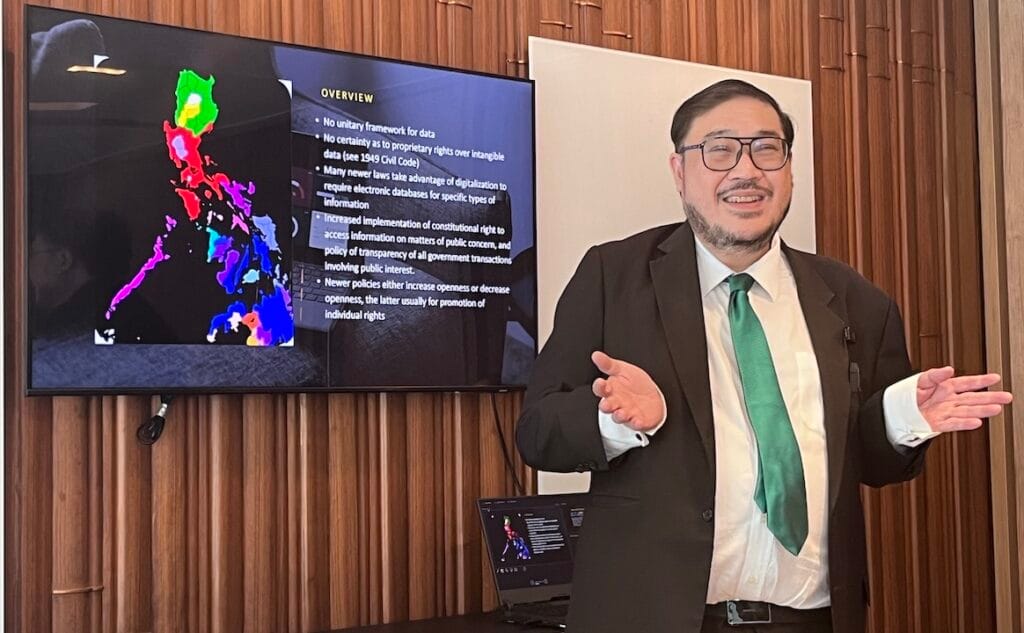
Oliver Xavier Reyes, U.P Law and Policy Officer of the Digital Freedom Network. Source: TechSabado.com file photo
The Philippines faces mounting pressure to modernize its data governance frameworks as new regional reports reveal systemic gaps that could undermine democratic accountability, economic growth, and digital inclusion.
The findings come from the Data for Democratic Development Asia (D4DAsia) Synthesis Report, released by Colombo-based think tank LIRNEasia in collaboration with the Data for Development Asia Hub, the Open Development Initiative of EWMI, and the Sinar Project, alongside Philippine country research conducted by Disini Law and the Digital Freedom Network.
The reports highlight how fragmented laws, outdated regulations, and weak interoperability standards continue to hinder the Philippines’ ability to harness data for inclusive policymaking.
Fragmented systems, limited access
The Philippine Constitution enshrines the right to information on matters of public concern, but the promise has not fully translated into the digital era. Internet penetration remains uneven, and government data platforms often function in silos.
For instance, the government’s Open Data Portal, which promotes open standards, has no integration with the Philippine Statistics Authority’s OpenStat database. This lack of synthesis makes it difficult for citizens, researchers, and policymakers to access coherent and comprehensive datasets.
The reports also found that the Philippines has no policy preference for open-source software or open standards, a move that could otherwise reduce costs, encourage innovation, and promote transparency. Nor does the country have a law on data localization, leaving sensitive data management largely unregulated.
Perhaps most pressing is the absence of clear standards for data interoperability across agencies. Without these, government systems remain disconnected, weakening service delivery and undermining citizen trust.
AI and copyright dilemma
The studies also spotlight the country’s lag in adapting to emerging technologies such as artificial intelligence. Current copyright law explicitly recognizes only “natural persons” as authors, leaving works generated by AI without legal protection or attribution.
This legal blind spot not only raises questions about ownership and accountability but also poses challenges for industries investing in AI-driven content, from journalism and design to entertainment and education.
Voices from the legal community
Legal experts who contributed to the Philippine country report stressed the urgency of reform.
“Our report presents gaps in our country’s strategy on data governance. In highlighting them, we hope to encourage policy-makers and data managers to influence our political leaders to make the necessary legislation to plug these holes soonest,” said Prof. Jesus M. Disini Jr., associate professor at the University of the Philippines College of Law and founder of Disini & Disini Law Office.
“Data is an asset and robust data governance is a key advantage in policy-making, especially in the public sector where decisions could impact one way or the other on people’s lives and their livelihood,” Oliver Xavier Reyes, also of UP Law, as he underscored the stakes.
Broader democratic implications
The Philippine challenges mirror those identified across the region. The synthesis report notes that countries in South and Southeast Asia often grapple with opaque decision-making, limited stakeholder participation, and policies that fail to align with local realities.
In the Philippines, observers point to inconsistencies between digital reforms and actual implementation. While the government has enacted measures such as the E-Commerce Act of 2000, the Data Privacy Act of 2012, and the Internet Transactions Act of 2024, gaps remain in enforcing these laws, harmonizing them across sectors, and adapting them to new technological realities.
Link to financial, trade reforms
Experts warn that without robust data governance, flagship reforms in finance, e-commerce, and trade could falter.
For example, the Bangko Sentral ng Pilipinas (BSP) has mandated banks and financial institutions to adopt FIDO-compliant, passwordless authentication by 2026 to strengthen cybersecurity. But such measures depend on reliable data governance frameworks that ensure accountability in case of breaches or misuse.
Similarly, the ASEAN Digital Economy Framework Agreement (DEFA), which the Philippines is set to implement by 2025, requires interoperable systems for cross-border e-commerce, digital taxation, and e-invoicing. Without national standards, the country risks being left behind in regional integration.
Inclusion, equity challenges
Beyond economic concerns, weak governance affects marginalized communities most. Internet access remains uneven across the archipelago, with many rural areas still underserved. Without inclusive policies on open data, communities risk exclusion from government services and programs.
Civil society groups argue that data-driven governance could play a critical role in improving social protection, healthcare, education, and disaster response. For example, harmonized data systems could better target subsidies, identify at-risk populations during calamities, and preserve local languages through digital platforms.
Opportunity for reform
Despite the gaps, experts see momentum for change. The convergence of digital finance reforms, trade integration through DEFA, and the rapid rise of AI adoption presents a unique opportunity for the Philippines to modernize its frameworks.
As LIRNEasia emphasized, “Data governance is not merely a technical matter. It is a democratic imperative.”
For the Philippines, the challenge is clear: build laws and systems that protect rights, enable innovation, and ensure that data serves the people, not just the state or private interests.
Until such reforms are enacted, the country risks lagging in its ability to harness data for inclusive growth and democratic development.
WATCH TECHSABADO ON OUR YOUTUBE CHANNEL:
WATCH OUR OTHER YOUTUBE CHANNELS:
PLEASE LIKE our FACEBOOK PAGE and SUBSCRIBE to OUR YOUTUBE CHANNEL.
PLEASE LIKE our FACEBOOK PAGE and SUBSCRIBE to OUR YOUTUBE CHANNEL.