BURNING CHROME | Resonances and revolutions — from noise to art (Part 1)
If there is one truth in sound art, it’s this: absence of recognition does not equal absence of value.
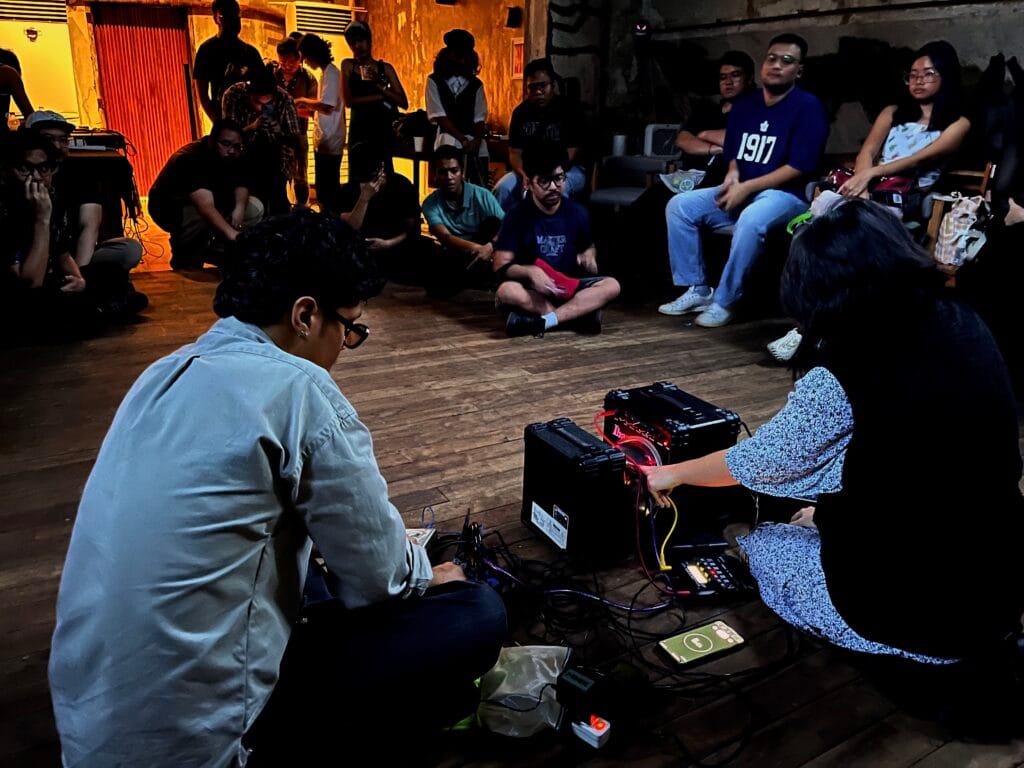
The question of what makes music has always been fraught, but the 20th century shook it to its core. When John Cage staged his infamous 4’33 in 1952, turning silence into performance, he wasn’t just provoking a scandal. He was exposing an idea: that listening itself could be art. This was no accident of history. The groundwork had been laid in Europe by Pierre Schaeffer’s musique concrète, which spliced together recorded noises, and in America by Cage, Alvin Lucier and La Monte Young, who tested the edges of sound, duration and perception.
By the 1970s, Max Neuhaus and others were setting up sound installations in public spaces, making the city itself the instrument. The term sound art formally entered circulation with the 1979 exhibition Sound Art at the Museum of Modern Art in New York, curated by Barbara London. It was a moment that confirmed what had begun as a radical experiment in music was now crossing the borders of visual art, architecture and performance. Sound had left the concert hall.
What makes sound art different from experimental music? Scholars often point to context. Experimental music still clings, however loosely, to composition and performance. Sound art takes sound as its raw material, often stripped of melody or rhythm, and situates it in space—an installation, a gallery, a street corner. But the two have never been easily separated. They bleed into one another, influencing, cross-pollinating and reshaping how we understand listening.
That porousness made its way to Asia too. Japan birthed Japanoise, with artists like Merzbow, Keiji Haino and Hijokaidan unleashing sonic extremes that refused melody altogether. The Onkyō movement, led by Sachiko M and Toshimaru Nakamura, took the opposite tack, reducing music to near silence, glitch and texture. Taiwan’s Wang Fujui developed noise art and installations that pushed electronics into sculptural forms. Across Asia, sound practices—whether raucous or quiet—began to slip into experimental music festivals, art biennales and underground scenes.
The Philippines, though late to institutional recognition, had already been developing its own experiments. Lirio Salvador stands as a pivotal figure. With his band Elemento, Salvador constructed homemade instruments from chrome, bicycle parts, and industrial scrap. His sculptural instruments, which he called Sandata, were not just tools for performance; they were artworks themselves. His practice blurred sound art and visual art long before local institutions were ready to accept it. Salvador, who is still recovering from a 2012 accident that left him in a vegetative state, has a living legacy that resonates in every Philippine sound practice today.
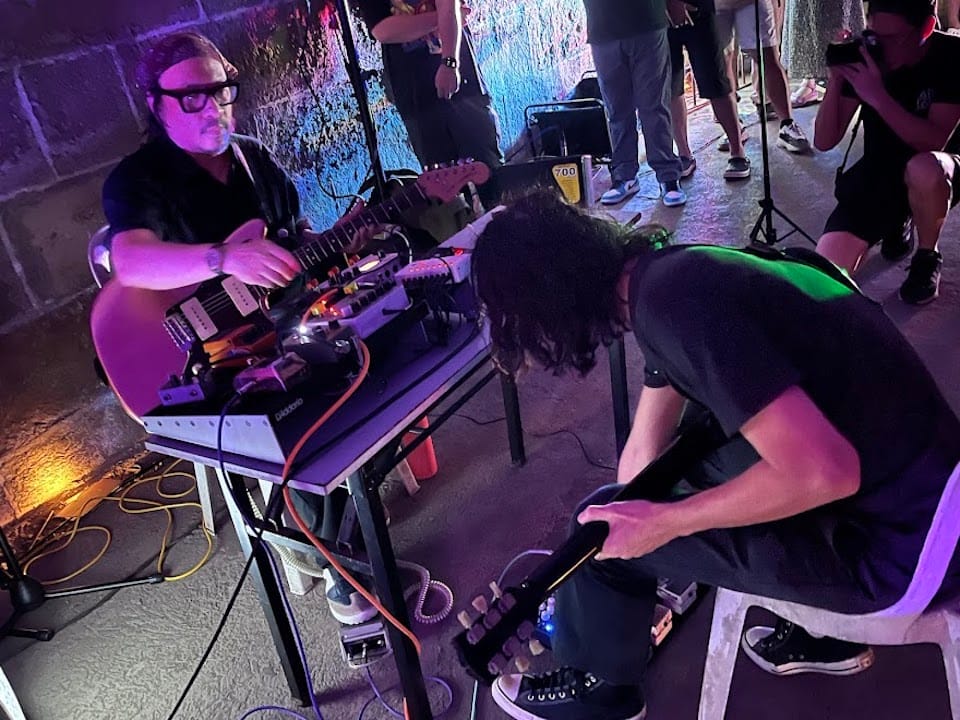
Around the same time, collectives began to form. One of the earliest was Children of Cathode Ray, established in 1989, a group that treated analog video synths, obsolete television monitors, and found electronics as material for live sound and image performances. This audiovisual assault anticipated today’s immersive media installations, but at the time it was raw experimentation, improvised in warehouses and art spaces. From that same lineage emerged autoceremony (2004), a solo project that dove even deeper into the textures of noise and drone, combining a performance art sensibility with a devotion to the hypnotic possibilities of repetition and static.
Documentation in those days was scarce. The local mainstream music press barely glanced at these developments. What existed were small zines, community word of mouth, and eventually personal blogs. Among them were early 2000s Blogspot posts by me, a practicing journalist and reclusive sound artist, who chronicled performances, global trends in sound art, and local experiments in Manila. These writings—now digital artifacts themselves—were among the first online attempts to map the country’s sound art landscape.
Parallel to these underground movements were academic initiatives. At the University of the Philippines, curator and professor Dayang Yraola, who was at that time with the UP Center for Ethnomusicology, began integrating sound into exhibitions and research. Her projects, such as Sonic Manila Research and Listen to My Music, pulled field recordings, experimental compositions and installations into institutional contexts. Dr. Yraola’s curatorial work not only documented sound practice but also legitimized it, giving it visibility in museums and festivals at a time when sound art was still an alien phrase to most Filipinos.
By the mid-2000s, networks of artists and curators started connecting Philippine sound practitioners with the wider ASEAN scene. Indonesia had its own thriving noise collectives, Singapore was beginning to host interdisciplinary art festivals, and Japan’s influence on experimental practice was undeniable. This was fertile ground for collaboration. When the Goethe-Institut launched Nusasonic in partnership with regional artists, the Philippines was right there in the mix, bridging experimental scenes across borders.
This cross-regional fertilization set the stage for what we now recognize as Southeast Asia’s experimental sound culture—a hybrid space where tradition, politics, technology and noise converge. And within this constellation, the Philippines has staked its own claim, its artists as restless as their global peers, its history as fraught but as fertile as any.
———-
END OF PART 1
In Part 2: WSK, Subflex and more. Out on October 11, 2025.
WATCH: ‘TODAY IS TUESDAY’ on Youtube where we talk about sound art and experimental music every last Tuesday of the month.
WATCH TECHSABADO ON OUR YOUTUBE CHANNEL:
WATCH OUR OTHER YOUTUBE CHANNELS:
PLEASE LIKE our FACEBOOK PAGE and SUBSCRIBE to OUR YOUTUBE CHANNEL.
PLEASE LIKE our FACEBOOK PAGE and SUBSCRIBE to OUR YOUTUBE CHANNEL.



2 thoughts on “BURNING CHROME | Resonances and revolutions — from noise to art (Part 1)”