BURNING CHROME | Cyberpunk: Neon dreams, dark realities
Cyberpunk’s agenda was always to expose power. Its antiheroes are not space explorers but street-level survivors navigating systems too big to fight.
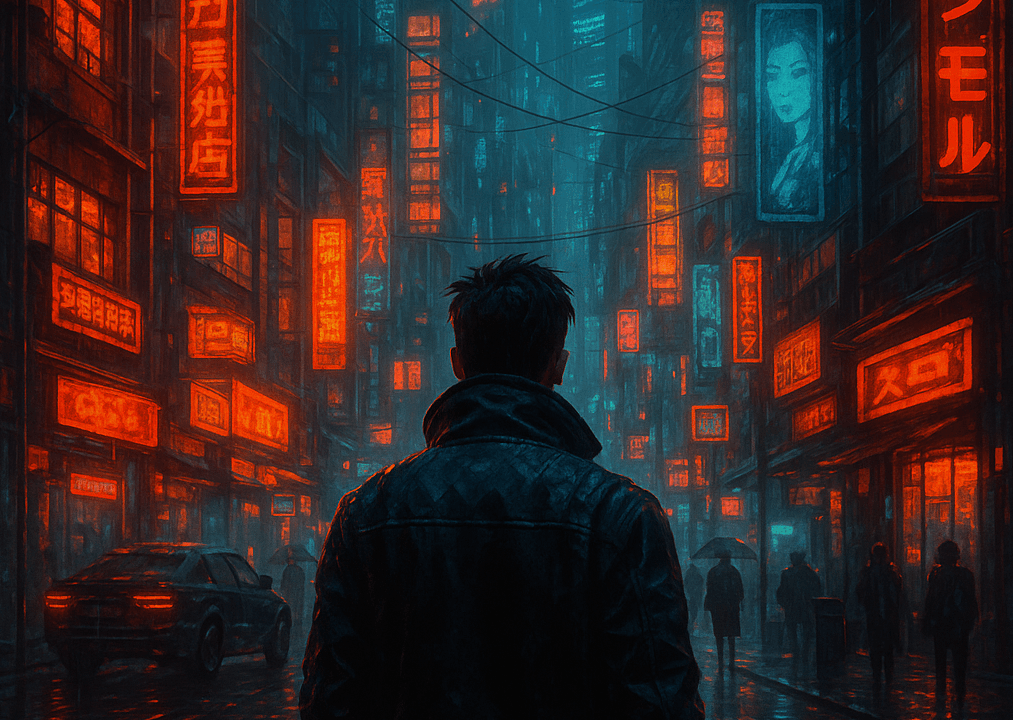
Cyberpunk has always been a prophecy disguised as entertainment. In the 1980s, when William Gibson dropped Neuromancer and Ridley Scott unveiled Blade Runner, the genre declared its manifesto with glowing billboards, synthetic rain, and lonely antiheroes jacked into a network that looked suspiciously like our own internet. Today, the neon has dimmed, but the prophecy lingers. We are left to ask: are we living in a cyberpunk world, or is cyberpunk still the future waiting to happen?
The word “cyberpunk” first appeared in Bruce Bethke’s short story published in 1983 in Amazing Science Fiction Stories. Bethke later admitted he invented the term by smashing together “cybernetics” and “punk” to describe teenage computer rebels. It was editor Gardner Dozois of Isaac Asimov’s Science Fiction Magazine who popularized the label. But it was William Gibson who gave it flesh and blood.
When Gibson released Neuromancer in 1984, he introduced cyberspace, a “consensual hallucination experienced daily by billions.” That phrase became the metaphor we now use to describe the internet itself. Alongside Gibson stood Bruce Sterling, Pat Cadigan, Rudy Rucker, and John Shirley—the so-called Mirrorshades group—who envisioned futures not in the stars, but in urban sprawls, megacorporations, and machines stripping away privacy. Sterling edited the anthology Mirrorshades (1986), often treated as the cyberpunk manifesto.
Gibson, in interviews with Wired magazine during the 1990s, emphasized that he wasn’t predicting the future so much as remixing the present, showing how technology reshapes power. His pessimism resonated with readers who had grown cynical about utopian sci-fi and skeptical of Reagan-era neoliberal promises.
Visions in neon
On film, Ridley Scott’s Blade Runner (1982) crystallized the aesthetic. Based loosely on Philip K. Dick’s novel Do Androids Dream of Electric Sheep?, the film turned Los Angeles into a claustrophobic labyrinth of neon, smoke, and perpetual rain. Syd Mead’s production design remains iconic, while Vangelis’ synth score provided an otherworldly soundscape. Critics like Pauline Kael recognized its visionary mood even when audiences were confused. Today, the film is considered a cornerstone of cyberpunk cinema.
Japan carried cyberpunk further, layering social critique with existential angst. Katsuhiro Otomo’s manga and later animated film Akira (1988) imagined Neo-Tokyo as a city reborn from nuclear ruin, with psychic children and militarized police hinting at authoritarian decay. Mamoru Oshii’s Ghost in the Shell(1995) expanded the genre’s philosophy, asking whether identity can survive when consciousness can be copied into machines. As the New York Times noted in its 1996 review, Ghost in the Shell was “a thinking person’s action movie,” prefiguring debates about AI and posthumanism.
Hollywood absorbed these Japanese visions. The Wachowskis’ Matrix trilogy (1999–2003) openly referenced Ghost in the Shell, Gibson’s Neuromancer, and hacker culture. It popularized terms like “red pill” that have since been co-opted far beyond their original context.
Punk in circuits, sound and words
Cyberpunk is not only visual—it has always been sonic. Vangelis’ work on Blade Runner remains the ur-text of cyberpunk soundscapes: synthetic, melancholic, alien. The industrial music movement of the 1980s, with bands like Front 242 and Skinny Puppy, provided the dystopian rhythms that seemed ripped straight from Gibson’s alleys.
In 1993, Billy Idol recorded a concept album titled Cyberpunk. It was derided by critics but notable for being promoted via early internet fan chats on The WELL, decades before social media became routine. As scholar Karen Collins argued in “Dead Channel Surfing” (2005), industrial music and cyberpunk shared thematic concerns: alienation, surveillance, and machine rhythm as rebellion.
The soundtrack of dystopia was never acoustic; it was always plugged in, distorted, synthesized. Even today, electronic artists like Perturbator and Carpenter Brut borrow heavily from cyberpunk imagery, soundtracking a nostalgia for futures that never quite arrived.
The cruelest twist of cyberpunk is how much of it has come true. Look around: the megacorporations are here, only they’re called Apple, Amazon, Google, Tencent, Meta. Their empires stretch across the globe, powered by our data and attention.
Shoshana Zuboff, in her 2019 book The Age of Surveillance Capitalism, argued that corporations now harvest behavioral data to predict and influence our choices. That could have been a Gibson plotline. Instead, it is our reality.
Gig workers on motorbikes wait for food delivery pings in the rain. AI writes news, creates art, and filters resumes. Hackers wage digital wars while governments install spyware into phones, as documented by Citizen Lab’s reports on Pegasus spyware. The “high tech, low life” slogan once used to describe fiction now describes Manila traffic under the glare of LED billboards, while your e-wallet bleeds hidden fees.
A critique wearing cool shades
But cyberpunk was never just about gadgets. It was social criticism wrapped in neon. It asked what happens when deregulation and privatization leave citizens powerless before giant systems. It interrogated identity, race, gender, and class—though often imperfectly.
Feminist scholar Donna Haraway’s “A Cyborg Manifesto”(1985) gave the movement a theoretical lens. Haraway argued that the boundaries between human, animal, and machine were dissolving, and that embracing hybridity could challenge patriarchal systems. This remains one of the most cited texts in science and technology studies, intersecting with cyberpunk’s visions of blurred identities.
The genre’s contradictions persist. It romanticizes the rebel hacker but warns that rebellion may be futile. It fetishizes neon cityscapes even as it critiques them. As Fredric Jameson once warned, late capitalism tends to commodify even its critiques, turning rebellion into wallpaper. Cyberpunk’s imagery is now used to sell smartphones and luxury fashion, stripped of its subversive edge.
Curiously, cyberpunk endures because it speaks to the unease of digital living. The internet is not the utopian commons once promised—it is a corporate maze, gamified and surveilled. Cyberpunk predicted the masks we wear online, the blurred line between avatar and self, and the illusion of freedom in walled gardens.
Gamers explore these anxieties in role-playing worlds like R. Talsorian’s Cyberpunk 2020, FASA’s Shadowrun, and CD Projekt Red’s troubled but ambitious video game Cyberpunk 2077. Each retells the same fable: technology liberates but also enslaves. We crave implants, connectivity, and digital escape, even as we fear the loss of autonomy.
Punk as prophecy living the neon nightmare
The irony is that cyberpunk was once considered niche, even disreputable. Today, it is mainstream. Its visuals dominate video games, anime, advertising, and streaming platforms. Its language shapes how we discuss AI, virtual reality, and biohacking. But to embrace only the style without the politics is to miss the point.
Cyberpunk’s agenda was always to expose power. Its antiheroes are not space explorers but street-level survivors navigating systems too big to fight. The lesson is clear: don’t worship the neon skyline—interrogate the system behind it.
So, are we living in cyberpunk times? The answer is yes—and no. The corporations, surveillance, and AI are real. The dystopia is creeping. But unlike the characters in Gibson’s Sprawl, we still have agency. Governments can regulate. Citizens can resist. Communities can reclaim technology for collective good. The future is not yet written, and that is the real punk spirit.
Cyberpunk is popular not because it glamorizes despair, but because it helps us see the machinery of control. It gives us a language of resistance. It reminds us that technology is never neutral, that every neon light casts a shadow.
The genre’s enduring question remains ours: will we let the future be built without us, or will we hack back the system before it consumes us entirely?
———-
WATCH TECHSABADO ON OUR YOUTUBE CHANNEL:
WATCH OUR OTHER YOUTUBE CHANNELS:
PLEASE LIKE our FACEBOOK PAGE and SUBSCRIBE to OUR YOUTUBE CHANNEL.
PLEASE LIKE our FACEBOOK PAGE and SUBSCRIBE to OUR YOUTUBE CHANNEL.




1 thought on “BURNING CHROME | Cyberpunk: Neon dreams, dark realities”