BURNING CHROME | SW: Ghost signals and the voices that won’t fade
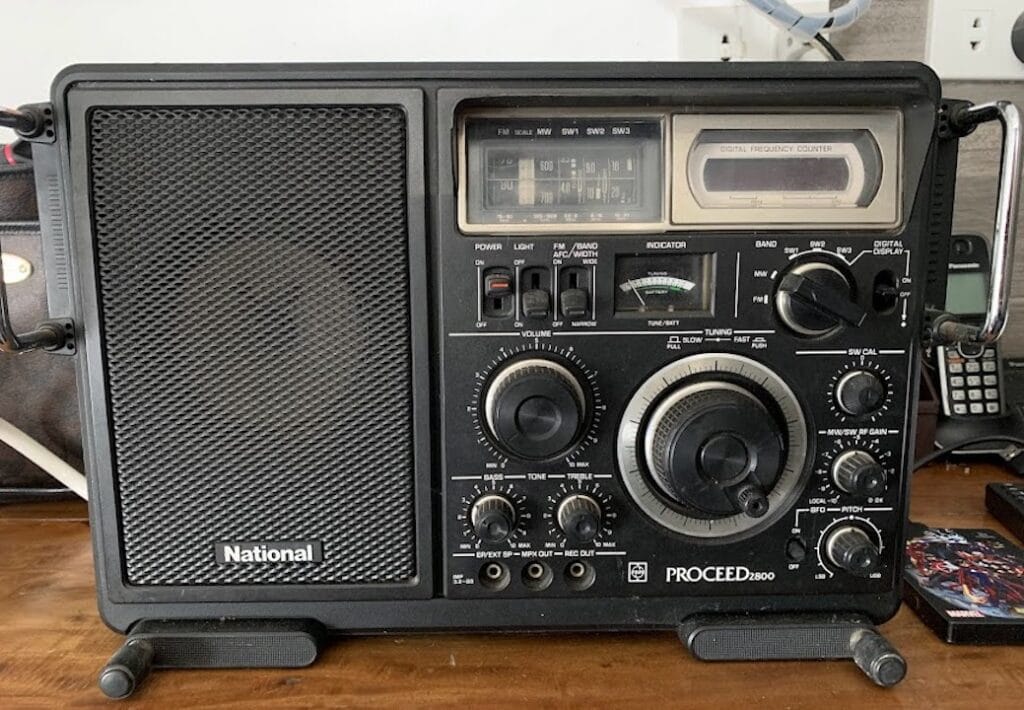
There was a time when the world didn’t tune in through fiber-optic cables or endless social media feeds, but through the static-soaked hiss of shortwave radio. Out in the provinces, DX’ers hunched over their sets; at sea, sailors leaned toward their receivers; even border guards paused to catch a drifting broadcast. Everyone twisted those stubborn dials, chasing a faint voice skipping across the ionosphere, carrying news, music, or a piece of someone else’s night from thousands of miles away.
In today’s hyper-digital Philippines, shortwave feels like an antique. But listen closely — those ghost signals still crackle on the dial, carrying voices of propaganda, resistance, and survival.
Shortwave wasn’t meant to be revolutionary. In the early 20th century, engineers dismissed frequencies above 1.5 megahertz as “useless.” They thought long waves were the future. But Marconi and other radio pioneers discovered that the Earth’s charged atmosphere could bend and bounce signals across oceans.
By the 1920s, experiments from Cornwall to Manila revealed that a modest transmitter could leapfrog continents. A global communications medium was born — not through grand design but by listening to the sky itself.
The Philippines and the shortwave age
For the Philippines, shortwave meant something bigger: connection. Manila became a listening post, both as a colony and later as an independent republic. Before satellites, before cable TV, the archipelago’s gateway to the wider world was often through the hum of shortwave bands.
I remember tuning in to shortwave radio on my old Sanyo boombox inside my small cave of a room at our QC home in the late ’70s through the mid-’80s. I’d collect those coveted QSL cards from distant stations in Europe and South America, each one confirming that their signal had somehow reached me. That same Sanyo became my lifeline to international news — especially BBC London and NHK Japan — during the coup d’état in the capital, and again in 1990 when a powerful earthquake struck Luzon and the power went out.
Radyo Pilipinas, the government’s voice to the world, began broadcasting internationally in 1933. Its transmitters in Malolos and Quezon City beamed Filipino news, music, and culture into Asia and the Middle East. Overseas workers — long before they were called OFWs — could tune in from foreign lands and hear voices from home.
During the Marcos dictatorship, shortwave played a darker, double role. The regime used Radyo Pilipinas as a propaganda tool. At the same time, Filipinos secretly tuned in to the BBC, Voice of America, or Radio Australia for unfiltered reports about the unfolding crisis at home. Shortwave was the VPN of its day — a way to bypass censorship when information itself was a battleground.
Globally, shortwave reached its brutal peak during war. In World War II, soldiers on both sides huddled around radios. The BBC’s Empire Service brought courage to occupied Europe, while Japan’s Radio Tokyo broadcast English-language propaganda aimed at Allied troops in the Pacific.
Then came the Cold War. The Soviet Union and the United States escalated into a broadcasting arms race. Moscow’s booming transmitters hurled Communist rhetoric across continents. Washington countered with the Voice of America, Radio Free Europe, and Radio Liberty, feeding uncensored news into the Eastern bloc.
Numbers stations added a layer of paranoia — eerie voices reading endless strings of digits, believed to be coded instructions for spies. Even today, hobbyists swear they can still hear them on certain bands, like ghosts that refuse to fade.
The SWL subculture
The rise of the SWL — shortwave listener — was inevitable. Here in the Philippines, university students and hobbyists spent nights spinning dials, trying to pull in faint signals from Berlin or Buenos Aires. They called themselves DXers, always chasing the farthest signal. Like me, they mailed out QSL reception reports, hoping for that prized card in return — tangible proof that a voice from the other side of the world had briefly found its way home.
A decent Sony or Grundig set was the passport. With nothing but wire strung across a bamboo pole, a DXer in Quezon City could log the BBC in London or a clandestine broadcast from Taiwan. In a nation of islands, where isolation was a given, shortwave offered the thrill of belonging to a global conversation.
But technology never stands still. By the 1990s, the internet and satellite television began dismantling shortwave’s dominance. Streaming killed the static. Governments decided it was cheaper to push podcasts than to power up massive transmitters that guzzled electricity.
Deutsche Welle, Radio Canada International, and many others signed off for good. Even the BBC scaled back, cutting entire regions from its once-global footprint. For a while, shortwave seemed doomed to vanish into nostalgia, like vinyl or Betamax.
———-
WATCH TECHSABADO ON OUR YOUTUBE CHANNEL:
WATCH OUR OTHER YOUTUBE CHANNELS:
PLEASE LIKE our FACEBOOK PAGE and SUBSCRIBE to OUR YOUTUBE CHANNEL.
PLEASE LIKE our FACEBOOK PAGE and SUBSCRIBE to OUR YOUTUBE CHANNEL.
Still alive, still useful
Yet here in 2025, shortwave still breathes. Why? Because in places where censorship reigns, or when disaster wipes out the grid, the sky remains free.
When Russia invaded Ukraine, the BBC quietly reactivated shortwave transmissions into Eastern Europe. In North Korea, shortwave remains a lifeline for defectors and those seeking a glimpse of the outside world. In parts of Africa, shortwave is still how communities get their news.
Closer to home, Radyo Pilipinas still beams across Asia, Europe, and the Middle East — a reminder that the Philippine government sees value in a voice that no firewall can silence. Fishermen in Mindanao keep radios for weather updates. Rural families, cut off by typhoons, can still find broadcasts on battered transistor sets when cell towers are down.
Some names never left the airwaves. The BBC World Service remains the gold standard. Voice of America, Radio France Internationale, and All India Radio still maintain shortwave services. Voice of Indonesia broadcasts in a dozen languages. And North Korea’s Voice of Korea continues blasting propaganda on multiple frequencies.
Even time signal stations — like WWV in the United States and CHU in Canada — tick steadily on, regulating clocks and navigation systems with atomic precision.
The listener today
The modern SWL is different. Some still use analog portables, but many have shifted to software-defined radios — tiny USB dongles that let laptops or even smartphones sweep the bands. Websites stream live shortwave catches for those without gear. DXing has gone digital, but the thrill remains: catching a faint signal from half a world away.
It’s no longer about mass audiences. It’s about resilience, nostalgia, and the stubborn magic of a medium that refuses to vanish.
Shortwave is no longer the world’s main stage. It’s a back alley, a parallel universe humming with propaganda, prayers, and pirate DJs. But it is not dead. Its greatest strength remains what made it revolutionary a century ago: independence.
It doesn’t need satellites. It doesn’t need fiber. It doesn’t care if your government censors the web. All you need is an antenna, a cheap radio, and the open sky.
In a Philippines battered by typhoons and authoritarian flirtations, that stubborn independence still matters. The static may be thick, the voices faint, but the message remains clear: the airwaves are still free, and somewhere, someone is still listening.
WATCH TECHSABADO ON OUR YOUTUBE CHANNEL:
WATCH OUR OTHER YOUTUBE CHANNELS:
PLEASE LIKE our FACEBOOK PAGE and SUBSCRIBE to OUR YOUTUBE CHANNEL.
PLEASE LIKE our FACEBOOK PAGE and SUBSCRIBE to OUR YOUTUBE CHANNEL.