SPECIAL FEATURE | 5G evolution and the road to 6G
AI-generated graphics
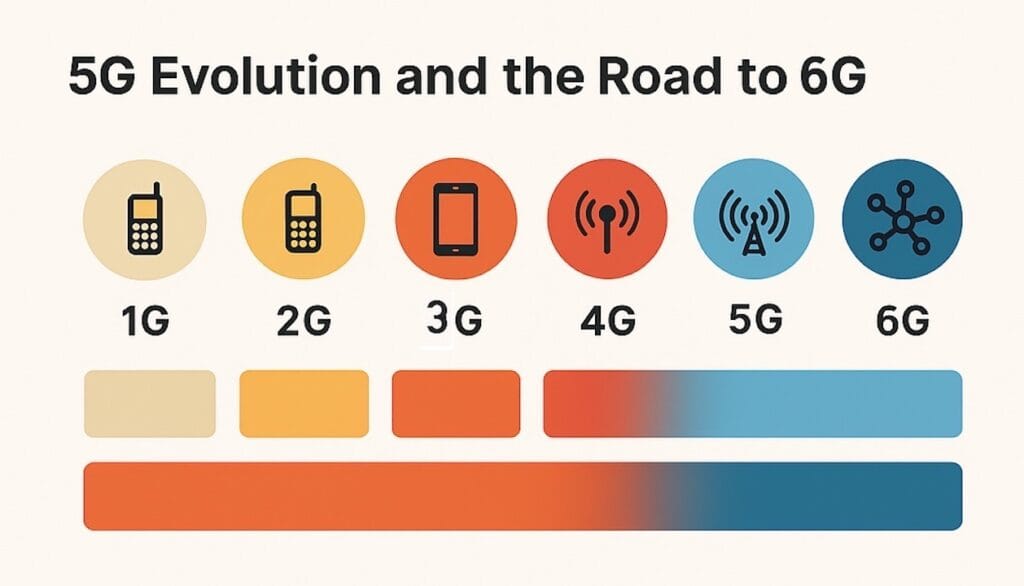
The story of mobile communications has always been about crossing thresholds every decade. In 1979, NTT launched the world’s first cellular system. Since then, each generation—1G to 4G—has pushed the limits of how humans connect. From the era of clunky car phones and SMS, the world moved to mobile multimedia with 3G and then to the smartphone explosion under 4G LTE. By 2020, the commercial rollout of 5G marked a new phase, one defined by high capacity, ultra-low latency, and the ability to connect massive numbers of devices.
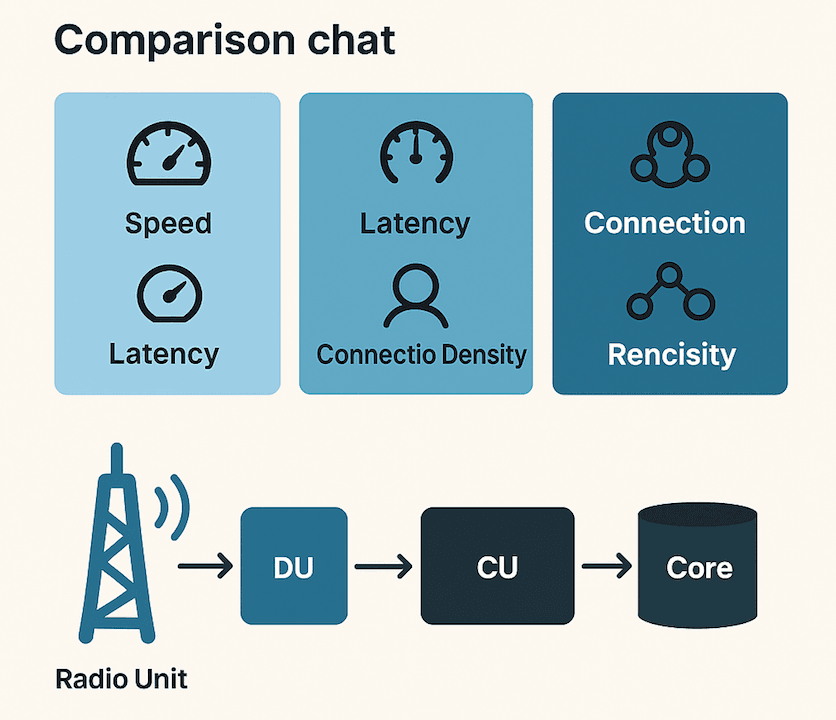
What makes 5G different is that it is not only about faster consumer downloads. The network is designed as a backbone for emerging digital industries, the Internet of Things (IoT), and artificial intelligence. According to EXFO, 5G enables throughput 25 times greater than 4G, latency cut to one-twenty-fifth, and 500 times more device density. That leap makes possible real-time VR, autonomous driving, remote surgery, and billions of IoT connections.
Samsung described 5G as the foundation for “immersive multimedia” and “ubiquitous connectivity,” foreseeing UHD streaming, augmented and virtual reality, smart homes, connected cars, and healthcare sensors. Those scenarios, once futuristic, now define the benchmarks operators are racing to deliver.
The architecture of change
The move from 4G to 5G has been less a leap than a staged evolution. Early deployments relied on a non-standalone architecture, where 5G radios piggybacked on 4G cores to boost speed but still depended on LTE for uplinks. The shift to standalone 5G, with a new core network, unlocked the promise of ultra-reliable low-latency communications (URLLC) and massive machine-type communications (mMTC).
This new network architecture broke down into three core elements: the radio unit (RU), distributed unit (DU), and centralized unit (CU). Connected by high-capacity Ethernet protocols, these layers allow operators to tune deployments for latency, coverage, and throughput. On top of this, mobile edge computing pushes processing power closer to users, lowering delays while reducing strain on the core.
The Next Generation Mobile Networks Alliance, which defined much of the 5G vision as early as 2015, stressed that 5G was not just a new radio interface but a complete end-to-end platform. Its goal was to enable a “fully mobile and connected society,” with flexibility, energy efficiency, and the ability to support radically different use cases—from industrial automation to ultra-low-cost connectivity in developing regions.
Toward 6G and cyber-physical fusion
But 5G is only the midpoint. NTT DOCOMO projects that a third wave of innovation will arrive in the 2030s, driven by what it calls 5G Evolution and 6G. The vision is not incremental. It imagines networks that act as a nervous system for a cyber-physical world, where artificial intelligence builds digital twins of reality, simulating outcomes, solving problems, and even predicting futures.
DOCOMO defines six extreme requirements for 6G: ultra-high speed and capacity, extreme coverage including satellites and non-terrestrial networks, drastic power and cost efficiency, millisecond-level latency, rock-solid reliability, and massive connectivity combined with sensing. In such a system, uplinks—devices sending information to the cloud—become as critical as downlinks.
The use cases point to a fusion of communications and cognition. Researchers foresee non-verbal communication through brain interfaces, haptic sharing of actions and emotions across distance, and recognition of objects and textures in real-time augmented reality. Wireless signals may no longer simply connect phones but mediate human thought, senses, and even wellbeing.
For operators and industries, this roadmap means investing not just in antennas and spectrum but in entire ecosystems of AI, edge computing, and sensing. Spectrum allocations are already being eyed for frequencies beyond 100 GHz, while research explores distributed antennas, reconfigurable intelligent surfaces, and joint communication-sensing systems.
The white papers make clear that the coming decade is not about a static “5G” but a continuum: 5G Evolution through advanced releases like 5G-Advanced, then a transition to 6G. As the NGMN Alliance wrote, enabling this future requires global coordination on spectrum, standards, and intellectual property, as well as business models that can sustain the infrastructure demands.
The 5G era has dawned, but the sixth generation is already on the horizon. In the words of DOCOMO, mobile communications will not only deliver faster speeds but also “resolution of social issues and human-centered value creation.” That may sound visionary, but if the past forty years of wireless history are a guide, the network of the 2030s will again redefine how humans live, work, and think.
———-
WATCH TECHSABADO ON OUR YOUTUBE CHANNEL:
WATCH OUR OTHER YOUTUBE CHANNELS:
PLEASE LIKE our FACEBOOK PAGE and SUBSCRIBE to OUR YOUTUBE CHANNEL.
PLEASE LIKE our FACEBOOK PAGE and SUBSCRIBE to OUR YOUTUBE CHANNEL.