OP-ED | The false binary of anonymity online
Anonymity online is not an accident of poor regulation. It is a design condition that has existed since the earliest networked spaces.
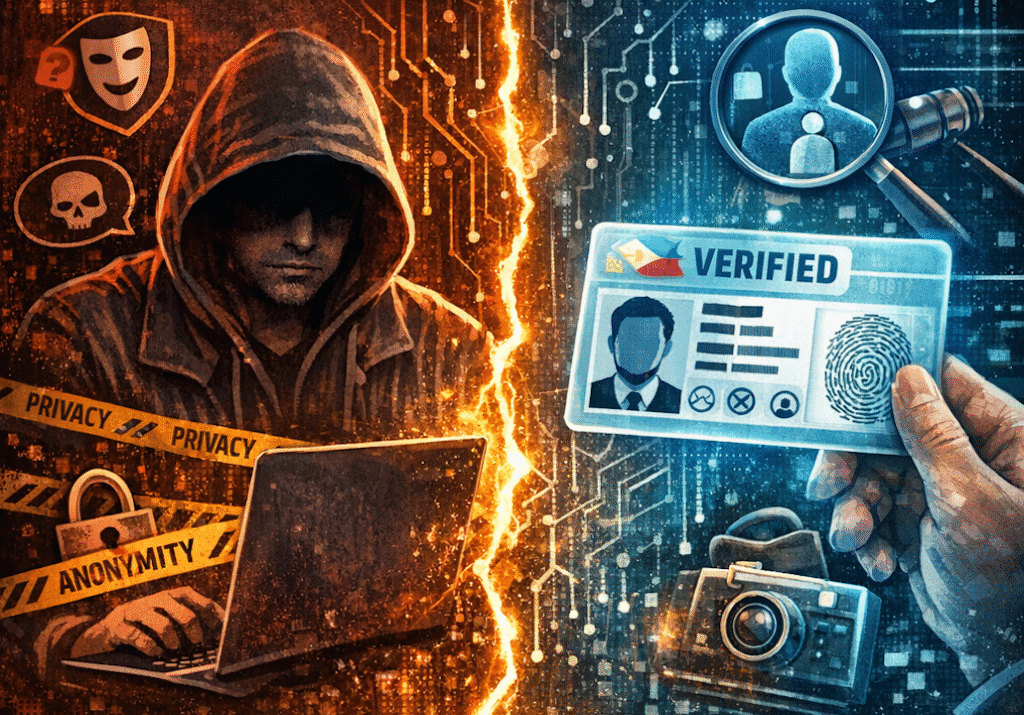
The Department of Information and Communications Technology’s (DICT) proposal to require social media user verification rests on a familiar premise: If everyone is identifiable, online harm will subside. Trolls will vanish, disinformation will retreat, and accountability will follow. It is an appealing narrative. It is also structurally flawed.
Anonymity online is not an accident of poor regulation. It is a design condition that has existed since the earliest networked spaces. Bulletin boards, IRC channels, forums, and early blogs relied on pseudonymity not to evade responsibility but to enable participation. It lowered barriers to entry. It allowed people to speak without credentials, status, or institutional backing. In uneven democracies, anonymity has never been theoretical. It has been protective.
The DICT proposal treats anonymity as the root cause of abuse. This confuses correlation with causation. Most large-scale online harm today is not spontaneous or truly anonymous. Troll operations are coordinated. Scam networks are systematic. Disinformation campaigns leave behavioral, financial, and infrastructural traces that platforms already know how to detect when they choose to. These are failures of enforcement and incentives, not identity.
Mandatory verification does not eliminate bad actors. It redistributes risk. It shifts exposure from platforms and institutions to ordinary users. Verification systems create centralized identity repositories—high-value targets in a country where data breaches are routine and accountability is inconsistent. When these systems fail, the damage is not abstract. It is personal, persistent, and irreversible.
There is also a quiet redefinition of power underway. Verification does not end anonymity; it privatizes it. Users may remain pseudonymous to the public, but their identities become legible to platforms and, through formal or informal channels, to the state. This fundamentally alters the relationship between citizens, platforms, and government without a corresponding expansion of safeguards, transparency, or redress mechanisms.
The argument that “law-abiding users have nothing to fear” misses the point. Rights are not designed for the compliant majority. They exist to protect edge cases: journalists, whistleblowers, labor organizers, activists, LGBTQ individuals, and politically inconvenient citizens. For these groups, anonymity is not about misbehavior. It is about survival. Remove that layer and participation does not become healthier. It becomes narrower.
Yes, anonymity carries risks. It lowers social friction. It can amplify cruelty and abuse. The online disinhibition effect is real. But framing anonymity as the primary villain is a category error. Harm flourishes because platforms reward outrage, algorithms amplify engagement regardless of truth, and governance lags behind scale. Identity checks do not correct these dynamics. They merely make attribution easier after harm has already occurred.
A more serious policy response would start elsewhere. It would require transparency around algorithmic amplification. It would impose meaningful penalties on coordinated inauthentic behavior regardless of account status. It would strengthen data protection regimes before expanding data collection. It would treat digital literacy as infrastructure, not a slogan. Most importantly, it would assess impact from the perspective of the most vulnerable users, not the most convenient administrative solution.
Verification promises accountability but delivers exposure. It assumes that naming people fixes systems, when history shows the opposite: weak systems paired with strong surveillance tend to discipline the public, not the powerful.
The real question is not whether the internet needs rules. It does. The question is whose risk is reduced and whose is increased when visibility becomes mandatory. If the answer is that ordinary users must surrender safety so institutions can avoid deeper reform, then the proposal is not a solution. It is displacement.
Before requiring citizens to prove who they are online, the state would do better to prove that the system itself deserves that level of trust.
————————————————————————-
WATCH TECHSABADO ON OUR YOUTUBE CHANNEL:
WATCH OUR OTHER YOUTUBE CHANNELS:
PLEASE LIKE our FACEBOOK PAGE and SUBSCRIBE to OUR YOUTUBE CHANNEL.
PLEASE LIKE our FACEBOOK PAGE and SUBSCRIBE to OUR YOUTUBE CHANNEL.