CES 20206 | Hybrid AI push accelerates as enterprise, edge, consumer systems converge
Announcements made during technology briefings in Las Vegas outlined how AI is moving beyond large-model training toward inferencing.
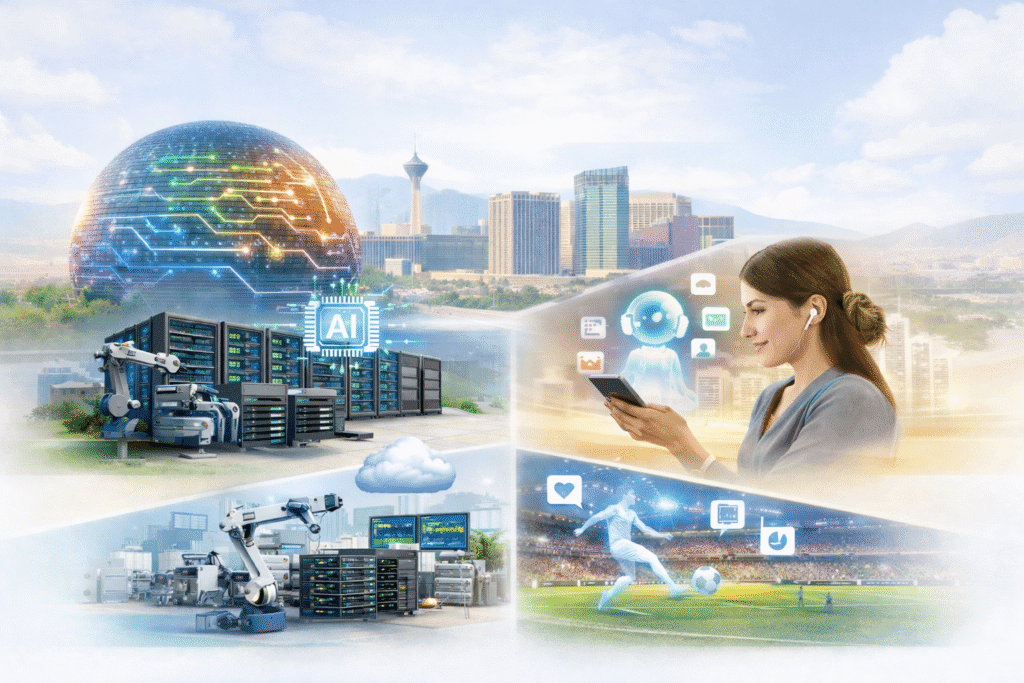
Artificial intelligence is shifting decisively from experimentation to execution, with new systems unveiled at CES 2026 signaling a broad industry push toward real-time, deployable AI across enterprise infrastructure, edge environments and personal devices.
Announcements made during technology briefings in Las Vegas outlined how AI is moving beyond large-model training toward inferencing — the stage where trained models analyze live data and produce immediate decisions. The shift reflects growing pressure on organizations to translate heavy AI investments into measurable operational and economic returns.
Analysts estimate the global AI inferencing infrastructure market could grow nearly tenfold by the end of the decade, driven by demand from sectors such as retail, manufacturing, health care, telecommunications and financial services. Unlike model training, which is typically centralized and compute-intensive, inferencing increasingly happens closer to where data is generated — in data centers, factories, hospitals and even storefronts.
From training to action
Industry executives framed inferencing as the missing link between AI potential and business value. By running trained models across cloud, data center and edge environments, enterprises can react to events as they occur — from detecting fraud in transactions to supporting real-time diagnostics in critical care.
To support this shift, new server platforms were introduced that emphasize high-density GPU compute, expanded memory and advanced networking, tailored for inferencing workloads rather than model development alone. Compact edge systems were also highlighted, designed to operate in constrained or harsh environments such as retail outlets, telecom sites and industrial facilities.
Cooling efficiency and power consumption emerged as recurring themes, as organizations struggle with the energy demands of AI workloads. Liquid and hybrid cooling technologies were positioned as key enablers for sustained performance, particularly as inferencing moves into environments not originally designed for high-performance computing.
Modular AI factories
Beyond hardware, vendors emphasized pre-integrated platforms that combine servers, storage, networking, orchestration software and services into modular “AI factory” frameworks. These systems aim to shorten deployment timelines, reduce configuration risks and standardize AI operations across organizations.
Several platforms showcased partnerships with virtualization, Linux and AI software ecosystems, allowing enterprises to run shared inferencing services, maximize GPU utilization and scale agentic AI applications. Cost control was positioned as a core selling point, with consumption-based pricing models promoted as a way for organizations to scale AI capacity without large upfront capital expenditure.
Professional services also featured prominently, reflecting a growing recognition that AI adoption is as much an organizational challenge as a technical one. Advisory, deployment and managed services were presented as tools to help enterprises assess readiness, tune performance and operate AI systems over time.
Personal AI enters the spotlight
While enterprise AI dominated the conversation, CES 2026 also marked a push toward more autonomous, personalized AI experiences at the device level. Demonstrations highlighted “personal AI agents” designed to operate across smartphones, PCs and other consumer devices, adapting to user behavior and context.
These agents were positioned as proactive assistants capable of coordinating tasks, surfacing information and interacting with enterprise systems, blurring the line between consumer and workplace AI. The approach reflects a broader trend toward hybrid AI architectures, where intelligence is distributed across devices, edge systems and cloud platforms rather than centralized in a single location.
AI at global-scale events
AI’s operational role at global-scale events was also underscored, with upcoming international sports tournaments cited as examples of how real-time analytics, computer vision and automation can enhance broadcasting, security and fan engagement. Such deployments highlight the growing maturity of AI systems capable of operating reliably under massive, real-world loads.
A pragmatic phase for AI
The announcements at CES 2026 suggest the AI industry is entering a more pragmatic phase. The focus is shifting from headline-grabbing model sizes to questions of deployment, efficiency, governance and return on investment.
For enterprises, the message was clear: AI’s value increasingly depends on where and how it runs, not just how advanced the model is. For consumers, the emergence of personal AI agents hints at a future where AI becomes less visible but more embedded in daily workflows.
As organizations grapple with skills gaps, energy constraints and integration challenges, the coming year is likely to test whether hybrid, inferencing-first strategies can deliver on AI’s long-promised productivity gains — or whether the next bottleneck will be organizational rather than technical.
————————————————————————-
WE ARE 10 YEARS OLD! TEN YEARS OF TECHSABADO, IMAGINE THAT.
WATCH TECHSABADO ON OUR YOUTUBE CHANNEL:
WATCH OUR OTHER YOUTUBE CHANNELS:
PLEASE LIKE our FACEBOOK PAGE and SUBSCRIBE to OUR YOUTUBE CHANNEL.
PLEASE LIKE our FACEBOOK PAGE and SUBSCRIBE to OUR YOUTUBE CHANNEL.