AWARDS | NEC C&C Prize recognizes optical clock, AI research pioneers
The awards ceremony is scheduled for Nov. 30 at the ANA InterContinental Tokyo, beginning at 3 p.m. Japan Standard Time.
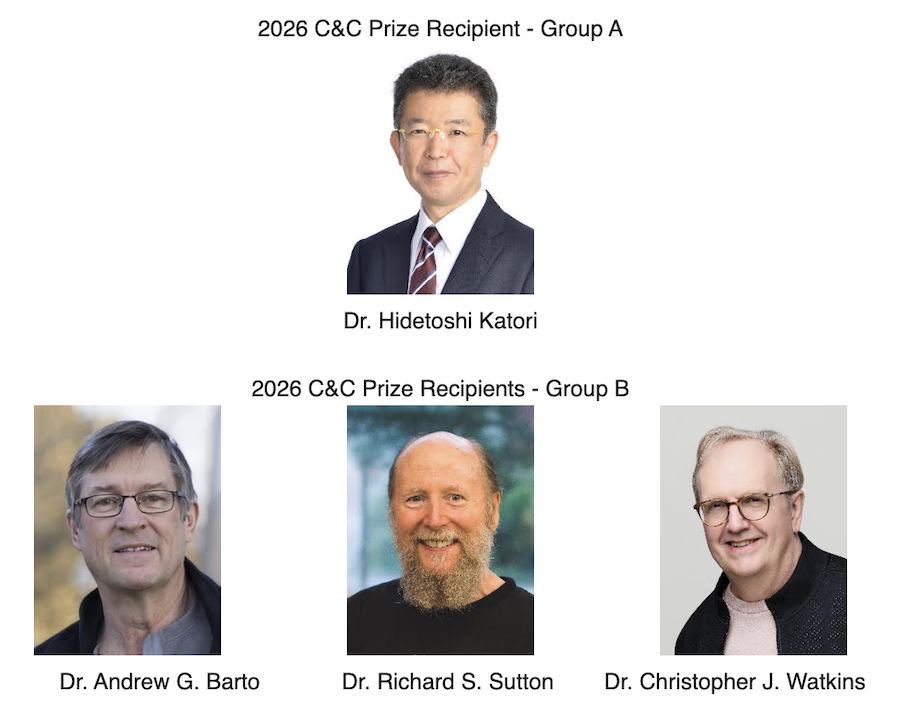
The NEC C&C Foundation will award its 2026 C&C Prize to four researchers for contributions to optical lattice clocks and reinforcement learning, recognizing advances in precision timekeeping and artificial intelligence.
Announced in Tokyo on Oct. 15, the awards will honor Hidetoshi Katori, a professor at the University of Tokyo, for his work on optical lattice clocks, and Andrew G. Barto, Richard S. Sutton and Christopher J. Watkins for establishing concepts and algorithms that underpin reinforcement learning.
Each of the two recipient groups will receive a certificate of merit, a plaque and a cash award of 10 million yen.
The awards ceremony is scheduled for Nov. 30 at the ANA InterContinental Tokyo, beginning at 3 p.m. Japan Standard Time. The ceremony and recipient lectures will also be streamed online. Registration for in-person and online participation is available through the foundation’s official website.
Optical clocks advance precision timekeeping
Katori, who also directs the Spacetime Engineering Research Team at the RIKEN Center for Advanced Photonics, will receive the Group A award for pioneering contributions to the realization of the optical lattice clock.
Conventional atomic clocks use microwave frequencies associated with cesium-133 atoms to define the second. Optical atomic clocks use much higher-frequency transitions in atoms, potentially allowing more precise time measurement.
Katori proposed the optical lattice clock, which traps large numbers of atoms in a lattice formed by laser light and measures their optical transition frequencies simultaneously. His work established a timekeeping system with precision that surpasses conventional atomic clocks, according to the foundation.
His research also extends to relativistic geodesy, which uses differences in clock rates caused by variations in gravitational potential to measure differences in elevation and gravity. The approach could support spacetime sensing to monitor changes such as crustal deformation and volcanic activity.
The foundation said Katori’s work combines laser, photonics, electronic control, vacuum and cooling technologies, with potential applications in communications, quantum technology and precision positioning.
Reinforcement learning foundations recognized
Barto, professor emeritus at the University of Massachusetts Amherst; Sutton, a professor at the University of Alberta and founder of Oak Lab Inc.; and Watkins, a professor at Royal Holloway, University of London, will share the Group B award.
The foundation cited their contributions to the conceptual and mathematical foundations of reinforcement learning, a machine learning approach in which an agent learns through interaction with its environment and feedback in the form of rewards.
Unlike supervised learning, which relies on labeled examples, reinforcement learning allows systems to develop strategies through trial and error and optimize decisions for long-term rewards.
Barto and Sutton helped establish key concepts and mathematical foundations for the field, while Watkins developed Q-learning, an algorithm that contributed to the practical application of reinforcement learning.
The approach has since been integrated with deep neural networks to produce deep reinforcement learning, with applications in game-playing systems, communications network control, semiconductor design, logistics and energy management.
Reinforcement learning using human feedback has also become a method for improving generative AI responses, including their safety, reliability and alignment with human intent. The foundation said the technology is expected to remain important in physical AI and next-generation robotics.
Award honors information and communications technology
Established in 1985, the C&C Prize recognizes contributions to research and development in information processing, communications and electronic device technologies, as well as technologies that integrate these fields. It also recognizes social science research related to advances in these areas.
Since its establishment, the prize has been awarded to 85 groups comprising 133 individuals and two teams, according to the foundation.
Full disclosure: All news articles published on the TechSabado website are written by human journalists, unless otherwise specified. Final text editing is also performed by human editors, with artificial intelligence (AI) used only to assist with additional grammar and style guide corrections..
————————————————————————-
TEN YEARS OF TECHSABADO!
PLEASE LIKE our FACEBOOK PAGE and SUBSCRIBE to OUR YOUTUBE & SPOTIFY channels.
WATCH TECHSABADO ON OUR YOUTUBE CHANNEL:
WE ARE ALSO ON SPOTIFY

WATCH OUR OTHER YOUTUBE CHANNELS:
PLEASE LIKE our FACEBOOK PAGE and SUBSCRIBE to OUR YOUTUBE CHANNEL.