BURNING CHROME | Repent, the end is near!
The end, in most traditions, is not final. It is cyclical. One world collapses so another can begin.
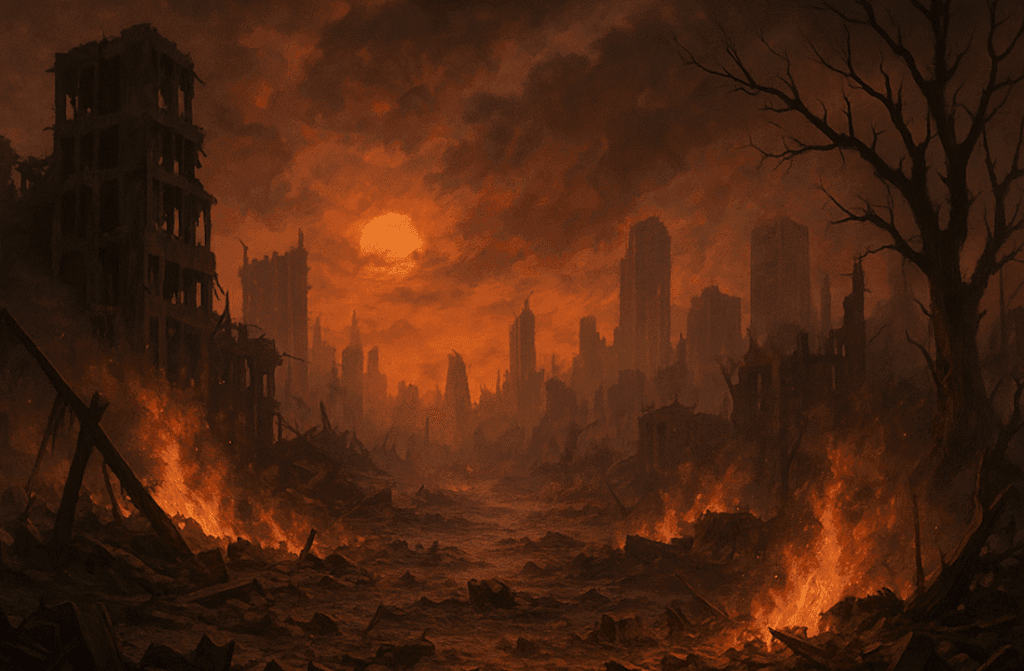
For thousands of years, humanity has looked over its shoulder, convinced that the end is near. The apocalypse has been promised, predicted, postponed, and sold. From the Old Testament prophets to 2012 Maya calendar enthusiasts, from medieval monks to modern YouTube doomsayers, the idea of “the end of days” refuses to die. What it tells us, though, is less about the cosmos and more about ourselves.
Religion gave us the first scaffolding of the apocalypse. Judaism spoke of the End of Days, a Messianic age when the righteous would rise and peace would reign. Christianity cemented its vision in the Book of Revelation, filled with beasts, dragons, and a final battle between good and evil. Islam outlined its own cosmic upheaval before the Day of Judgment, with the false messiah, the return of Jesus, and divine justice.
Other cultures sang different songs but with familiar refrains. Hindus anticipate the end of the Kali Yuga, when Vishnu appears as Kalki to restart the cycle. Norse myth envisioned Ragnarok, where gods die and the world burns before life sprouts again. The Aztecs feared cosmic destruction with each “sun,” while Buddhist texts warned of Dharma’s decline before a future Buddha emerges.
The end, in most traditions, is not final. It is cyclical. One world collapses so another can begin. Apocalypse becomes less an ending than a reset button.
Prophets and profiteers
If history has taught us anything, it is that specific predictions never hold. American preacher William Miller and his Adventist followers expected Christ in 1843 and suffered the “Great Disappointment.” While American Christian radio broadcaster and evangelist Harold Camping twice promised the rapture in 2011 and failed. South Korea’s Dami Mission swore the world would end in 1992. The most recent global panic, the Mayan calendar of 2012, turned out to be nothing more than a misunderstood reset of a calendar cycle.
Each time, believers found ways to explain the failure. Psychologists call it cognitive dissonance reduction. Faith does not collapse under evidence; it adapts. And where there is fear, there is profit. Prophets of doom sell books, sermons, and survival kits. Even Nostradamus, vague as he was, continues to feed an entire industry of retrofitted prophecy.
Strip away the fire and brimstone, and science offers its own catalogue of endings. Climate change threatens to destabilize societies through rising seas, collapsing ecosystems, and extreme weather. The Intergovernmental Panel on Climate Change warns of tipping points we may not be able to reverse.
Nuclear war remains the most obvious apocalypse of our own making. Even a regional conflict could darken skies, trigger nuclear winter, and kill millions. The Cold War showed how close we came; modern arsenals could still erase civilization.
Artificial intelligence is the newest specter. Geoffrey Hinton, one of the pioneers of the field, warned in 2024 of a one-in-five chance AI could wipe us out within the next 30 years. Philosophers such as Nick Bostrom echo the danger of a misaligned superintelligence. The fear is not of machines rebelling like in Hollywood films, but of systems optimized so narrowly that human survival becomes collateral damage.
Cosmic dangers exist too. Asteroids still zip through space, though NASA assures us none large enough to end civilization are on a collision course anytime soon. Over the truly long term, cosmology points to the “heat death” of the universe, trillions of years away. The cosmos, for now, is stable. The real threat remains human behavior.
Israel and Armageddon
Few modern states carry as much eschatological weight as Israel. For some Christians, its re-establishment in 1948 was a direct fulfillment of biblical prophecy. Wars in the Middle East are often cast as preludes to Armageddon, with Jerusalem as the stage. Jews see Israel’s role as restorative rather than apocalyptic, tied to Messianic redemption. In Islam, Jerusalem appears in Hadith describing battles before Judgment Day.
The danger lies not in prophecy itself but in its political consequences. Evangelical support for Israel in U.S. politics, for instance, often carries eschatological undertones. When theology becomes foreign policy, apocalyptic belief stops being abstract. It shapes geopolitics.
The false comfort of fatalism
The idea of an inevitable end has social costs. On one hand, it can inspire urgency. Some argue that if time is short, we must live responsibly. On the other hand, fatalism can be paralyzing. Why fight climate change if God is ending the world anyway? Why push for peace if war is prophecy?
History shows how destructive these beliefs can be. Cults dissolve families, drain bank accounts, and in tragic cases, lead to mass suicides. Governments and media, too, exploit fear for control. The end of the world is a powerful narrative tool.
We should ignore anyone who gives us a date. Every dated prophecy has failed. We should be skeptical of claims that earthquakes or disasters are “increasing” without data. We should be wary of those who profit from panic.
But we should believe the scientists who warn of real risks. Climate models, nuclear arsenals, pandemics, and AI misalignment are not fantasies. They are measurable, observable, and preventable. These risks do not guarantee an end, but they demand action.
Not the End, but an opening
If the end does not arrive—and history suggests it won’t—what then? Humanity continues. We may learn to live within planetary limits, colonize Mars, or merge with machines. Religions will reinterpret their prophecies, as they always have. The myth of the end will not disappear; it will simply take new shapes.
The truth is that apocalypse is not about the future. It is about the present. Our fears of war, technology, and moral decay are projected into cosmic drama. The apocalypse is a mirror.
What matters is not when the world ends but how we live before it does. If the end is not written, then responsibility is ours. We are not waiting for the end. We are writing what comes next.
WATCH TECHSABADO ON OUR YOUTUBE CHANNEL:
WATCH OUR OTHER YOUTUBE CHANNELS:
PLEASE LIKE our FACEBOOK PAGE and SUBSCRIBE to OUR YOUTUBE CHANNEL.
PLEASE LIKE our FACEBOOK PAGE and SUBSCRIBE to OUR YOUTUBE CHANNEL.