TELECOM | PLDT, SMS Global team up to bring Starlink internet to remote communities
The collaboration will use PLDT Satellite Internet through Starlink to support government agencies operating in off-grid locations where traditional connectivity remains limited.
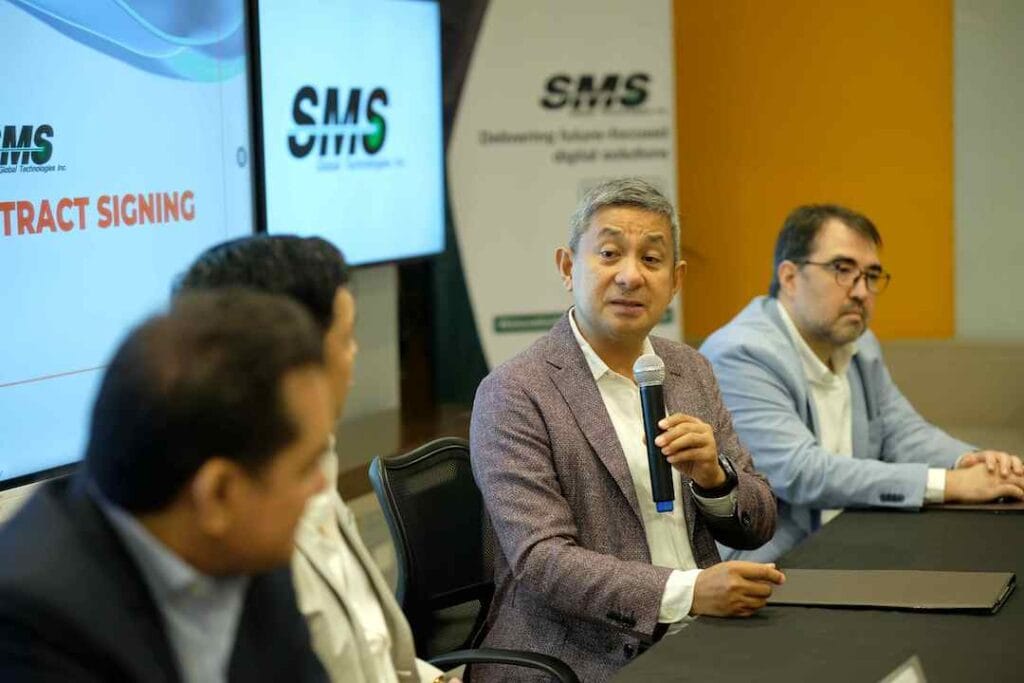
Source: PLDT Enterprise
PLDT Enterprise has partnered with SMS Global Technologies Inc. (SMSGT) to expand satellite-powered internet access to geographically isolated and underserved areas in the Philippines.
The collaboration will use PLDT Satellite Internet through Starlink to support government agencies operating in off-grid locations where traditional connectivity remains limited.
“We’re proud to partner with SMS Global Technologies in enabling mission-critical connectivity that supports national development,” said Blums Pineda, senior vice president and head of Enterprise Business Group at PLDT and Smart. “Through this collaboration, we empower SMS Global Technologies with the tools they need to help government agencies reach and serve Filipino communities and deliver public service more effectively.”
SMSGT, a local systems integrator and technology management firm, will deploy Starlink units for government clients to boost access to reliable, high-speed internet in remote areas.
“We’ve long been looking for a resilient solution that meets the needs of our remote government projects,” said Anthony Christian Angeles, president and CEO of SMSGT. “We were very excited when PLDT Enterprise started offering PLDT Satellite Internet through Starlink. This partnership allows us to fulfill our commitment to digital access in the most underserved areas.”
PLDT Enterprise is the first and only telco in the country authorized to resell Starlink services. The initiative is part of its broader goal to provide scalable connectivity solutions while supporting national development and global efforts toward bridging digital inequality.
6G is coming—but are we ready?
by Jing Garcia
When fifth-generation, or 5G, mobile technology was first rolled out a few years back, the promise was transformative: superfast download speeds, ultra-low latency, and networks that could carry not just human conversations but entire industrial systems. In many ways, 5G delivered. It enabled remote work, real-time streaming, and paved the way for smart factories, logistics, and even urban planning powered by live data.
But just as the world continues to grapple with patchy 5G coverage and the costs of deployment, the next big leap is already on the horizon. Sixth-generation wireless technology, or 6G, is no longer science fiction. The industry, from equipment vendors to regulators, is actively sketching what the network of 2030 and beyond will look like.
The question is no longer if 6G will come. It’s how it will reshape societies—and whether countries like the Philippines are prepared for yet another seismic shift in connectivity.
A vision beyond speed
Ericsson’s March 2023 white paper on spectrum framed 6G as more than just a speed boost. “Future 6G networks will open new technological possibilities for immersive, ubiquitous, and sensory digital experiences,” the Swedish vendor wrote. “The Internet of Senses has the potential to greatly reduce the need to travel for work, leisure, education, or health care, and therefore contribute significantly to reducing greenhouse gas emissions, delivering a massive societal impact.”
That phrase—the Internet of Senses—is not a marketing gimmick. It encapsulates the idea of extending communication beyond sight and sound. Imagine networks that transmit touch, texture, even smell. In Ericsson’s vision, these capabilities could drive advances in remote surgery, inclusive hybrid learning, and immersive entertainment.
Qualcomm, in its December 2022 study on the path to 6G, described the technology as “a smart, wireless communication fabric that connects people and things, and also as a platform that can sustain the continued expansion of the connected intelligent edge.” The American chipmaker added, “6G will fully unleash the synergistic potential of artificial intelligence, integrated sensing, and novel green technologies.”
If 5G created the backbone for the so-called Internet of Things, 6G wants to blur the line between physical and digital altogether. Digital twins of entire cities, real-time holographic meetings, and distributed AI running seamlessly from cloud to device are just some of the scenarios.
The 2030 target
Global standardization typically runs in decade-long cycles. Third-generation (3G) defined mobile internet. Fourth-generation (4G LTE) brought us the smartphone era. Fifth-generation (5G) is still rolling out worldwide. The International Telecommunication Union (ITU) has already set the framework for IMT-2030, which will define 6G’s technical requirements.
Qualcomm noted in its paper that “official specifications work on 6G standards will start around 2025,” with the first completed standard expected by 2028 to enable commercial launches in 2030. Trials and interoperability tests will happen in the late 2020s.
South Korea’s SK Telecom, in its 2024 white paper, put it bluntly: “The 6G Framework Recommendation emphasizes the importance of ubiquitous intelligence as an overarching aspect for 6G, and it is vital to consider a balance between connectivity and AI when designing the 6G architecture.” In Seoul’s view, artificial intelligence is not an add-on but the very foundation of the next network generation.
China, Japan, the European Union, and the United States are investing billions in research. In Asia, the Next G Alliance, the Hexa-X project in Europe, and industry forums like the Brooklyn 6G Summit are laying the groundwork.
Here in ASEAN, the conversation is quieter. Singapore is participating in international projects. Vietnam has announced ambitions to be a 6G developer by 2030. But countries like the Philippines are still catching up with 5G, let alone charting a course for its successor.
The limits of 5G
The irony is that 5G itself has not yet reached its full potential in Southeast Asia.
As Ericsson observed in its spectrum paper, “5G is still in its early phase and is ramping up even faster than previous generations of cellular communication. While there are multiple waves of deployments and upgrades yet to happen in many parts of the world, the ICT industry, academia, and standardization bodies have already begun to discuss and invest in new technologies to power the next generation.”
In the Philippines, Smart Communications claims to have more than 7,000 5G sites nationwide. Globe has also expanded aggressively in major urban centers. Dito Telecommunity and Converge ICT are testing fixed-wireless 5G for homes and enterprises.
But ask a subscriber in the provinces, and the story is uneven. Coverage gaps remain wide. Device affordability is a barrier. And many enterprise applications—smart factories, logistics networks, precision agriculture—are still in pilot stages.
This raises a thorny issue: Can the Philippines, still climbing the 5G adoption curve, leapfrog into 6G when the time comes?
Spectrum: The lifeblood
Spectrum is always the bottleneck.
Ericsson estimates that immersive 6G use cases such as holographic communication and massive digital twins could require up to 3 gigahertz of wide-area spectrum—a demand far beyond what most regulators are prepared to allocate.
“The additional spectrum from within the 7–15 GHz range is necessary to realize the capacity-demanding use cases in future 6G networks,” the company warned. “Mobility and coverage restrictions would deprive such use cases of their full potential and value to society.”
Qualcomm echoed this, stressing the importance of new spectrum bands: “By opening up bands in the 7 to 16 GHz range for mobile communications, 6G operations would combine the best of both worlds: the wide-area coverage of sub-7 GHz spectrum and the extreme capacity of mmWave.”
In short, without timely and harmonized spectrum planning, 6G will remain a dream.
The AI-native network
If there is one common thread across all vendor visions, it is that 6G will be AI-native.
ZTE’s February 2025 white paper on AI Core technology argued that “the integration of communication and AI has prompted global mobile network researchers to consider what new characteristics networks should possess as future communication paradigms evolve from ‘Internet of Everything’ to ‘Intelligent Internet of Everything.’”
SK Telecom went further: “AI-native networks can include functions such as autonomous network management, intelligent traffic management, prediction and analytics, network security enhancement, and energy efficiency management.”
This means networks will monitor themselves, detect anomalies, reroute traffic, and even predict failures before they happen. The promise is efficiency, sustainability, and resilience. But it also raises concerns about overreliance on machine decision-making and the risks of adversarial AI attacks on critical infrastructure.
The Promise and the peril
No doubt, the potential is transformative. Imagine a rural doctor in Mindanao conducting a complex procedure remotely with real-time haptic feedback. Picture a digital twin of Metro Manila used to monitor traffic, energy use, and disaster response. Or a Filipino student on a remote island attending a holographic lecture in real time.
But the pitfalls are just as real. Infrastructure costs will be massive. Early 6G devices—smart glasses, wearables, sensors—will not be cheap. Security threats will evolve in sophistication. And in a country where millions still rely on 3G or even 2G, the risk of deepening the digital divide is stark.
Ericsson candidly admitted that even under optimistic scenarios, there will be “a shortfall of 1.5 to 2.2 GHz of spectrum for the considered 6G use cases under the most optimistic assumptions in terms of spectrum availability by 2030.”
Qualcomm, for its part, warned that “6G will need to be designed from the outset with sustainability in mind,” including energy-harvesting devices that can operate without traditional batteries.
SK Telecom tied it back to business survival: “The telco’s business model, represented as a cycle—increased traffic demand, revenue generation, infrastructure investment—has stagnated in growth, necessitating new monetization efforts through architectural innovation of AI-based telco infrastructure.”
The ASEAN challenge
For ASEAN, the story of 6G will be uneven. Wealthier states like Singapore and perhaps Vietnam will push early. Thailand and Malaysia may follow. Indonesia and the Philippines, with their sprawling geographies and infrastructure gaps, face steeper climbs.
Still, there is hope. The integration of non-terrestrial networks—satellites, drones, high-altitude platforms—could finally bridge connectivity gaps across archipelagos. If policies align, 6G could enable inclusive growth.
But policymakers will need to act early. Spectrum roadmaps must be drawn up now. Investments in fiber backhaul, edge data centers, and AI research must be scaled. And perhaps most crucially, affordability and accessibility must not be afterthoughts.
A network is a choice
At its core, 6G is not just a technology. It is a choice—about what kind of digital society we want to build.
Ericsson dreams of an Internet of Senses. Qualcomm pitches the connected intelligent edge. SK Telecom and ZTE argue for AI-native infrastructures. Each vision points to a future of seamless, intelligent, immersive networks.
But for the Philippines, the decision is whether to be a passive consumer of these technologies or an active participant in shaping them. That means not only catching up with 5G deployment but also investing in local research, policy frameworks, and industry collaboration for 6G.
If we fail, we risk another cycle of being late adopters, paying premium prices for imported technologies, and widening the digital divide. If we succeed, 6G could help leapfrog barriers and put the Philippines at the center of Southeast Asia’s digital transformation.
The future is arriving faster than we think. The next question is whether we are ready to meet it.
-30-