TECH NEWS | AI transformation requires trust, talent and institutional change
Microsoft Philippines urged Philippine organizations to move beyond small-scale artificial intelligence experiments and rethink how work is performed, with trust, talent and governance emerging as key requirements for broader AI adoption.
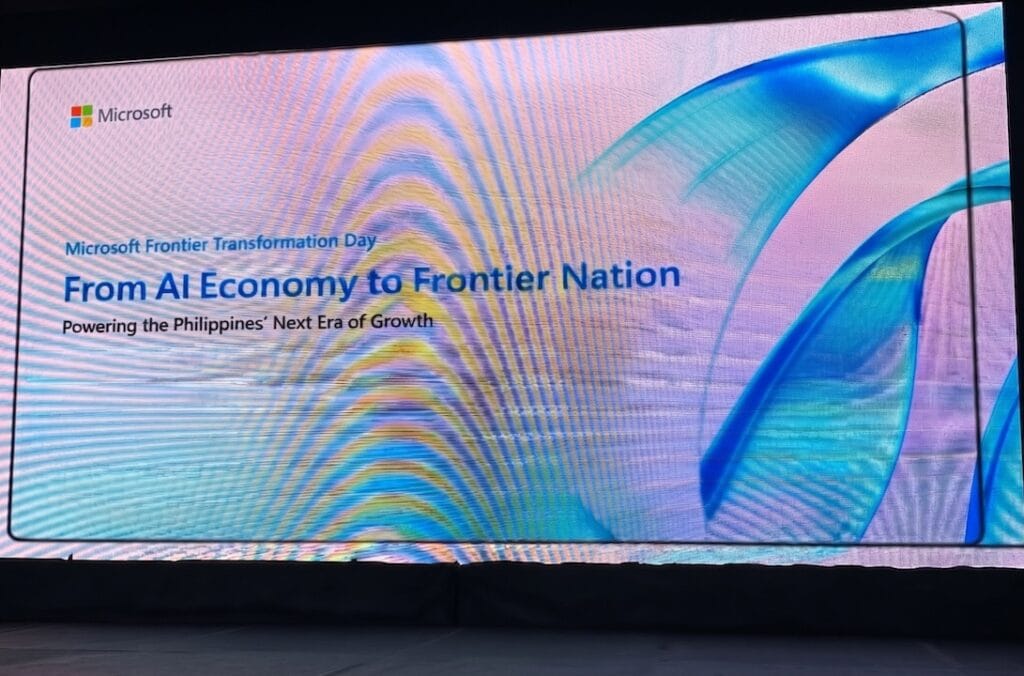
Speaking at Microsoft Frontier Transformation Week on Sept. 22 at the Fairmont Makati, Microsoft Philippines Managing Director Caroline Foo said the country is moving from an “AI economy” toward what Microsoft calls a “frontier nation,” where organizations embed AI more deeply into their operations.
“The winners in this room will not be the organization that adopt the most AI tools,” Foo said. “It is really one that really redesign how work gets done and earning trust in that process.”
Foo said Microsoft’s latest Work Trend Index research found that 25% of Filipino professionals surveyed are advanced AI adopters, compared with 16% globally.
She cited organizations including PLDT and Smart, BPI, Unilever and BPO company Inspiro as examples of enterprises developing AI applications for business operations and customer experiences. Foo said successful deployments require governance, measurement and the ability to scale beyond individual pilot projects.
Foo defined the “frontier” as the point where organizations move from experimenting with AI in isolated pockets to embedding it across the organization while earning the trust of employees, customers and other stakeholders.
“Crossing this frontier is not a technology decision, crossing this frontier is a leadership decision,” she said.
Trust was also highlighted by Foo as a prerequisite for wider AI adoption.
“We need the trust of our customers, trust of our employees, trust of our citizens, and trust of the institutions that hold us to account,” she said.
The event also featured a presentation by Senior Associate Justice Marvic M.V.F. Leonen of the Supreme Court of the Philippines on the judiciary’s digital transformation and its approach to artificial intelligence.
Leonen said technology adoption in the judiciary must be tied to public service and justice rather than technological novelty.
“Public service can’t simply adopt technology because it is new, available, and impressive. Technology must always serve a purpose,” Leonen said.
He said the judiciary must consider whether digital transformation can improve efficiency without compromising human judgment, inclusivity and access to justice.
“Can our institutions become more efficient without becoming less humane? Can they become more digital without becoming less inclusive? Can they use artificial intelligence without surrendering human judgment?” Leonen said.
Leonen outlined the judiciary’s ongoing digitalization, including electronic filing and service of court documents, court management systems and the Philippine Judiciary Platform. Electronic filing of pleadings in civil cases became the primary mode of filing in December 2024, while the Supreme Court has been transitioning covered filings to its digital platform.
The Supreme Court is also developing an AI governance framework based on ethical and management governance. Leonen said the framework emphasizes fairness, accountability, transparency and human-centered use of AI.
At present, the judiciary has authorized only one AI-based application, Scriptix, a voice-to-text transcription tool integrated with the Microsoft ecosystem used by stenographers across Philippine courts.
“For now, no generative artificial intelligence may be used in our courts,” Leonen said, adding that AI use in judicial processes remains subject to review by the court’s AI committee.
Microsoft’s presentation on its own AI transformation similarly emphasized that deploying AI is not simply a matter of selecting models and applications. Mark Souza, corporate vice president and chief technology officer at Microsoft Asia,
described the company as its own “customer zero,” using more than three years of experience with AI to identify both successful approaches and mistakes.
The executive said the technical components of AI deployment are only part of the challenge. Organizations must also address data, context, orchestration, monitoring, governance, security and efficiency as AI systems become more autonomous and involve multiple agents.
The Microsoft event brought together business leaders, government representatives and technology practitioners to discuss AI adoption, digital transformation, trust and workforce skills in the Philippines.
Full disclosure: All news articles published on the TechSabado website are written by human journalists, unless otherwise specified. Final text editing is also performed by human editors, with artificial intelligence (AI) used only to assist with additional grammar and style guide corrections..
————————————————————————-
TEN YEARS OF TECHSABADO!
PLEASE LIKE our FACEBOOK PAGE and SUBSCRIBE to OUR YOUTUBE & SPOTIFY channels.
WATCH TECHSABADO ON OUR YOUTUBE CHANNEL:
WE ARE ALSO ON SPOTIFY

WATCH OUR OTHER YOUTUBE CHANNELS:
PLEASE LIKE our FACEBOOK PAGE and SUBSCRIBE to OUR YOUTUBE CHANNEL.
WE ARE ALSO ON SPOTIFY
WATCH OUR OTHER YOUTUBE CHANNELS:
PLEASE LIKE our FACEBOOK PAGE and SUBSCRIBE to OUR YOUTUBE CHANNEL.