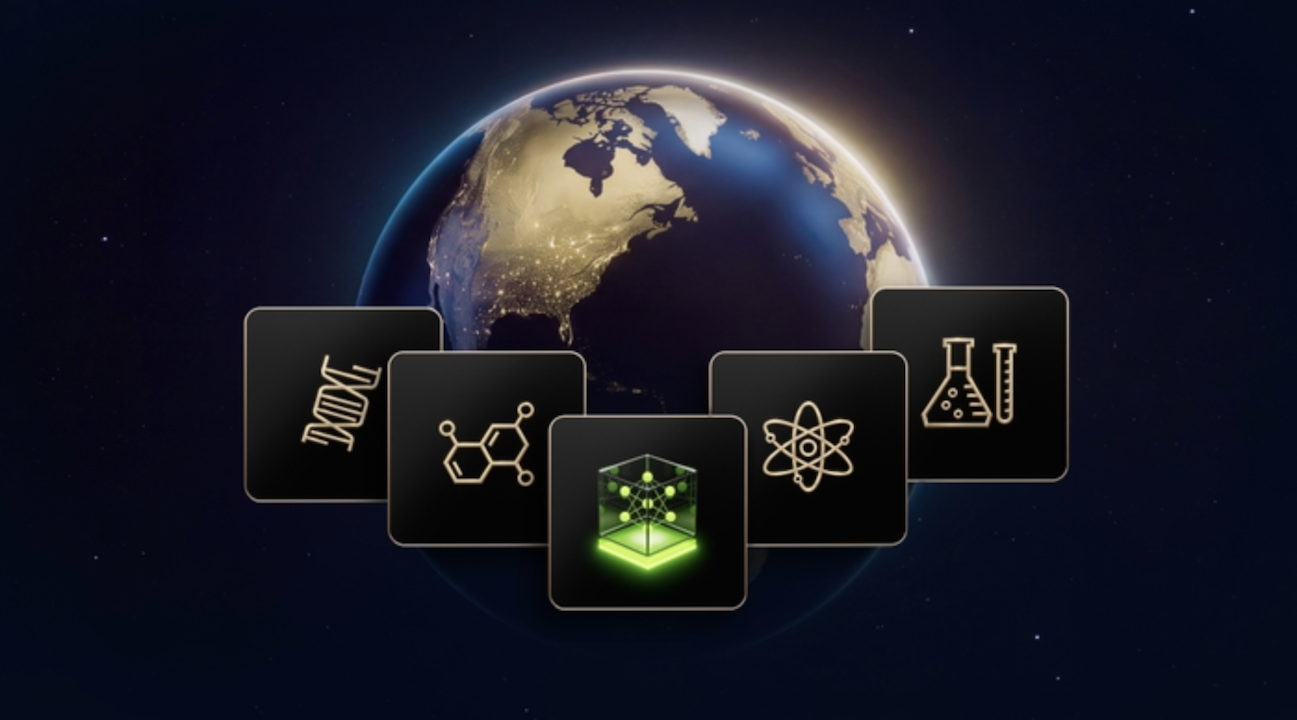
NVIDIA has introduced an open artificial intelligence model, chemistry dataset and post-training resources to help researchers develop specialized AI agents for scientific discovery, including applications in drug development, protein design and materials research.
Announced Nov. 16, 2026, NVIDIA Nemotron for Science combines the Nemotron 3.5 Super VL model with scientific evaluation tools, an open chemistry dataset and post-training recipes that researchers can use to adapt models to specialized tasks.
The initiative is designed to help scientists build agents that can interpret scientific information, reason through research problems, conduct computational tasks and use specialized tools in laboratory workflows.
A central component is LitmusBench v0.2, an open dataset containing nearly 50,000 questions for training and evaluating language models on chemistry reasoning. It draws on molecular properties and experimental drug discovery data to help models predict how molecules behave, including their solubility and how the human body processes them.
NVIDIA said researchers can use domain-specific data to post-train Nemotron models and integrate them into agent workflows that interpret information, generate code and call computational tools. These workflows can also use NVIDIA CUDA-X accelerated computing tools.
“Nemotron for Science gives researchers open models, scientific data and post-training recipes to build specialized agents that reason through scientific problems and use CUDA-X accelerated tools to turn ideas into discoveries,” said Ian Buck, NVIDIA vice president of hyperscale and high-performance computing.
Researchers apply models to drug and materials discovery
Life sciences companies Lila Sciences, Terray Therapeutics and Therna are using or customizing Nemotron 3.5 Super VL for scientific applications, including chemical data extraction, experiment planning, therapeutic design and laboratory protocols.
Terray Therapeutics post-trained Nemotron to extract reactants, products and reaction conditions from scientific diagrams. NVIDIA said the model surpassed previously published results on two benchmarks. On the RxnScribe test, it recovered about 76% of annotated reactions under the benchmark’s matching criteria.
The capability could help convert information from published chemistry research into structured data for synthesis planning and scientific agents.
Lila Sciences used Nemotron to generate laboratory protocols for automated research facilities. NVIDIA said the model matched frontier-level performance without additional fine-tuning. Post-training with laboratory feedback nearly doubled its accuracy in making quantum dots to 61%, compared with 54% for GPT-6 Astra, according to the company.
Quantum dots are nanoscale crystals used in applications such as displays and solar panels. The reported improvement is intended to help researchers translate desired material properties into laboratory synthesis procedures.
Therna worked with NVIDIA to post-train Nemotron for agentic messenger RNA therapeutic design. The company reported that the model nearly doubled accuracy in predicting protein-expression ranges compared with frontier models. Scientists preferred its explanations over those of the base model in 96% of comparisons.
Research institutions deploy AI agents
Research institutions are also using Nemotron models in scientific computing and discovery projects.
Argonne National Laboratory, part of the U.S. Department of Energy, is integrating Nemotron into its StructBioReasoner multi-agent system to design and evaluate protein-based therapeutic candidates for cancer and other diseases.
KTH Royal Institute of Technology developed an AI agent using Nemotron to repair faulty GROMACS molecular dynamics setups. NVIDIA said the agent fixed 81% of test cases during an overnight run on a single NVIDIA DGX Spark system, with each fix independently checked by GROMACS.
Japan’s RIKEN research institute has made Nemotron models, including Nemotron 3.5 Super VL, available through its RIKYU AI supercomputing platform and RiVault inference gateway.
The Jülich Supercomputing Centre is also among the research organizations integrating Nemotron into AI agents for scientific discovery.
NVIDIA said the combination of desktop systems such as DGX Spark and data center infrastructure allows researchers to run scientific AI workflows on systems they control, including secure computing environments.
Nemotron 3.5 Super VL and the LitmusBench v0.2 chemistry dataset are available through Hugging Face. NVIDIA has also optimized the model to run locally on a DGX Spark system with 128 GB of memory.
Full disclosure: All news articles published on the TechSabado website are written by human journalists, unless otherwise specified. Final text editing is also performed by human editors, with artificial intelligence (AI) used only to assist with additional grammar and style guide corrections..
————————————————————————-
TEN YEARS OF TECHSABADO!
PLEASE LIKE our FACEBOOK PAGE and SUBSCRIBE to OUR YOUTUBE & SPOTIFY channels.
WATCH TECHSABADO ON OUR YOUTUBE CHANNEL:
WE ARE ALSO ON SPOTIFY

WATCH OUR OTHER YOUTUBE CHANNELS:
PLEASE LIKE our FACEBOOK PAGE and SUBSCRIBE to OUR YOUTUBE CHANNEL.




Leave a Reply