TELECOM | Starlink shifts from backup internet to primary broadband choice worldwide
Growth has been strongest in rural areas, where the cost of building fiber and cable infrastructure remains high.
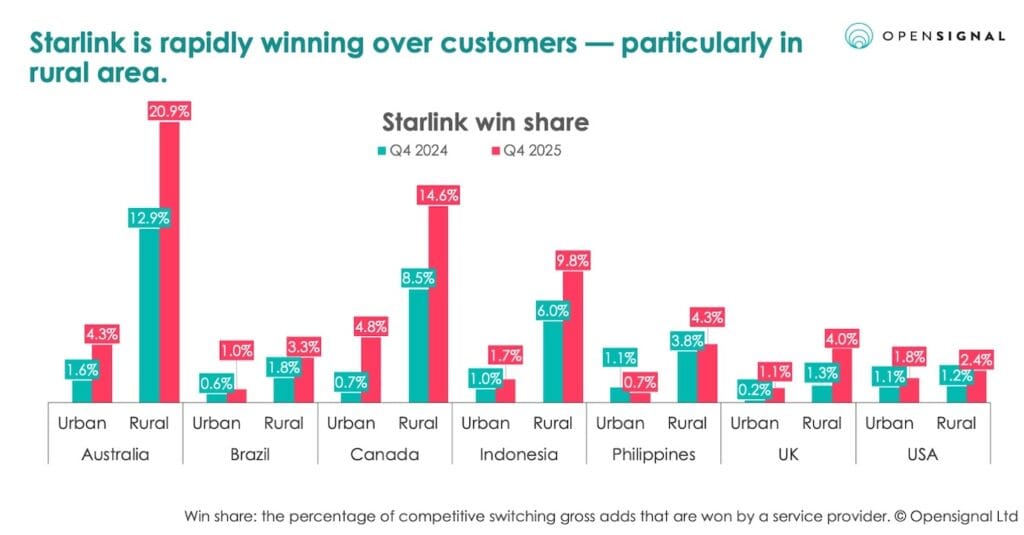
Satellite internet is moving from a fallback option to a primary broadband service as Starlink gains millions of users globally, according to Opensignal’s latest analysis released to media on Friday, March 27.
The analysis, by Opensignal, a leading global independent analytics firm that specializes in measuring and analyzing consumer mobile and broadband network experiences, found that Starlink’s subscriber base more than doubled in 2025, rising from 4.5 million to 9 million, and exceeded 10 million by February 2026, as users increasingly switched from traditional fixed broadband providers.
Growth has been strongest in rural areas, where the cost of building fiber and cable infrastructure remains high. In Australia, about one in five rural households that changed internet providers last year chose Starlink, with similar trends in Canada.
The report also showed rising adoption in urban and suburban markets, indicating that Starlink is no longer limited to underserved areas but is becoming a competitive alternative to cable and fixed wireless services.
Improvements in network performance have contributed to the shift. Opensignal said reliability scores increased by more than 30% in Canada and the United Kingdom and over 25% in the United States in the second half of 2025, driven by reduced packet loss and expanded satellite capacity.
These gains were supported by upgrades such as V2 Mini satellites, inter-satellite links, and expanded ground infrastructure, which collectively pushed total network capacity beyond 600 terabits per second.
Starlink is also using a two-tier pricing strategy. In North America and Europe, it has lowered monthly fees and offered free hardware rentals to attract customers. In emerging markets such as the Philippines and Indonesia, pricing remains higher, with additional surcharges used to manage demand and network congestion.
Despite higher costs relative to income, demand in these markets continues to exceed available capacity, often resulting in waitlists.
The report noted that reliability in developing regions can be affected by limited ground infrastructure, weather conditions such as heavy rainfall and network congestion from shared connections.
Industrywide, the rise of satellite broadband is beginning to reshape competition. Traditional telecom operators face pressure on rural revenues, while governments are reassessing large-scale fiber investments as satellite services offer faster deployment.
At the same time, competition in low-Earth orbit is intensifying, with companies such as Amazon and OneWeb expanding their satellite networks.
Opensignal said the shift signals a broader change in broadband delivery, with satellite internet emerging as a mainstream option rather than a last resort.
————————————————————————-
WE ARE 10 YEARS OLD! TEN YEARS OF TECHSABADO, IMAGINE THAT.
WATCH TECHSABADO ON OUR YOUTUBE CHANNEL:
WATCH OUR OTHER YOUTUBE CHANNELS:
PLEASE LIKE our FACEBOOK PAGE and SUBSCRIBE to OUR YOUTUBE CHANNEL.
PLEASE LIKE our FACEBOOK PAGE and SUBSCRIBE to OUR YOUTUBE CHANNEL.