THINK SINGAPORE 2026 | IBM outlines AI-first enterprise strategy
IBM cited its latest executive research, which found that 79% of global executives expect AI to contribute significantly to revenue by 2030, while about 80% are increasing investments in agentic AI.
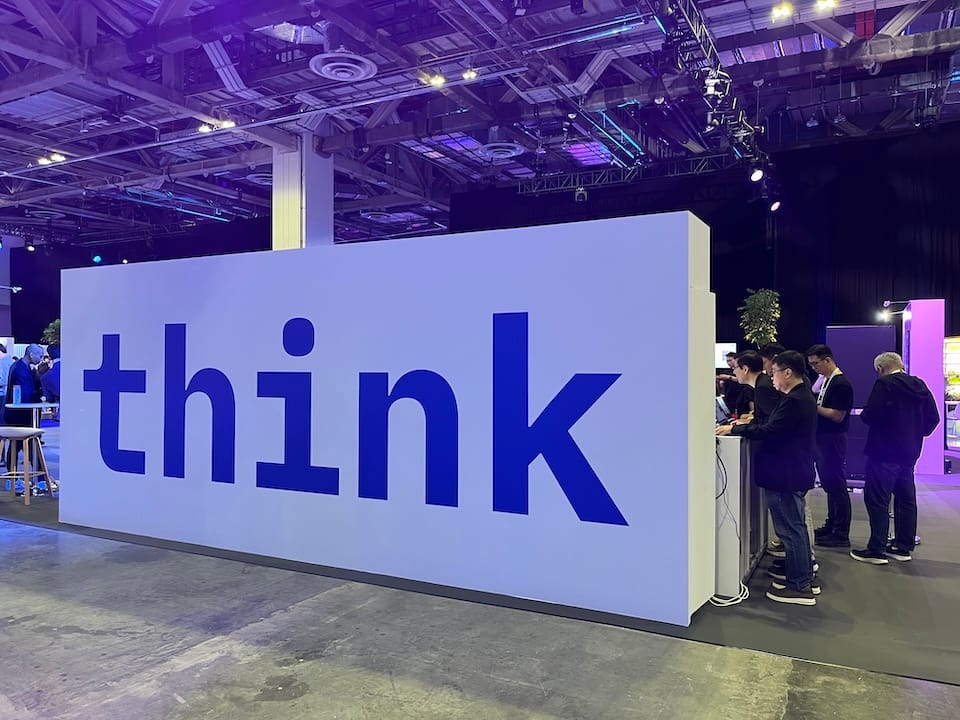
Tech giant IBM said organizations across Asia-Pacific are entering a new phase of enterprise artificial intelligence, shifting from isolated AI experiments toward large-scale deployment built on governance, hybrid cloud infrastructure and digital sovereignty, during its THINK on Tour Singapore conference on July 21. The company also unveiled new AI technologies, industry collaborations and enterprise use cases spanning manufacturing, healthcare, emergency response and quantum computing.
IBM presented what it described as a blueprint for helping organizations become AI-first enterprises by 2030, arguing that trusted AI, sovereign digital infrastructure and hybrid cloud platforms will be critical as businesses increasingly deploy agentic AI systems.
Speaking at the event attended by Singapore Minister for Digital Development and Information Josephine Teo, IBM Asia-Pacific General Manager Hans Dekkers said the region is well positioned to lead enterprise AI adoption because organizations already operate under complex regulatory, data residency and hybrid IT environments.
“Asia-Pacific is uniquely positioned to be a leader in the race to AI-first enterprises,” Dekkers said. “The region is already navigating the realities of fragmented regulations, data sovereignty requirements and complex hybrid environments at scale. By treating this complexity as a strategic advantage, and building AI that is sovereign by design, organizations here are setting the global benchmark for how trusted AI is governed and scaled.”
IBM cited its latest executive research, which found that 79% of global executives expect AI to contribute significantly to revenue by 2030, while about 80% are increasing investments in agentic AI. Spending on AI agents is projected to nearly triple by 2027 as organizations seek greater operational visibility, governance and measurable business outcomes. The study also found that 68% of executives consider data residency and sovereignty a major challenge, while 72% of Asia-Pacific CEOs are willing to make strategic decisions based on AI.
To support enterprise adoption, IBM announced expanded capabilities across its AI and hybrid cloud portfolio, including the next generation of IBM watsonx Orchestrate for multi-agent orchestration, IBM Confluent for real-time AI data integration, the IBM Concert platform for intelligent operations, IBM Sovereign Core for operational independence and IBM Bob, an agentic AI software development assistant designed for enterprise environments.
The conference also highlighted several regional collaborations.
Singapore’s Defence Science and Technology Agency and the Singapore Armed Forces are working with IBM to explore quantum computing applications for mission planning and future operational challenges.
“Quantum computing has the potential to transform how complex mission planning problems are solved, and we believe it is important to engage early to understand both its opportunities and limitations,” said Military Expert 7 Guo Jinghua, commander of the SAF C4 and Digitalisation Command. “By investing in our people and capabilities today, we will be better prepared to harness quantum technologies as they mature.”
IBM also announced a collaboration with Visionbay.ai, backed by Hon Hai Technology Group (Foxconn), to support sovereign AI infrastructure across Asia.
“IBM and Visionbay.ai will help nations establish AI as a new digital industry — enabling local ownership of critical infrastructure, accelerating enterprise adoption, developing AI talent and creating economic opportunities across the ecosystem,” said Visionbay.ai CEO Neo Yao.
Healthcare was another focus area. Changi General Hospital demonstrated how IBM’s watsonx platform is being used alongside mixed reality technologies to improve pediatric mass casualty incident training by providing AI-assisted workflow orchestration, real-time scenario intelligence and performance analytics.
According to Adjunct Assistant Professor Jimmy Goh, senior consultant in the Department of Emergency Medicine at Changi General Hospital, the system combines AI, mixed reality and clinical expertise to enhance decision-making and improve emergency preparedness.
Beyond the product announcements, IBM’s Industry 4.0 Studio showcased practical AI deployments already being used across industries.
Among the demonstrations was a 3D spatial AI equipment management platform developed with the Singapore Civil Defence Force. The system combines AI visual recognition, smart glasses and IBM Maximo Visual Inspection to provide real-time equipment monitoring, inventory management and remote technical assistance, allowing up to eight experts to guide field personnel simultaneously through live video sessions.
Manufacturing applications included AI-powered visual inspection systems developed with Ford and SMART Modular Technologies. Ford demonstrated automated inspection of vehicle door assemblies using AI image recognition during production, while SMART showcased an AI-integrated collaborative robot system capable of detecting more than 15 types of semiconductor defects to improve manufacturing quality and efficiency.
IBM also presented an autonomous solar panel inspection platform combining drones, IoT sensors, AI-powered visual recognition and agentic AI to automate maintenance planning and defect detection in solar farms. Additional demonstrations featured mixed reality-assisted maintenance for IBM z17 systems and AI-enabled robot dogs capable of monitoring hazardous industrial environments, identifying risks and supporting emergency rescue operations through multimodal generative AI.
IBM said the technologies reflect its broader strategy of helping enterprises move beyond AI pilots toward operational AI deployments that combine trusted governance, hybrid infrastructure and industry-specific applications.
“The enterprise AI race is already underway, and by 2030, the leaders will be organizations that embed AI across every aspect of their business to transform operations, accelerate innovation and create lasting competitive advantage,” Dekkers said. “Success will depend on three essentials: trusted AI, AI-ready data, and an open, hybrid, sovereign digital foundation built for scale.”
Full disclosure: All news articles published on the TechSabado website are written by human journalists, unless otherwise specified. Final text editing is partially assisted by artificial intelligence (AI).
————————————————————————-
TEN YEARS OF TECHSABADO!
PLEASE LIKE our FACEBOOK PAGE and SUBSCRIBE to OUR YOUTUBE & SPOTIFY channels.
WATCH TECHSABADO ON OUR YOUTUBE CHANNEL:
WE ARE ALSO ON SPOTIFY

WATCH OUR OTHER YOUTUBE CHANNELS:
PLEASE LIKE our FACEBOOK PAGE and SUBSCRIBE to OUR YOUTUBE CHANNEL.