TECH NEWS | Japan builds national AI infrastructure for robotics
The announcement coincided with NVIDIA’s unveiling of Cosmos 3 Edge, an AI model designed for robots and vision AI systems that enables on-device reasoning and action generation using Jetson edge computing platforms.
Japan has launched a national artificial intelligence infrastructure initiative aimed at accelerating robotics and intelligent manufacturing, partnering with NVIDIA and local technology companies to develop multimodal AI models for industrial applications. The effort supports the country’s broader strategy of expanding its physical AI capabilities across manufacturing, logistics, healthcare and telecommunications.
The initiative is anchored on the Ministry of Economy, Trade and Industry’s (METI) FRONTia Project, which seeks to develop multimodal foundation models for robotics and physical AI. Under the program, Noetra Corp. will build an AI factory powered by NVIDIA’s Vera Rubin platform, featuring 13,750 Vera CPUs, 27,500 Rubin GPUs and 140 megawatts of data center capacity. The facility will make pretrained AI models available to Japanese developers and enterprises to accelerate the creation of AI agents, digital twins and robotics applications.
The announcement coincided with NVIDIA’s unveiling of Cosmos 3 Edge, an AI model designed for robots and vision AI systems that enables on-device reasoning and action generation using Jetson edge computing platforms. The company also introduced new Metropolis software libraries intended to speed the development of industrial vision AI applications.
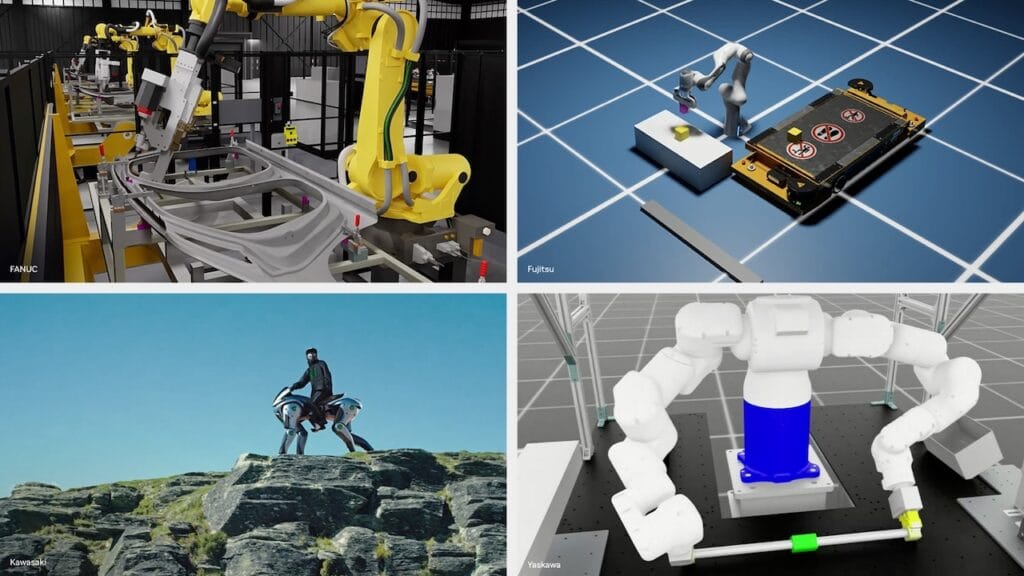
Several Japanese companies—including FANUC, Fujitsu, Hitachi, Kawasaki Heavy Industries, Kubota, NEC, SoftBank Corp., Sony Group Corp. and Yaskawa Electric—also announced plans to join the NVIDIA Cosmos Coalition, an open ecosystem for developing world models and other AI technologies for robotics and industrial automation. Coalition members will contribute to open AI models, datasets and software frameworks that can be used to test and validate physical AI systems before deployment.
Japanese manufacturers have already begun applying the technologies to specific industries. Fujitsu is exploring a collaborative control platform with FANUC, Kawasaki Heavy Industries and Yaskawa Electric, while SoftBank is developing a physical AI platform based on NVIDIA technologies. Kubota is evaluating physical AI for autonomous farming, Kawasaki Heavy Industries is applying the technology to healthcare, transportation and energy, and companies including Hitachi, OMRON and Shimizu Corp. are using AI vision systems for building management, automated inspection and construction safety.
According to METI, the initiative supports Japan’s AI Robotics Strategy, which targets capturing more than 30% of the global AI robotics market by 2040. The government estimates that market at approximately $133 billion and expects the new AI infrastructure to support the development of trillion-parameter AI models for next-generation manufacturing and robotics.
Full disclosure: All news articles published on the TechSabado website are written by human journalists, unless otherwise specified. Final text editing is partially assisted by artificial intelligence (AI).
————————————————————————-
TEN YEARS OF TECHSABADO!
PLEASE LIKE our FACEBOOK PAGE and SUBSCRIBE to OUR YOUTUBE & SPOTIFY channels.
WATCH TECHSABADO ON OUR YOUTUBE CHANNEL:
WE ARE ALSO ON SPOTIFY

WATCH OUR OTHER YOUTUBE CHANNELS:
PLEASE LIKE our FACEBOOK PAGE and SUBSCRIBE to OUR YOUTUBE CHANNEL.