TECH NEWS | NVIDIA, Korean firms expand AI infrastructure projects
The initiatives come as governments and businesses worldwide race to build the computing infrastructure needed to support increasingly complex AI models, autonomous systems and enterprise applications.
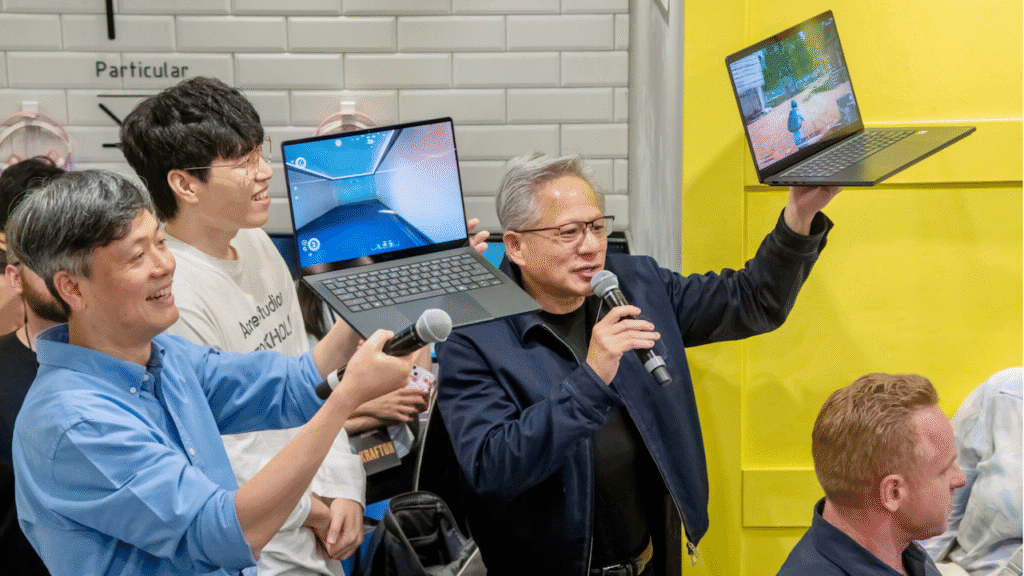
Photo from NVIDIA
South Korea’s technology, telecommunications and industrial sectors are expanding investments in artificial intelligence infrastructure through a series of new collaborations with NVIDIA, underscoring the country’s push to strengthen sovereign AI capabilities and support growing demand for AI services.
The announcements, made this month, involve major Korean companies including NAVER, SK Telecom, SK hynix and Doosan Group. The projects span AI factories, cloud infrastructure, semiconductor development, robotics and data center technologies, reflecting broader efforts to position South Korea as a regional AI hub.
The initiatives come as governments and businesses worldwide race to build the computing infrastructure needed to support increasingly complex AI models, autonomous systems and enterprise applications. Industry analysts have identified computing power, memory supply and energy availability as key factors shaping the next phase of AI development.
AI factories gain momentum
Among the largest announcements, NAVER said it plans to expand its AI infrastructure beginning with a 55-megawatt deployment at its GAK Sejong data center in South Korea. The company intends to use NVIDIA’s DSX platform to develop AI factories, large-scale computing facilities designed to train, fine-tune and run AI models.
NAVER said the project could eventually scale to gigawatt-level capacity as demand for AI services grows. The company plans to use the infrastructure to support enterprise AI applications, government services, AI cloud customers and future versions of its HyperCLOVA X language models.
The expansion also reflects growing interest in sovereign AI, an approach that allows countries and organizations to develop and operate AI systems using locally controlled infrastructure, data and models.
NAVER said it also plans to develop agentic AI services and a Seoul World Model based on urban spatial data and digital mapping technologies.
SK Telecom announced a similar initiative, revealing plans to build a gigawatt-scale AI cloud platform using NVIDIA’s DSX architecture. The telecommunications provider said its first AI factory is expected to become operational in 2027.
The planned AI cloud will support AI training, inference and agentic AI workloads for enterprises and industries across South Korea, with the possibility of expanding services to other Asian markets.
The announcements highlight a growing shift among telecommunications companies. Traditionally focused on connectivity services, major carriers are increasingly investing in AI infrastructure and cloud computing as new sources of growth.
Memory becomes strategic AI resource
The expansion of AI infrastructure has also intensified demand for advanced semiconductor technologies.
NVIDIA and SK hynix announced a multiyear partnership to develop next-generation memory technologies for future AI computing platforms.
High-bandwidth memory has become a critical component in modern AI systems because it enables processors to handle the massive volumes of data required for model training and inference. As AI workloads continue to grow, securing reliable memory supplies has become a strategic concern for both chipmakers and cloud providers.
Under the agreement, SK hynix will work with NVIDIA on memory technologies for future AI supercomputers, CPUs, personal AI systems and robotic computing platforms.
The companies also plan to use AI to accelerate semiconductor design and manufacturing processes. SK hynix is adopting NVIDIA software frameworks for simulation, computational lithography and engineering workflows.
In addition, the companies are exploring the use of digital twins, virtual replicas of physical facilities, to improve semiconductor manufacturing operations. Such systems can help engineers simulate factory processes, optimize equipment utilization and improve production efficiency before making changes in real-world facilities.
Robotics and physical AI
Doosan Group expanded its collaboration with NVIDIA through projects involving robotics, industrial automation, power systems and advanced electronics materials.
Doosan Robotics plans to integrate NVIDIA technologies into its Agentic Robot OS platform, which combines perception, reasoning, simulation and AI inference capabilities.
The company aims to improve the ability of industrial robots to operate in dynamic environments and perform increasingly complex tasks. Areas being explored include material handling, industrial finishing applications and future humanoid robotics systems.
Doosan Bobcat is also evaluating AI technologies for construction, agriculture and material-handling equipment.
The initiatives reflect growing interest in physical AI, a category of artificial intelligence focused on machines that can interact with and respond to real-world environments. Industry leaders increasingly view physical AI as a major growth area beyond chatbots and generative AI applications.
Meanwhile, Doosan Enerbility is studying how power-generation technologies, including gas turbines, hydrogen fuel cells and small modular reactors, could support future AI data centers.
Power availability has emerged as a significant challenge for AI infrastructure projects worldwide because large AI clusters require substantial amounts of electricity to operate continuously.
Gaming and consumer AI
NVIDIA also used recent events in South Korea to introduce RTX Spark, a new computing platform designed for AI-enabled laptops and compact desktop systems.
The company showcased the technology with gaming firms KRAFTON, NC and Riot Games, as well as members of T1, one of the country’s leading esports organizations.
According to NVIDIA, RTX Spark combines AI capabilities with gaming technologies such as ray tracing, DLSS and Reflex to support gaming and content-creation workloads on smaller devices.
Demonstrations included KRAFTON titles such as PUBG: BATTLEGROUNDS and Subnautica 2, as well as NC projects including CINDER CITY and AION 2.
KRAFTON also presented PUBG Ally, an AI-powered in-game companion developed using NVIDIA ACE technologies.
The demonstrations highlight how AI is increasingly being integrated into consumer applications, including gaming, where developers are exploring AI-driven characters, assistants and interactive experiences.
Strategic importance
Taken together, the announcements illustrate how South Korean companies are investing across the AI value chain, from cloud infrastructure and semiconductor manufacturing to robotics and consumer applications.
The projects remain at various stages of development, with several involving planned deployments and future research initiatives. However, they signal continued efforts by Korean firms to expand AI capabilities amid intensifying global competition in computing infrastructure, semiconductor technology and advanced AI services.
As demand for AI computing continues to accelerate, infrastructure, memory supply, energy systems and robotics are expected to become increasingly important components of the broader AI economy.
————————————————————————-
TEN YEARS OF TECHSABADO!
PLEASE LIKE our FACEBOOK PAGE and SUBSCRIBE to OUR YOUTUBE & SPOTIFY channels.
WATCH TECHSABADO ON OUR YOUTUBE CHANNEL:
WE ARE ALSO ON SPOTIFY

WATCH OUR OTHER YOUTUBE CHANNELS:
PLEASE LIKE our FACEBOOK PAGE and SUBSCRIBE to OUR YOUTUBE CHANNEL.