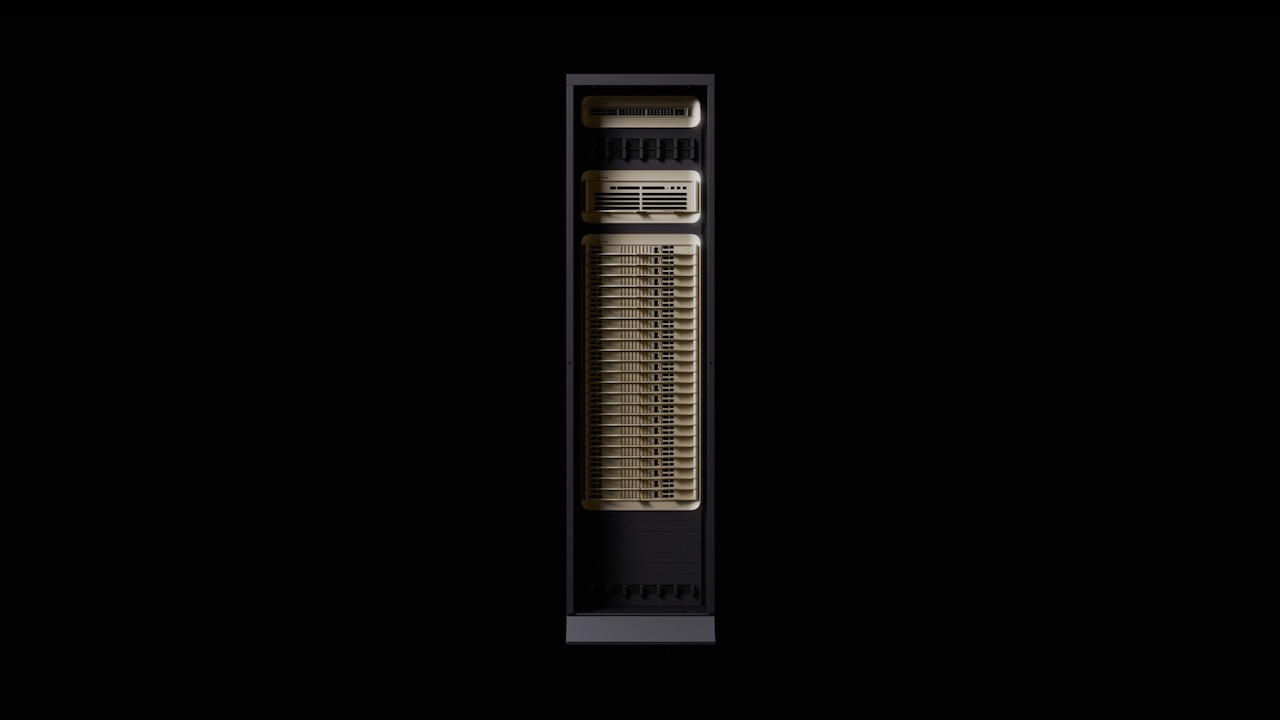
NVIDIA has introduced a rack-scale CPU platform designed to accelerate scientific simulations and AI workloads, combining 192 custom processors with high-speed networking and memory infrastructure for applications such as climate modeling and molecular research.
The NVIDIA Vera CPU platform integrates the company’s custom data center processors with Quantum-X800 InfiniBand networking in a liquid-cooled system designed for high-performance computing. NVIDIA said the platform delivers more than 200 terabytes per second of aggregate peak memory bandwidth.
Each Vera CPU features 88 custom NVIDIA Olympus cores, 176 threads and SOCAMM2 LPDDR5X memory with bandwidth of up to 1.2 terabytes per second.
The complete rack combines 192 processors, approximately 300 terabytes of memory and 1 petabyte of storage in an NVIDIA MGX design. Each 1U tray houses eight Vera CPUs, alongside NVMe storage and management components.
The system also uses NVIDIA SHARP In-Network Computing technology to reduce the time processors spend coordinating tasks during complex simulations.
NVIDIA said its tests showed Vera delivering 1.9 times the performance and 2.4 times the performance per watt of x86 systems on the OpenFOAM motorBike Large airflow simulation.
The company also benchmarked the open-source Weather Research and Forecasting model, reporting projected performance gains of 1.6 times and energy-efficiency improvements of 2 times compared with x86 systems.
Climate research and software support
The German Climate Computing Center (DKRZ) has selected Vera CPUs for its HLRE-5 supercomputer, which will also use NVIDIA GB200 Grace Blackwell systems and Quantum-2 InfiniBand networking.
The system, being built by Bull, is expected to become available in early 2028. It is intended to support climate simulations and AI research, including global climate modeling at kilometer-scale resolution.
“Scientific simulations need CPUs that can keep large datasets moving and sustain performance as applications scale,” said Ian Buck, NVIDIA vice president of hyperscale and high-performance computing.
Buck said the platform combines custom processor cores, high-bandwidth memory and InfiniBand networking to help researchers run demanding simulations more efficiently.
NVIDIA HPC SDK 26.11 is available now, with compilers and libraries optimized for Vera. The company is also introducing a public beta of its next-generation Fortran compiler, developed with input from high-performance computing centers and national laboratories.
The compiler is designed to improve the performance of existing Fortran programs on NVIDIA platforms without requiring researchers to rewrite their code.
Vera CPU rack systems are expected to be available from Dell Technologies, HPE, Lenovo and Supermicro beginning in early 2027.
Full disclosure: All news articles published on the TechSabado website are written by human journalists, unless otherwise specified. Final text editing is also performed by human editors, with artificial intelligence (AI) used only to assist with additional grammar and style guide corrections..
————————————————————————-
TEN YEARS OF TECHSABADO!
PLEASE LIKE our FACEBOOK PAGE and SUBSCRIBE to OUR YOUTUBE & SPOTIFY channels.
WATCH TECHSABADO ON OUR YOUTUBE CHANNEL:
WE ARE ALSO ON SPOTIFY

WATCH OUR OTHER YOUTUBE CHANNELS:
PLEASE LIKE our FACEBOOK PAGE and SUBSCRIBE to OUR YOUTUBE CHANNEL.





Leave a Reply