BUSINESS TECH | Radenta, Vantiq introduce Aegis for real-time disaster management
The Aegis platform starts with existing infrastructure, such as cameras, sensors, traffic systems, emergency hotlines, CCTVs, social media feeds, and agency workflows.
Radenta Technologies, one of the country’s leading solutions integrators, and Vantiq, a global leader in real-time AI orchestration, have launched Aegis—a platform designed to form a cohesive whole from a tangled web of disaster data.
In times of calamity, cities and municipalities deploy cameras, sensors, databases, and responders. However, these bits and pieces of information often remain fragmented, leaving local governments rich in data but poor in context. As a result, officials are forced to make critical decisions using incomplete or delayed statistics.
Randall Lozano, president of Radenta Technologies, shares: “Aegis brings clarity to chaos. Real city resilience is not about adding more sensors and cameras. It is about having a real-time management layer that is built for how a specific locality works.”
The Aegis platform starts with existing infrastructure, such as cameras, sensors, traffic systems, emergency hotlines, CCTVs, social media feeds, and agency workflows. Aegis connects these disparate elements and integrates the most important component: intelligence.
Most LGUs generate data every second, but the critical question is: who is connecting the dots? Currently, a CCTV might capture an incident, but the footage sits unwatched. A flood sensor at a riverbank spikes near a barangay, but the disaster management office only finds out 20 minutes later via a phone call. Traffic backs up after a road incident, leaving the City Management Office and the Philippine National Police looking at different, uncoordinated views. When a public health alert is issued, hospitals and barangay health centers still coordinate manually.
Aegis integrates these existing, disparate systems without requiring a costly “rip-and-replace” overhaul. It merges incident-response platforms across emergency hotlines, CCTV, and social media feeds, while adding real-time dashboards, ticketing, and cross-channel incident workflows. The outcome is a far broader, highly coordinated citizen-response capability that maximizes existing infrastructure.
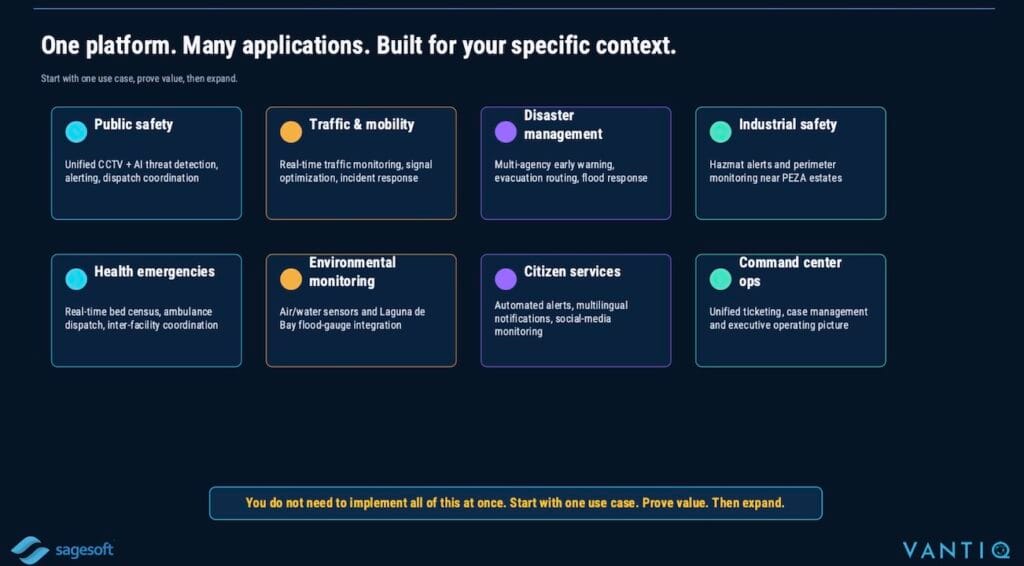
Aegis is a single, unified platform with multiple applications tailored for specific contexts:
1. Public Safety – Unified CCTV integration combined with AI threat detection, automated alerting, and dispatch coordination.
2. Traffic and Mobility – Real-time traffic monitoring, signal optimization, and incident response.
3. Disaster Management – Multi-agency early warning systems, evacuation routing, and flood response.
4. Emergency Response Orchestration – Real-time coordination across essential public health, fire, and law enforcement agencies.
5. Environmental Monitoring – Air/water quality sensors and localized flood-gauge integration.
6. Citizen Services – Automated alerts, multilingual notifications, social media monitoring, and citizen incident-reporting capabilities.
These applications do not have to be deployed all at once. Municipalities can start with their most urgent needs, prove the system’s value, and scale up over time. Raw information alone is not enough; the true power of an intelligent system lies in getting the right data to the right person at the exact right time.
Aegis delivers results in months, not years. It allows LGUs to access the latest developments in AI without replacing their legacy hardware.
Key Benefits of Aegis:
– Enhance, Don’t Replace: It sits directly on top of existing infrastructure. CCTV cameras, IoT devices, databases, and command centers become active inputs rather than sunk costs. Technology should complement current investments, not require a costly overhaul.
– Rapid ROI: Finalizing the scope and Business Requirements Document (BRD) leads to a Proof of Concept (PoC) in about four weeks, with full implementation taking just four to five months. Unlike typical three-year modernization programs, this rapid timeline easily aligns with LGU budget cycles and changing administrations.
– Model-Agnostic AI: Aegis works with the AI models available today and seamlessly evolves as technology improves. It can utilize proprietary models or market leaders like OpenAI where needed, ensuring LGUs are never locked into a single AI vendor in a fast-moving market.
Any city or municipality can benefit from Aegis. Find out how your LGU can become part of the central nervous system for a smarter, safer Philippines.
Website: https://www.radenta.com
Email: info@radenta.com
Mobile: 0919-081-2978
Landline: (02) 8535-7801
Full disclosure: All news articles published on the TechSabado website are written by human journalists, unless otherwise specified. Final text editing is partially assisted by artificial intelligence (AI).
————————————————————————-
TEN YEARS OF TECHSABADO!
PLEASE LIKE our FACEBOOK PAGE and SUBSCRIBE to OUR YOUTUBE & SPOTIFY channels.
WATCH TECHSABADO ON OUR YOUTUBE CHANNEL:
WE ARE ALSO ON SPOTIFY

WATCH OUR OTHER YOUTUBE CHANNELS:
PLEASE LIKE our FACEBOOK PAGE and SUBSCRIBE to OUR YOUTUBE CHANNEL.