BURNING CHROME | The future is already here—it’s just not evenly distributed
Scientific futurist Dr. Catherine Ball explicitly cited famous sci-fi writer William Gibson and used the idea to frame her argument about emerging technologies: different countries and communities experience the technological future at different speeds because of differences in economic capacity, culture, social conditions and access to technology.
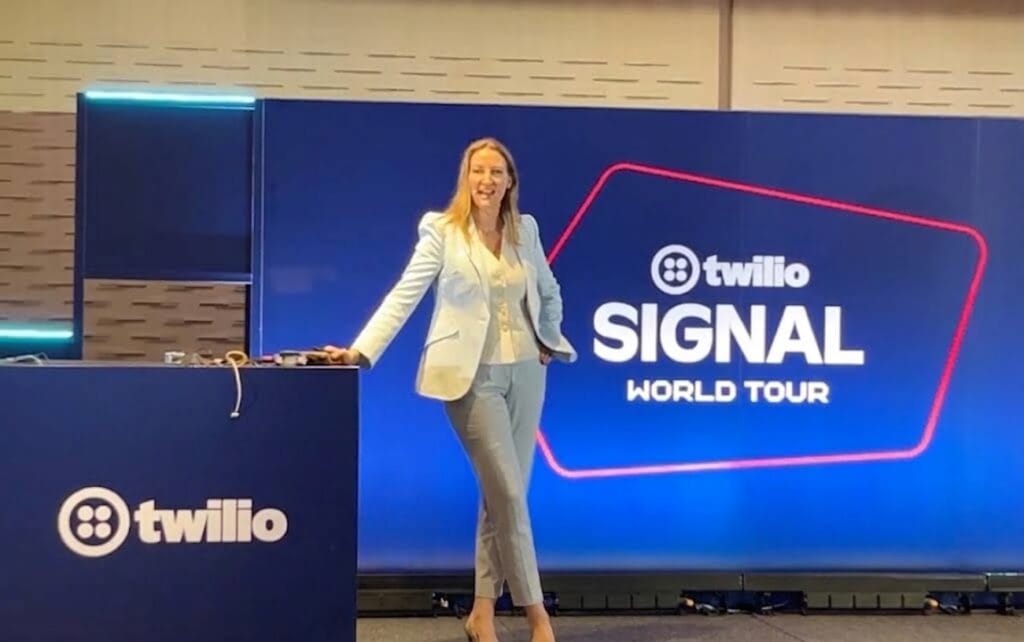
Scientific futurist Dr Catherine Ball
There is something oddly comforting about looking backward when talking about the future.
At SIGNAL Singapore 2026, scientific futurist Dr. Catherine Ball began her keynote by taking the audience back to the 1990s — to computer rooms, Nokia phones, rotary-dial telephones and the almost magical sound of a stereo system being interrupted by an incoming mobile call.
It was a useful place to begin because technology has always gone through a cycle of excitement, adoption, disappointment and nostalgia.
The computer that once occupied an entire room is now in our pockets. The mobile phone has become a camera, navigation system, payment instrument, entertainment platform and increasingly an interface to artificial intelligence.
Now we are moving toward something even less visible: ambient AI.
Ball sees the transition from today’s agentic AI toward systems embedded in the physical environment — homes, clothing, vehicles, appliances and eventually perhaps our bodies. The technology disappears into the background.
Ball described a hypothetical morning in 2036 in which a smart bed monitors biological cycles, adjusts temperature and responds to sleep patterns; lighting responds to respiration; a smart toilet communicates with a refrigerator; a personalized printer produces clothing; robots take care of household chores; and AI agents deal with work before their human owners even wake up. Yes, it sounds like science fiction.
But her more interesting point was that the individual technologies are already here. What we do not yet have at scale is their convergence into a seamless system. And that distinction matters.
Technology rarely arrives as one spectacular invention that suddenly changes everything. More often, seemingly unrelated technologies converge until they produce capabilities nobody initially anticipated.
Ball described this as technological convergence. Artificial intelligence, quantum computing, biotechnology, robotics, sensors and communications increasingly interact with one another. In fact, the implications extend far beyond consumer gadgets.
Consider drug discovery. Ball pointed to AI working alongside systems such as AlphaFold from Google DeepMind, which can map protein structures at extraordinary scale. Her argument is that AI becomes substantially more powerful when integrated into other scientific and technological systems rather than treated as an isolated tool. For her, this is where much of the current AI conversation remains too narrow.
We spend enormous amounts of time debating chatbots, generative images and AI assistants. Those are visible manifestations of AI. The larger transformation may happen underneath them, when AI becomes embedded in scientific research, manufacturing, logistics, transportation and communications.
The interface may become less noticeable precisely because the intelligence has become pervasive. And that raises another issue Ball touched on: expectations.
She recalled being on a Qantas flight where Wi-Fi became available again after being largely unavailable on international flights during the pandemic. When the connection failed intermittently, a passenger became frustrated.
Five minutes earlier, reliable Wi-Fi had not been an expectation. Once it was offered, however, its failure became unacceptable. This is the expectation paradox of modern technology.
When technology works, we stop noticing it. When it fails, we suddenly discover how dependent we have become on systems we previously took for granted. The same principle applies to AI.
An AI system that quietly anticipates a need may quickly become invisible. But when that system makes a mistake, the consequences can be disproportionately large because humans may no longer understand the mechanisms operating underneath the interface.
That is why the human element cannot be treated as an afterthought. Ball put it plainly: “humans being in the loop, humans being on the loop, humans are the loop.” That is a more useful framework for discussing AI than the familiar binary of AI versus humans.
The question should not simply be whether AI replaces people. It should be where AI adds value, where human judgment remains essential and where the interaction between the two produces something neither could accomplish alone.
This becomes particularly interesting when technology is applied to accessibility. Ball reminded the audience that the deaf community helped develop SMS. Technologies that become conveniences for the general population can be lifelines for people with disabilities.
The same principle is visible in emerging technologies. AI-powered translation could allow people to communicate across languages in real time. Ball described using an AI clone capable of speaking in other languages and discussed experimental brain-computer interfaces that could convert intended speech into text. For people who cannot communicate through conventional speech, the implications could be profound.
This is where technological optimism becomes more convincing: not when technology is sold as magic, but when its capabilities are connected to specific human problems. Yet the same technology can create new problems.
Thought-to-text systems raise questions about privacy and consent. AI clones introduce questions about identity and authenticity. Ambient computing raises questions about how much information our homes, vehicles and personal devices should continuously collect.
The disappearance of the interface does not mean the disappearance of the data. In fact, the opposite may be true. The less visible technology becomes, the easier it may be for users to forget that they are interacting with technology at all.
Ball’s discussion of the return of analog technology was therefore unexpectedly relevant.She pointed to renewed interest in phone booths and landlines, noting that some younger people are rediscovering the appeal of having a physical telephone in a fixed location.
Old technology does not necessarily disappear because new technology is superior in every respect. Sometimes the old technology performs a social function that the new one removed.
Ball gave the example of decommissioned telephone booths in Scotland being repurposed to house public defibrillators. The phone booth retains its physical location and cultural familiarity while acquiring a new function.
Technology, in other words, is not simply about replacing old things with new things. Sometimes it is about repurposing what already exists. This becomes especially important when organizations deploy emerging technology.
Ball proposed a “fractal business model,” comparing technological experimentation to a coral reef. Instead of imposing a massive technology transformation overnight, companies should create small areas of experimentation, test what works, learn from failures and then scale successful approaches.
AI deployment should not be a switch that gets flipped across an organization on Monday morning. It should be iterative.
Small experiments create evidence. Evidence informs decisions. Successful systems can then be expanded.
The alternative is to spend enormous amounts of money implementing technology simply because everyone else appears to be doing so.
The most interesting part of Ball’s argument, however, was her discussion of “emergent properties.” Whenever a new technology enters an existing system, it can produce consequences that were not part of the original design.
Introduce drones into a transportation system and eventually you need anti-drone systems. Introduce autonomous vehicles and you have to rethink roads, insurance, ownership and logistics. Introduce AI agents into an enterprise and you may discover new security, governance and accountability problems that were not obvious during the initial deployment.
The technology creates a second-order technology. And sometimes a third-order one. That is why technological forecasting based purely on individual products can be misleading. The important question is not simply what a technology can do. It is what happens after millions of people start using it.
Ball ended with an image that neatly captured the contradiction at the center of technology: an ancient Viking runestone beside a modern silicon chip. Both are made from sand.
The runestone carries a human message across a thousand years. The silicon chip carries messages too, but now the material itself has become part of a computational system capable of processing and generating information.
The technology changed. The human impulse did not.
We still want to communicate. We still want to connect. We still want to solve problems, make life easier, help other people and create opportunities.
The future, then, is not simply about smarter machines. It is about what humans choose to do with increasingly powerful machines — and what happens when those machines become so deeply embedded in our lives that we no longer notice them.
The future may arrive through silicon, algorithms, robots, sensors and autonomous systems. But it is still going to be inhabited by humans.
Full disclosure: All news articles published on the TechSabado website are written by human journalists, unless otherwise specified. Final text editing is also performed by human editors, with artificial intelligence (AI) used only to assist with additional grammar and style guide corrections..
————————————————————————-
TEN YEARS OF TECHSABADO!
PLEASE LIKE our FACEBOOK PAGE and SUBSCRIBE to OUR YOUTUBE & SPOTIFY channels.
WATCH TECHSABADO ON OUR YOUTUBE CHANNEL:
WE ARE ALSO ON SPOTIFY

WATCH OUR OTHER YOUTUBE CHANNELS:
PLEASE LIKE our FACEBOOK PAGE and SUBSCRIBE to OUR YOUTUBE CHANNEL.
WE ARE ALSO ON SPOTIFY
WATCH OUR OTHER YOUTUBE CHANNELS:
PLEASE LIKE our FACEBOOK PAGE and SUBSCRIBE to OUR YOUTUBE CHANNEL.