TECH NEWS | NVIDIA Nemotron 3.5 Super VL targets specialized AI agents
Nemotron 3.5 Super VL uses a 120-billion-parameter mixture-of-experts architecture that activates 12 billion parameters per token.
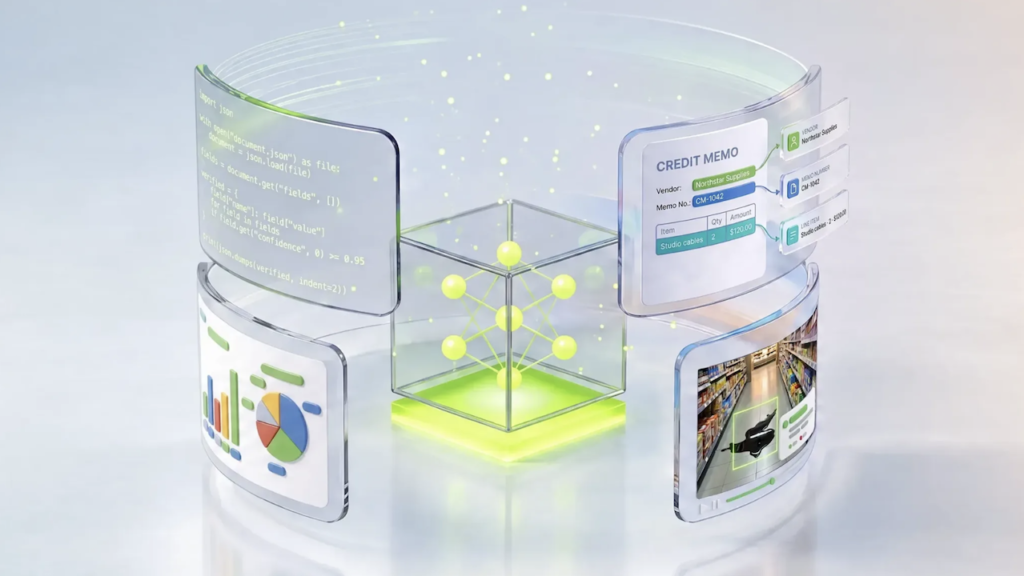
NVIDIA has introduced Nemotron 3.5 Super VL, an open multimodal artificial intelligence model designed to help enterprises build specialized AI agents for complex workflows involving reasoning, tool use, documents, images and video.
In an Oct. 15, 2026, technical article titled “NVIDIA Nemotron 3.5 Super VL Powers Specialized Agents with Multimodal Reasoning,” NVIDIA authors Chris Alexiuk and Chintan Patel described the model’s architecture, training methods and potential enterprise applications.
Nemotron 3.5 Super VL uses a 120-billion-parameter mixture-of-experts architecture that activates 12 billion parameters per token. NVIDIA said the design balances model capacity with inference efficiency and allows organizations to customize the model using their own data, tools, policies and workflows.
The model targets tasks such as coding, web research, document analysis, cybersecurity and video understanding. It combines text and visual processing to interpret optical character recognition, tables, charts, multipage documents and video, allowing agents to work across different information formats without relying on separate text and vision-language models.
NVIDIA said Nemotron 3.5 Super VL delivers up to five times the throughput of other open models in its size category on a single GPU. The company’s technical article reported throughput exceeding 600 output tokens per second on the Artificial Analysis Intelligence Index agentic tasks benchmark using the Baseten endpoint. NVIDIA also reported four times faster task completion in a comparison involving 10,000 tasks on B200 GPUs.
In behavioral evaluations cited by NVIDIA, the model scored 63.44% on Hermes Bench and 87.05% on LangChain evaluations, compared with 56.33% and 84.3%, respectively, for Nemotron 3 Ultra. On the CharXiv chart-reasoning benchmark, it scored 80.8%, increasing to 84% when Python code interpretation was used.
Organizations can customize the model through NVIDIA NeMo libraries, using supervised fine-tuning, low-rank adaptation and reinforcement learning to align its behavior with specialized data and workflows. NVIDIA is also releasing datasets covering agentic tool use, finance, instruction following, long-context tasks, fairness and vision-language understanding.
Several companies are adapting the model for specific applications. NVIDIA said Scale AI post-trained it for Skydance’s vendor credit processing workflow, with projected inference costs 40 times lower and latency five times lower. Ramp is using it to convert receipt images into structured data and expects up to 50% higher throughput and 10 times lower latency. AI21 and Alice customized the model for cybersecurity threat intelligence and vulnerability analysis, reporting a 41% improvement in accuracy.
Other organizations are applying the model to credit agreement analysis, financial document intelligence, scientific discovery, coding and medical claims processing. Companies integrating or customizing it include Atlassian for agentic search, CrowdStrike for enterprise security, Dassault Systèmes for engineering design and simulation, Perplexity for search, Salesforce for government workflows, and Synopsys for semiconductor design verification.
NVIDIA said organizations in the Nemotron Coalition contributed to the model’s development. Data from Perplexity supported mid-training, while environments from Prime Intellect helped develop teacher models.
The model was distilled from Nemotron 3 Ultra and further trained on coding, software engineering, visual reasoning and video tasks. NVIDIA also incorporated 10 billion Indic-language tokens during continued pretraining. The company is releasing a dataset containing about 2.8 trillion tokens across 22 Indian languages, developed with the Indian Institute of Technology Madras and its AI4Bharat lab.
Inference optimizations include speculative decoding, multi-token prediction, context reuse and mixed-precision quantization. NVIDIA reported that its LiLiCorr speculative decoding technique delivers up to 2.3 times faster token generation on DGX Spark compared with decoding without speculation.
For production deployment, NVIDIA NIM packages the model with optimized inference engines and validated configurations, while NVIDIA Dynamo provides distributed-inference features intended to improve throughput and reduce latency. According to NVIDIA, a Dynamo configuration using 16 B200 GPUs at 50 tokens per second per user could serve up to eight times as many users while reducing time to first token by 85%.
Nemotron 3.5 Super VL is available through Hugging Face, ModelScope and OpenRouter, as well as NVIDIA NIM. NVIDIA says the model can run on supported DGX Spark, DGX Station, RTX PRO and RTX systems, Jetson devices, and data center and cloud environments.
Full disclosure: All news articles published on the TechSabado website are written by human journalists, unless otherwise specified. Final text editing is also performed by human editors, with artificial intelligence (AI) used only to assist with additional grammar and style guide corrections..
————————————————————————-
TEN YEARS OF TECHSABADO!
PLEASE LIKE our FACEBOOK PAGE and SUBSCRIBE to OUR YOUTUBE & SPOTIFY channels.
WATCH TECHSABADO ON OUR YOUTUBE CHANNEL:
WE ARE ALSO ON SPOTIFY

WATCH OUR OTHER YOUTUBE CHANNELS:
PLEASE LIKE our FACEBOOK PAGE and SUBSCRIBE to OUR YOUTUBE CHANNEL.