BUSINESS | Physical AI accelerates shift to autonomous industry, Deloitte report finds
The report, “Physical AI: The moment of acceleration,” identifies 2025–2026 as a turning point, as advances in hardware, software, and infrastructure converge to push AI beyond digital applications into physical environments such as factories, logistics networks, and autonomous systems.
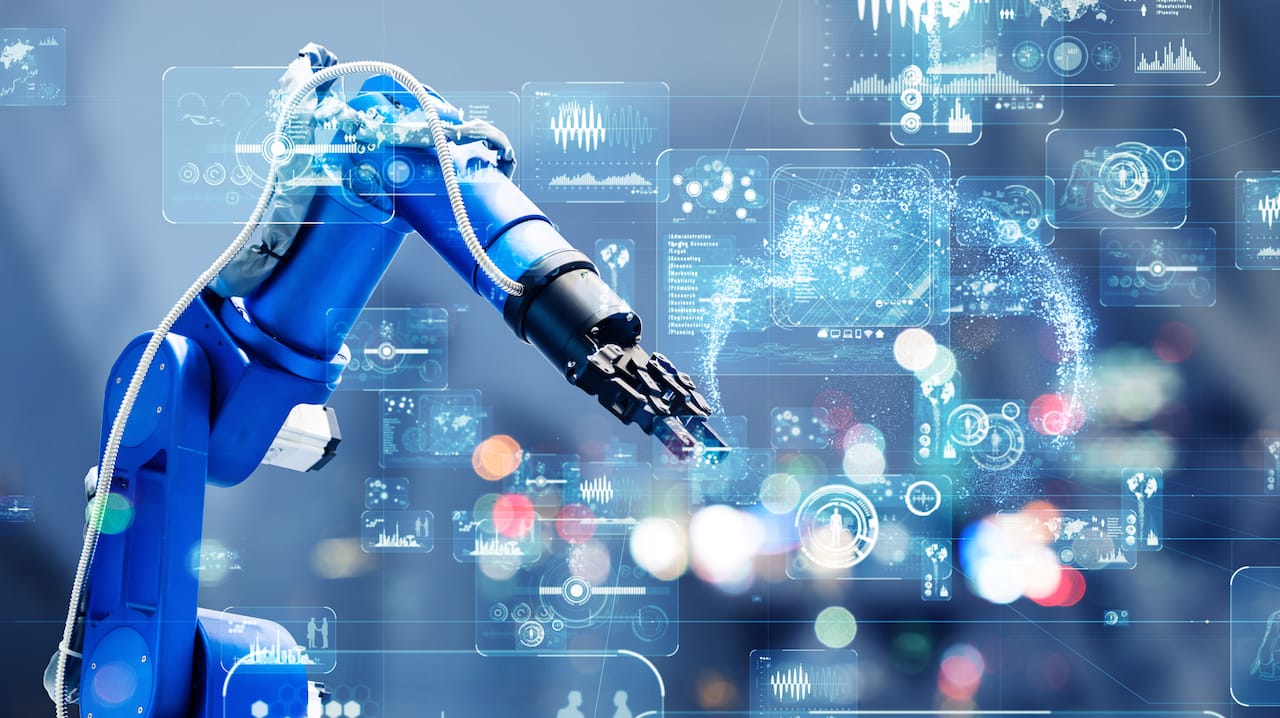
Industrial technology concept. Factory automation. Smart factory. INDUSTRY 4.0
Physical AI (PAI), the integration of artificial intelligence into machines and real-world systems, is moving from experimentation to large-scale industrial deployment, according to a new report released by Deloitte, a global professional services firm providing audit, consulting, tax, and advisory services.
The report, “Physical AI: The moment of acceleration,” identifies 2025–2026 as a turning point, as advances in hardware, software, and infrastructure converge to push AI beyond digital applications into physical environments such as factories, logistics networks, and autonomous systems.
PAI refers to AI systems embedded in physical hardware—including robots, drones, and autonomous vehicles—that can perceive their environment through sensors, make real-time decisions, and execute actions with direct physical outcomes.
Despite its limited current adoption, the trajectory is steep. Only 5% of firms report that PAI is transforming their organization today, but 41% expect it to do so within three years. At the same time, just 3% have extensively integrated PAI into operations, a figure projected to reach 18% within two years.
The gap between current deployment and expected impact underscores what Deloitte describes as a narrowing window for organizations to build capabilities and operational readiness.
Industrial robotics leads adoption
Manufacturing has emerged as the primary environment where PAI is being deployed at scale. More than 500,000 industrial robots were installed globally in 2024, with annual deployments expected to reach 700,000 by 2028.
Globally, around 405 million robots are already in operation, a number projected to grow to 1.3 billion by 2035. Increasingly, these systems are being augmented with AI, enabling machines to move beyond fixed programming toward adaptive, autonomous behavior.
Applications are expanding across sectors. In manufacturing, AI-guided robots are performing assembly and quality control tasks. In logistics, robotic systems are handling warehousing and delivery operations. Autonomous driving technologies are being deployed in transport, while healthcare systems are introducing robots for tasks such as medication delivery and diagnostics.
Technology convergence drives acceleration
Deloitte attributes the acceleration of PAI to the convergence of several technological advances. Sensor costs have declined while precision has improved by about 60%, expanding the range of tasks that can be automated.
At the same time, AI models are increasingly trained in digital twin environments—virtual replicas of physical systems—allowing simulation-based learning before deployment in real-world operations. Open-source ecosystems and edge computing are also reducing barriers to development and enabling real-time execution.
These developments are enabling a shift from traditional automation toward systems that can perceive, learn, and adapt continuously.
Adoption constrained by cost and capability gaps
Despite the technological progress, organizations face multiple barriers to adoption. Deloitte’s survey identifies cost and resource requirements as the top constraint, cited by 41% of firms. Other challenges include identifying viable use cases (36%), talent and skills shortages (33%), and limitations in data and technology infrastructure (31%).
The report emphasizes that PAI is not a standalone technology deployment but a capability that requires organizational transformation. Operational maturity—including standardized processes, digital infrastructure, and workforce readiness—is critical to capturing value from PAI systems.
Shift from automation to autonomy
PAI marks a transition from fixed, rule-based automation to adaptive, autonomous systems. Deloitte outlines a four-stage maturity model, progressing from basic automation to collaborative systems, digital twin integration, and ultimately fully autonomous physical AI systems.
At the highest level, systems are capable of perceiving unstructured environments, reasoning about optimal actions, and executing tasks independently, with humans shifting into supervisory and oversight roles.
Global investment, governance expand
The acceleration of PAI is being reinforced by large-scale investments and emerging regulatory frameworks. Governments in major economies are investing in AI infrastructure and robotics, while new standards and regulations are beginning to shape deployment practices.
This combination of capital, policy, and technological progress is positioning PAI as a central component of future industrial systems.
Readiness becomes strategic priority
Deloitte said the key question for organizations is no longer whether PAI will be adopted, but whether they are prepared to implement it effectively.
With 41% of business leaders expecting transformational impact within three years, the report highlights the need for companies to assess their position in terms of technology maturity, operational readiness, and workforce capability.
The report concludes that early adopters are likely to gain a long-term advantage by building the organizational learning and systems integration required to scale PAI across operations.
————————————————————————-
TEN YEARS OF TECHSABADO!
WATCH TECHSABADO ON OUR YOUTUBE CHANNEL:
WATCH OUR OTHER YOUTUBE CHANNELS:
PLEASE LIKE our FACEBOOK PAGE and SUBSCRIBE to OUR YOUTUBE CHANNEL.
PLEASE LIKE our FACEBOOK PAGE and SUBSCRIBE to OUR YOUTUBE CHANNEL.