TECH NEWS | NVIDIA links AI agent performance to stronger security architecture
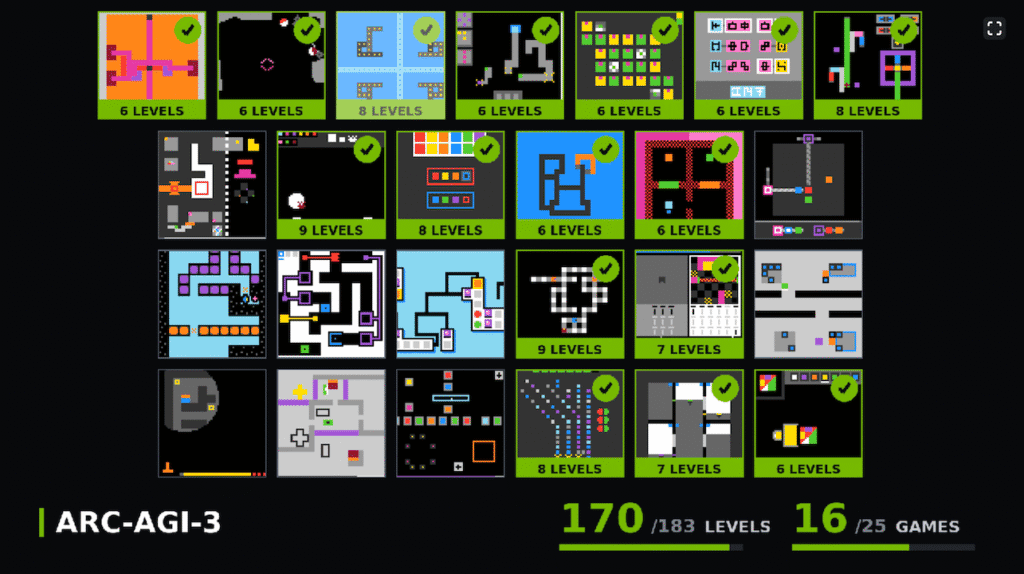
The company’s Agentic Variation Operators (AVO) architecture completed all 183 levels across the 25 environments in the ARC-AGI-3 public set, using Claude Opus 5.
NVIDIA researchers are highlighting the role of agent architecture and infrastructure security as artificial intelligence systems take on longer, more complex autonomous tasks, following research that achieved a 100.00 score on the ARC-AGI-3 benchmark.
The company’s Agentic Variation Operators (AVO) architecture completed all 183 levels across the 25 environments in the ARC-AGI-3 public set, using Claude Opus 5. NVIDIA said the system completed the benchmark in 6,624 environment actions, about 12% fewer than the 7,542 actions reported for VISTA using the same model.
The result forms part of NVIDIA’s broader research into AI agent architectures, which the company said should be evaluated as complete systems rather than solely by the capabilities of the underlying language model.
AVO was initially developed for software engineering and GPU-kernel optimization. In a seven-day experiment on NVIDIA DGX B200 systems, the architecture explored more than 500 optimization directions and produced 40 committed kernel versions. The resulting multihead attention kernels outperformed cuDNN by up to 3.5% and FlashAttention-4 by up to 10.5% across the evaluated configurations.
For ARC-AGI-3, researchers connected the same architecture to an interactive environment in which agents receive no explicit rules or stated goals. The AVO system used a text-only interface consisting of exact 64-by-64 text grids and had to infer the effects of available actions through interaction.
NVIDIA said the experiments point to persistent memory, tool use, feedback, supervision and recovery as important components of long-horizon agent performance.
The findings also connect to a separate NVIDIA security framework that argues these increasingly autonomous systems need security controls enforced outside the agent itself.
NVIDIA’s AI safety and security teams said models and agent harnesses can guide behavior but should not hold final authority over what an agent is allowed to do. That authority should reside in infrastructure capable of enforcing identity, policy, access controls, isolation and auditing.
The proposed architecture separates behavioral components from infrastructure-enforced controls. NVIDIA identifies the agent harness as the layer that manages context, tools and sessions, while a secure runtime such as NVIDIA OpenShell provides isolation, identity, policy, credentials and audit controls. NVIDIA Dynamo serves as the inference data plane for model serving, routing, cache placement and scheduling.
NVIDIA outlines five principles for securing agent systems: higher layers should propose actions while lower layers make authoritative decisions; security policy should remain below the security boundary; every external effect should be checked; access should be narrow and granted only when needed; and systems should support isolation and recovery.
The framework also defines four security profiles — isolated, connected, production and adversarial — with progressively stronger controls based on an agent’s authority and potential impact.
For production systems, NVIDIA recommends task-scoped access, independent checks and human approval for high-impact actions. Adversarial or red-team deployments should use default-deny communications, automatic quarantine and the strongest isolation.
The company said the underlying principle is that an AI model is only one component of an autonomous agent. The surrounding architecture determines both how effectively the model can sustain work over time and how securely its actions can be constrained.
Full disclosure: All news articles published on the TechSabado website are written by human journalists, unless otherwise specified. Final text editing is also performed by human editors, with artificial intelligence (AI) used only to assist with additional grammar and style guide corrections..
————————————————————————-
TEN YEARS OF TECHSABADO!
PLEASE LIKE our FACEBOOK PAGE and SUBSCRIBE to OUR YOUTUBE & SPOTIFY channels.
WATCH TECHSABADO ON OUR YOUTUBE CHANNEL:
WE ARE ALSO ON SPOTIFY

WATCH OUR OTHER YOUTUBE CHANNELS:
PLEASE LIKE our FACEBOOK PAGE and SUBSCRIBE to OUR YOUTUBE CHANNEL.