BUSINESS TECH | PH workers lead AI use, but companies need to catch up
The 2026 Work Trend Index, titled “Agents, human agency and the opportunity for every organization,” examines how AI agents are changing the relationship between workers, managers and organizations.
Pinoy workers are emerging as some of the most advanced users of artificial intelligence, but organizations need to change how they manage, measure and support AI-enabled work if they want to capture its full value, according to Microsoft’s 2026 Work Trend Index.
The report found that 25% of Filipino AI users qualify as “Frontier Professionals,” compared with 16% globally. These workers use AI agents for complex, multistep work, redesign workflows around AI capabilities and participate in structured practices that allow AI-enabled work to scale.
Josh Aquino, head of communications for Microsoft Philippines, said the findings indicate that the Philippines is not simply catching up with other markets in AI adoption.
“So, the headline out of this room is that the Philippines is ready for AI. Not catching up—ready and ahead of the world on the measures that matter the most,” Aquino said during Microsoft’s Work Trend Index launch in Makati City on Aug. 7.
The 2026 Work Trend Index, titled “Agents, human agency and the opportunity for every organization,” examines how AI agents are changing the relationship between workers, managers and organizations.
The study said 58% of AI users globally reported producing work they could not have produced a year earlier, rising to 80% among Frontier Professionals. It also found that 66% of AI users said AI allowed them to spend more time on high-value work.
For Filipino workers, the report found that critical thinking has become particularly important as AI takes on more work. Some 65% of Filipino AI users identified critical thinking as the most important human skill, the highest percentage among the markets surveyed, compared with 46% globally. Quality control of AI output was identified by 59% of Filipino respondents.
The report also found that 93% of Filipino AI users treat AI output as a starting point rather than a final answer. Among Filipino Frontier Professionals, 53% said they deliberately do some work without AI to keep their skills sharp, compared with 43% of Frontier Professionals globally.
Aquino said the findings show that advanced AI use does not necessarily mean reducing human involvement.
“Our most advanced users are the most deliberate about staying human. This is not hesitancy; it’s discipline,” he said.
The bigger challenge, however, lies with organizations.
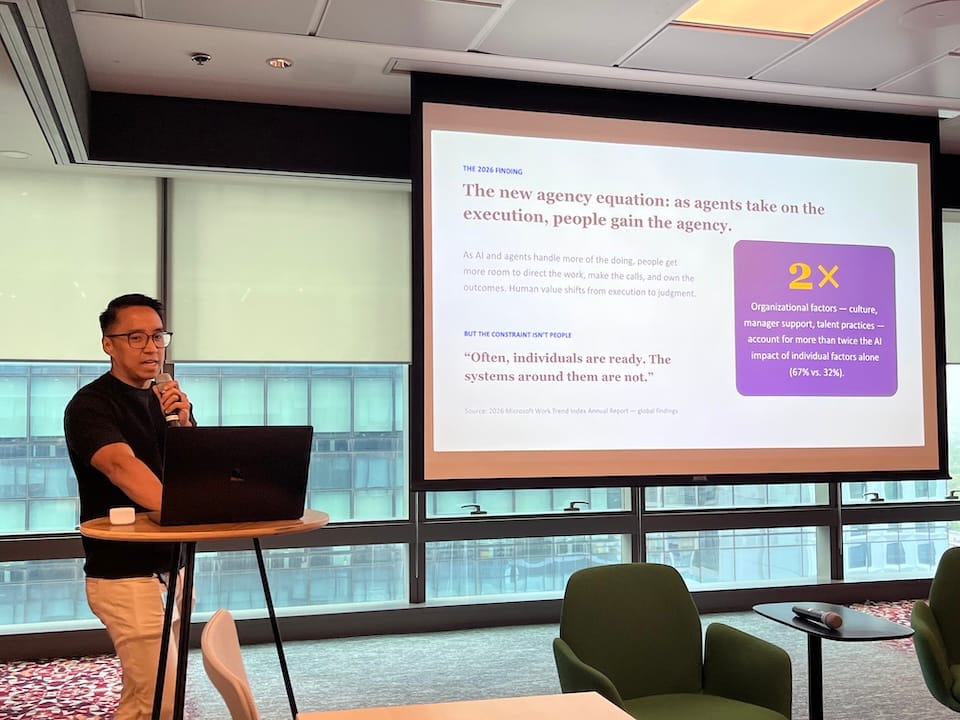
The Work Trend Index found that organizational factors, including AI culture, manager support and talent practices, accounted for 67% of the reported AI impact, compared with 32% for individual mindset and behavior. Microsoft cautioned that the analysis identifies statistical associations rather than causal relationships.
The report also identified what it calls the “Transformation Paradox.” While workers are increasingly prepared to change how they work with AI, organizational systems often continue to reward existing processes.
Globally, 65% of AI users said they fear falling behind if they do not adapt quickly to AI, while 45% said it feels safer to focus on current goals than to redesign work with AI. Only 13% said they are rewarded for reinventing work with AI even when the change does not immediately produce results.
The Philippines shows a similar tension. Aquino said 66% of Filipino AI users worry about falling behind, while 53% said it feels safer to stick with current priorities than redesign their work. Only 35% reported clear leadership alignment on AI, while 25% said they are rewarded for reinventing how they work with AI.
“Our people have gone further than the systems. And closing that gap is the opportunity in front of every leader in this market,” Aquino said.
The role of managers is particularly important. The study found that Frontier Professionals are more likely than other AI users to say their managers openly use AI, establish quality standards, create room for experimentation and encourage more ambitious redesign of work. Globally, the figures were 85% versus 64% for managers openly using AI, 83% versus 57% for setting quality standards, 84% versus 61% for creating space to experiment, and 87% versus 61% for encouraging work redesign.
A separate Microsoft People Science analysis of 1,800 workers found that when managers actively modeled AI use, employees reported a 17-point increase in perceived AI value, a 22-point increase in critical thinking about their AI use and a 30-point increase in trust in agentic AI. Managers who created psychological safety around experimentation were also associated with higher reported AI readiness and value.
Aquino said organizations therefore need to focus less on simply providing additional AI training and more on changing how work is organized.
“So, what closes that gap? Not more individual training. 67% of AI impact comes from organizational factors—culture, manager support, talent practices—versus 33% from individual mindset,” he said.
Microsoft’s research also points to a shift from AI adoption to what it calls AI absorption, where organizations capture lessons from AI-enabled work and incorporate them into repeatable processes. Frontier Professionals are more likely to report that teams collectively identify AI opportunities, share AI-related learnings and mistakes, and establish quality standards for AI-assisted work.
Aquino said this requires organizational decisions rather than simply deploying new technology.
“None of these require new technology. They require decisions,” he said.
He pointed to four areas for leaders: aligning visibly on AI, rewarding employees who redesign their work, supporting managers and turning successful experiments into organization-wide practices.
Microsoft said the findings ultimately shift the question from whether workers are ready for AI to whether their organizations are prepared to unlock what those workers can already do.
“Our people are ready. That’s not an aspiration; it is a finding measured against 20-plus other markets on the same instrument,” Aquino said. “The system question—whether our organizations are built to unlock what people can already do—is the one we get to answer starting now.”
The Work Trend Index survey was conducted by Edelman Data x Intelligence among 20,000 full-time employed or self-employed knowledge workers who use AI at work. The core survey covered 10 markets from Feb. 18 to April 7, 2026, with additional market-level research conducted through May 1. The Philippines was among the additional markets.
Full disclosure: All news articles published on the TechSabado website are written by human journalists, unless otherwise specified. Final text editing is also performed by human editors, with artificial intelligence (AI) used only to assist with additional grammar and style guide corrections..
————————————————————————-
TEN YEARS OF TECHSABADO!
PLEASE LIKE our FACEBOOK PAGE and SUBSCRIBE to OUR YOUTUBE & SPOTIFY channels.
WATCH TECHSABADO ON OUR YOUTUBE CHANNEL:
WE ARE ALSO ON SPOTIFY

WATCH OUR OTHER YOUTUBE CHANNELS:
PLEASE LIKE our FACEBOOK PAGE and SUBSCRIBE to OUR YOUTUBE CHANNEL.