TECH NEWS | NVIDIA, Cisco develop denser optical modules for AI networks
The Ultra-Dense Small Form Factor Pluggable (USFP) is designed to support electrical signaling at 400 gigabits per second (Gbps) per lane, with an aggregate capacity of up to 12.8 terabits per second (Tbps).
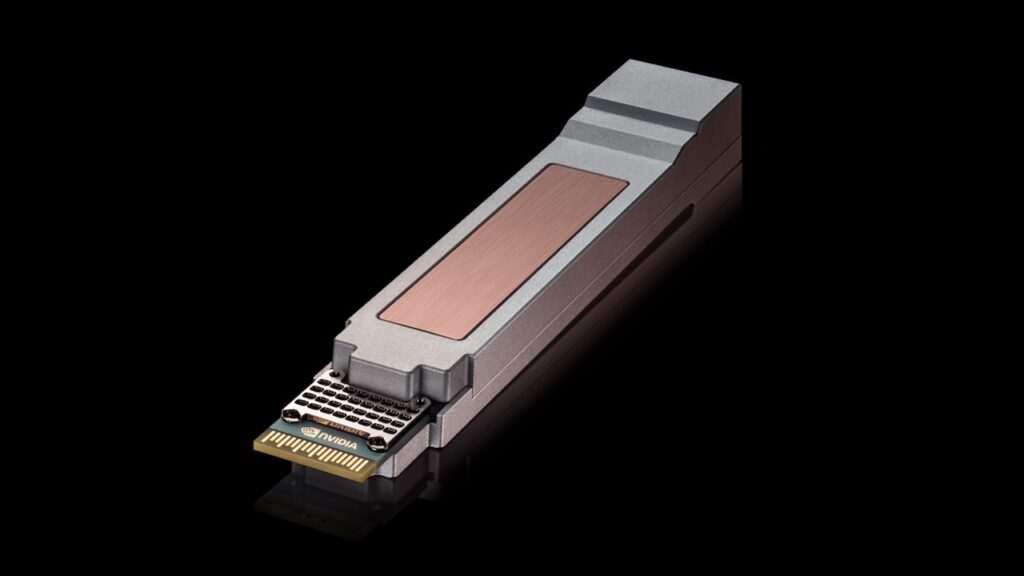
NVIDIA and Cisco announced plans to develop a new optical transceiver form factor designed to increase network capacity for AI data centers without expanding their physical footprint or proportionally increasing power consumption.
The Ultra-Dense Small Form Factor Pluggable (USFP) is designed to support electrical signaling at 400 gigabits per second (Gbps) per lane, with an aggregate capacity of up to 12.8 terabits per second (Tbps). The companies said the technology could help AI infrastructure operators connect more computing systems without adding network layers.
The planned modules will initially use 16 full-duplex lanes in a footprint comparable to that of an Octal Small Form Factor Pluggable (OSFP) module. The design can scale to 32 lanes or more in future configurations, according to the announcement.
NVIDIA and Cisco said USFP would deliver four times the bandwidth density and approximately 1.3 times the power efficiency of pluggable optical modules using 200-Gbps-per-lane signaling. The design aims to increase computing capacity within existing network space while reducing networking’s share of an AI facility’s power budget.
As AI models grow and demand for inference expands, data centers must move more data between computing systems. Increasing network capacity can otherwise require additional switches and optical links, adding complexity, latency, power consumption and cost.
USFP is intended to extend the established deployment model of pluggable transceivers while supporting higher data rates. The approach would allow operators to adopt the new optical technology without completely redesigning their data center infrastructure.
“Building the world’s largest AI factories starts with rethinking the smallest of connections,” said Gilad Shainer, NVIDIA senior vice president. “With USFP, NVIDIA and Cisco are building an ecosystem to reinvent pluggable optics — connecting more computing with greater efficiency to power the next generation of AI factories.”
Cisco said the design seeks to increase bandwidth density while retaining the serviceability and deployment flexibility of pluggable optics.
“AI builders need an interconnect architecture that can scale performance without locking them into a more complex operating model,” said Bill Gartner, senior vice president and general manager of optical systems and optics at Cisco.
“Through our collaboration, USFP is designed to deliver a new level of bandwidth density while preserving the serviceability, deployment flexibility and operational simplicity of pluggable optics,” he added.
Connector and power design
USFP uses a two-dimensional array connector with a two-step insertion mechanism. The design engages high-speed contacts after the module is inserted, with the aim of reducing contact wear, improving signal integrity and making insertion force more predictable.
The connector is designed to support future increases in lane count and is also intended to improve performance at 200 Gbps per lane.
The modules are designed to dissipate up to 100 watts without requiring a separate, dedicated embedded cooling circuit within the transceiver. The companies said this could reduce switch design complexity and improve reliability.
USFP configurations will also support optical designs intended to reduce latency and power consumption by simplifying signal processing. Support for different optical technologies and connection distances is intended to give system designers flexibility for different AI infrastructure deployments.
Industry partners and specifications
NVIDIA and Cisco are working with TE Connectivity and Amphenol to develop USFP cages, connectors and modules. They expect additional companies to join the hardware ecosystem.
The companies also plan to develop an open industry specification through a community-led, multisource project, allowing suppliers to build compatible components around a common form factor.
The effort builds on NVIDIA and Cisco’s existing collaboration to support interoperability between NVIDIA Spectrum-X Ethernet networking and Ethernet networks based on Cisco Silicon One. The companies are targeting enterprise data centers, neocloud providers and sovereign cloud operators deploying AI infrastructure.
The announcement did not provide a commercial availability date or pricing for USFP-based transceivers.
Full disclosure: All news articles published on the TechSabado website are written by human journalists, unless otherwise specified. Final text editing is also performed by human editors, with artificial intelligence (AI) used only to assist with additional grammar and style guide corrections..
————————————————————————-
TEN YEARS OF TECHSABADO!
PLEASE LIKE our FACEBOOK PAGE and SUBSCRIBE to OUR YOUTUBE & SPOTIFY channels.
WATCH TECHSABADO ON OUR YOUTUBE CHANNEL:
WE ARE ALSO ON SPOTIFY

WATCH OUR OTHER YOUTUBE CHANNELS:
PLEASE LIKE our FACEBOOK PAGE and SUBSCRIBE to OUR YOUTUBE CHANNEL.