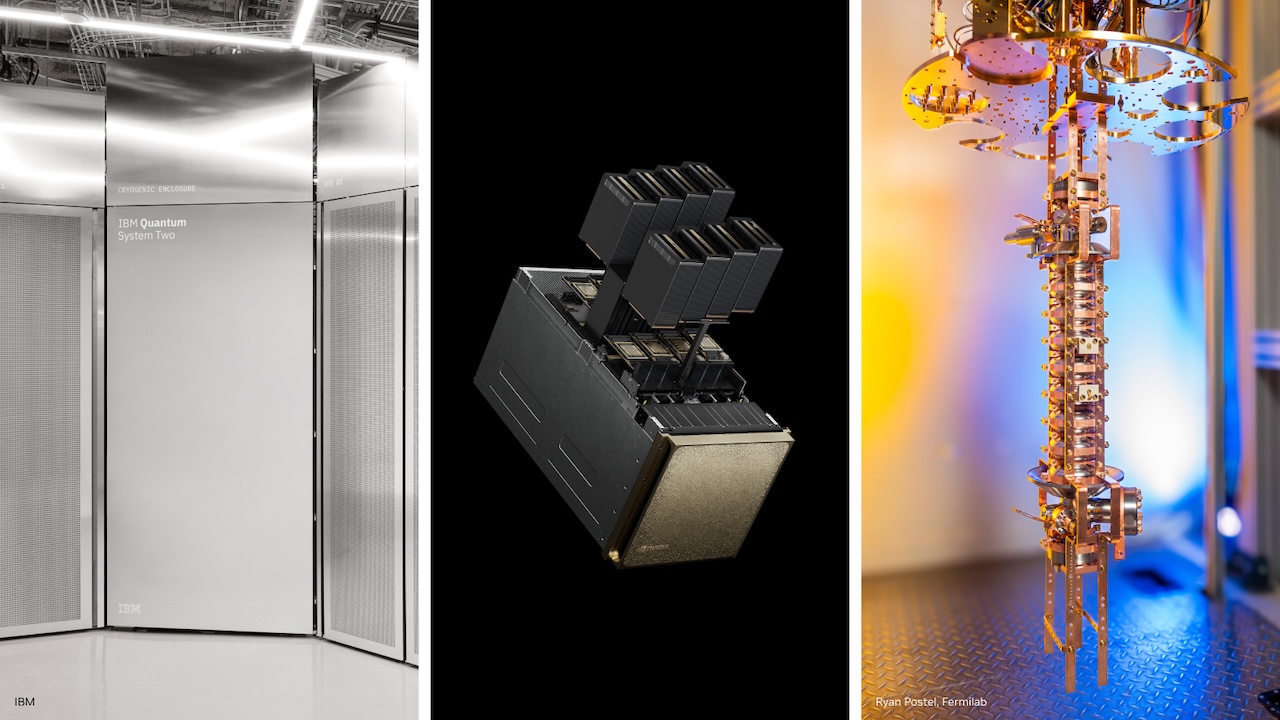
NVIDIA, IBM and the U.S. Department of Energy’s Fermi National Accelerator Laboratory are collaborating on a platform that combines quantum processors with accelerated classical computing to advance quantum error correction and scientific research.
The proposed quantum-classical codesign platform will connect NVIDIA DGX B200 systems with IBM quantum computers, including those powered by IBM Quantum Nighthawk, to help researchers develop error-correction codes, decoding algorithms and applications for next-generation quantum systems.
The collaboration is intended to support research in high-energy and nuclear physics, while exploring how multiple interconnected quantum processors can work alongside classical computing systems in modular architectures.
Fermilab will contribute its expertise in quantum error correction and high-energy and nuclear physics to help define requirements for future fault-tolerant quantum computers.
“Making quantum computers useful for science requires advances in error correction, applications and the systems that bring quantum processors and accelerated computing together,” said Krysta Svore, NVIDIA vice president of applied research for quantum computing.
The announcement also includes a separate development in quantum error correction: NVIDIA’s TCBP-JOBS decoding algorithm, which the company says can accelerate certain research workloads by up to 13,000 times compared with existing leading algorithms.
Available through the NVIDIA CUDA-Q QEC 0.9.0 library, the algorithm reduces the time needed to evaluate quantum error-correction designs. NVIDIA said a computation that previously took about 12 weeks could be completed in 45 minutes.
Quantum processors are vulnerable to errors that limit the complexity and duration of computations. Quantum error correction protects information by distributing it across multiple physical quantum bits, or qubits. Classical decoding algorithms then interpret measurement data to identify likely errors so they can be corrected.
Faster decoding allows researchers to test different error-correction codes and configurations more efficiently, helping them assess how future quantum systems could achieve fault-tolerant operation.
Quantum-classical computing expands scientific applications
The announcement also highlighted research by IBM and Japan’s RIKEN institute that combines quantum computing with GPU-accelerated simulations.
The research, named a finalist for the 2026 ACM Gordon Bell Prize, calculated binding energies for two protein-ligand complexes to study molecular interactions relevant to drug discovery.
By dividing the molecular systems into fragments and combining quantum sampling with GPU-accelerated calculations, the researchers modeled complexes containing up to 12,635 atoms. NVIDIA said this was more than 40 times the size of the previous 303-atom quantum-classical benchmark.
The work uses RIKEN’s ROQUO quantum-classical supercomputer, which combines IBM quantum computing resources with NVIDIA GB200 systems and Quantum-X800 InfiniBand networking.
The research is supported by Japan’s New Energy and Industrial Technology Development Organization under a program focused on quantum-supercomputer hybrid platforms.
Quantum processors enter supercomputing workflows
NVIDIA is also expanding the open-source Slurm workload manager with an interface for integrating quantum processors into high-performance computing environments.
IBM is contributing through its Quantum Resource Management Interface, which connects IBM quantum computing resources to the expanded Slurm capabilities.
The integration is intended to allow researchers and supercomputing centers to schedule quantum processors alongside conventional central processing units and graphics processing units using familiar commands and resource-management tools.
Supercomputing centers currently rely on different approaches to connect quantum hardware to their computing infrastructure. NVIDIA and IBM said the integration aims to reduce the engineering and maintenance work involved in managing hybrid quantum-classical applications.
The initiatives reflect a broader effort to combine quantum processors with conventional accelerated computing, allowing researchers to use each technology for tasks suited to its capabilities.
The new codesign platform, error-correction algorithm and Slurm integration are intended to help address technical barriers to practical quantum computing while expanding its potential applications in scientific research.
Full disclosure: All news articles published on the TechSabado website are written by human journalists, unless otherwise specified. Final text editing is also performed by human editors, with artificial intelligence (AI) used only to assist with additional grammar and style guide corrections..
————————————————————————-
TEN YEARS OF TECHSABADO!
PLEASE LIKE our FACEBOOK PAGE and SUBSCRIBE to OUR YOUTUBE & SPOTIFY channels.
WATCH TECHSABADO ON OUR YOUTUBE CHANNEL:
WE ARE ALSO ON SPOTIFY

WATCH OUR OTHER YOUTUBE CHANNELS:
PLEASE LIKE our FACEBOOK PAGE and SUBSCRIBE to OUR YOUTUBE CHANNEL.



Leave a Reply